
1. What is an acrostic poem?
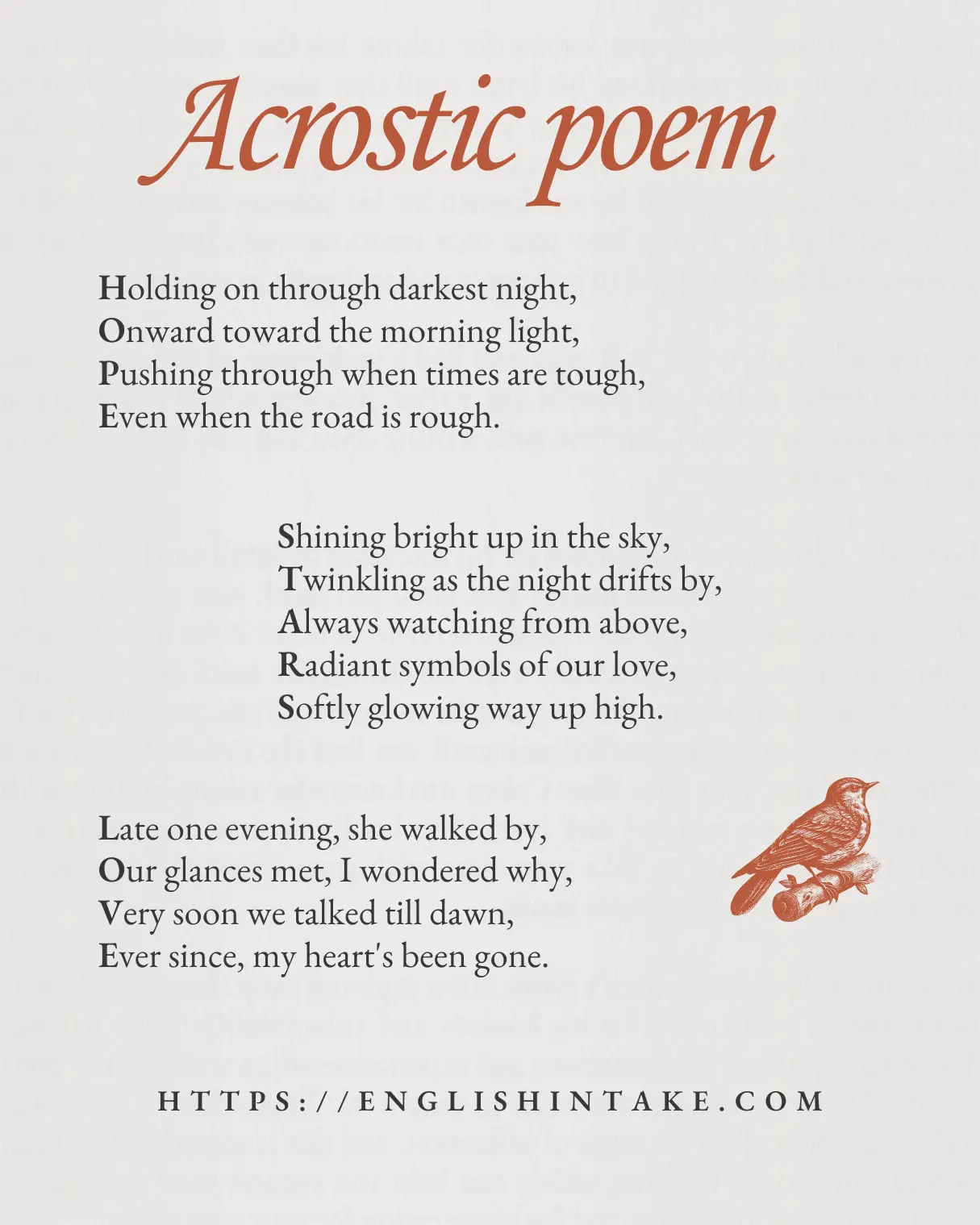
An acrostic poem uses a structural literary device where specific letters in each line spell out a word or message when read vertically. The word "acrostic" comes from the Greek words akros (meaning "highest" or "at the end") and stichos (meaning "line" or "verse"). In most acrostic poems, the first letter of each line forms the hidden word.
Think of it as tipping a word on its side and watching new words and phrases spill out from each letter. The vertical word is called the "spine word" because it forms the backbone of your poem. Every line you write branches out from this spine, creating a piece that works in two directions at once.
1.1 Why acrostic poems are popular
Acrostic poems have remained popular for thousands of years because they combine creativity with structure. Unlike sonnets or haikus, acrostic poems have no strict rules about rhyme, rhythm, or line length. This freedom makes them accessible to writers of all ages and skill levels, from primary school children to published poets.
For English language learners, acrostic poems offer a particularly valuable exercise. They allow you to practise vocabulary and experiment with language without worrying about perfect grammar or complex sentence structures. Each line can be as simple as a single word or as elaborate as a complete sentence.
1.2 Famous examples throughout history
Acrostic poetry has a rich literary heritage. The Hebrew Bible contains several acrostic passages, including sections of Psalms and the Book of Lamentations. Medieval monks wrote acrostic poems to honour saints and patrons. Edgar Allan Poe composed acrostics as love letters, whilst Lewis Carroll crafted them as gifts for children.
Perhaps the most famous literary acrostic appears at the end of Carroll's Through the Looking-Glass. The poem "A Boat, Beneath a Sunny Sky" spells out "Alice Pleasance Liddell," the full name of the real girl who inspired Alice in Wonderland. This demonstrates how acrostics can add a hidden layer of meaning to a poem, rewarding attentive readers with a secret message.
2. Understanding the word POETRY
Before writing an acrostic poem using the word POETRY, it helps to understand what poetry itself represents. The word "poetry" derives from the Greek poiein, meaning "to make" or "to create." At its core, poetry is the art of using language in creative, expressive, and concentrated ways.
Poetry differs from ordinary prose because every word carries weight. Poets select words not only for their meaning but also for their sound, rhythm, and emotional resonance. When you write an acrostic poem about POETRY, you have the opportunity to capture these qualities in your lines.
2.1 What poetry means to different people
Poetry means different things to different readers and writers. For some, it represents emotional expression and a way to process feelings that ordinary language cannot capture. For others, it offers a playground for linguistic experimentation, where rules can be bent or broken entirely.
Consider what poetry means to you as you prepare to write your acrostic. Does it bring to mind images of nature, love, or loss? Do you think of rhythm and rhyme, or free-flowing thoughts? Your personal connection to poetry will shape the lines you create, making your acrostic uniquely yours.
3. How to write an acrostic poem of POETRY
Writing an acrostic poem follows a straightforward process. Once you understand the basic steps, you can apply them to any word or phrase you choose. Here is a step-by-step guide specifically for writing an acrostic using the word POETRY.
3.1 Step one: write your spine word vertically
Begin by writing POETRY down the left side of your page, with each letter on its own line. Leave plenty of space to the right of each letter for your poem lines. Your page should look like this:
P
O
E
T
R
Y
This vertical arrangement forms the skeleton of your poem. Every line you write will begin with one of these letters, reading from top to bottom.
3.2 Step two: brainstorm related words and ideas
Before writing your lines, spend time brainstorming words and phrases connected to poetry. Do not worry about which letter they start with yet. Simply list everything that comes to mind when you think about poetry and what it represents.
Here are some ideas to get you started:
Words about the nature of poetry: verses, stanzas, rhythm, rhyme, metre, imagery, metaphor, simile, language, expression, creativity, art, beauty, emotion, feeling, soul, heart, voice, words, lines.
Words about reading poetry: inspiring, moving, thought-provoking, powerful, delicate, musical, lyrical, haunting, memorable, meaningful, touching, resonant.
Words about writing poetry: crafting, creating, composing, imagining, experimenting, playing, expressing, releasing, discovering, exploring.
3.3 Step three: match words to letters
Now look at your brainstormed list and identify words that begin with P, O, E, T, R, or Y. Place these words next to their corresponding letters. You will likely find some letters easier to fill than others.
Words beginning with P: powerful, passionate, profound, playful, painterly, peaceful, pure, personal, precious.
Words beginning with O: original, organic, orchestrated, open, overflowing, ornate.
Words beginning with E: emotional, evocative, expressive, enchanting, endless, eternal, eloquent.
Words beginning with T: touching, transforming, truthful, tender, timeless, thoughtful.
Words beginning with R: rhythmic, resonant, raw, revealing, rich, radiant.
Words beginning with Y: yearning, yielding, youthful.
3.4 Step four: build your lines
Using your matched words as starting points, expand each into a complete line. Your lines can be single words, phrases, or full sentences. There is no requirement for lines to be the same length or to rhyme with each other.
As you write, consider how each line connects to the overall theme. Try to create a poem that flows naturally from beginning to end, where each line builds upon or complements the ones around it.
3.5 Step five: revise and refine
Once you have a complete draft, read your poem aloud. Listen for awkward phrases or words that do not quite fit. Consider whether your lines capture what poetry means to you.
Do not be afraid to replace words or restructure lines. Professional poets often revise their work many times before reaching a final version. The revision process is where good poems become great ones.
4. Acrostic poem examples using POETRY
Seeing examples can help you understand the range of possibilities when writing acrostic poems. Below are several different approaches, from simple word-based acrostics to more elaborate sentence-based versions.
4.1 Word-based acrostic examples
Word-based acrostics use a single word for each line. This style works well for beginners and for creating visually striking poems with minimal text.
Example one:
Powerful
Original
Emotional
Timeless
Rhythmic
Yearning
Example two:
Passion
Overflowing
Expression
Truth
Resonance
You
Example three:
Pure
Open
Endless
Tender
Raw
Yours
4.2 Phrase-based acrostic examples
Phrase-based acrostics expand each letter into a short phrase. This style allows for more descriptive and evocative content whilst remaining concise.
Example one:
Dancing under moonlit sky
Reaching for the stars up high
Every wish begins to gleam
As we chase our sweetest dream
Making memories, you and I
Example two:
Shining bright above the trees
Travelling on the evening breeze
Ancient lights from far away
Reminding us of brighter days
Silent guides across the seas
This example shows how an acrostic can form a continuous message when read line by line, with each phrase building upon the last to paint a cohesive picture.
Example three:
Holding memories so dear
Echoes of the ones held near
Always beating, strong and true
Rhythms only known to few
Treasured feelings, crystal clear
4.3 Sentence-based acrostic examples
Sentence-based acrostics use complete sentences for each line. This style offers the most room for expression and storytelling.
Example one:
When I write, my thoughts take flight and soar.
On the page, I find what I've been searching for.
Reading back, I see my soul laid bare.
Dreams and hopes are woven everywhere.
Stories flow like rivers to the shore.
Example two:
Words can build a bridge from heart to heart.
Readers feel the passion in your art.
Inspiration strikes like morning light.
Take your pen and let your spirit write.
Every poem is a brand new start.
Example three:
Voices echo through the lines we write.
Emotions dance from darkness into light.
Rhythm carries meaning deep inside.
Silent truths no longer need to hide.
Every verse can make the world feel right.
4.4 Creative and themed acrostic examples
Once you feel comfortable with basic acrostics, you can experiment with different themes and approaches.
Example: nature-themed
Every river flows towards the sea.
Ancient forests standing wild and free.
Rolling hills beneath the golden sun.
Time and nature, forever joined as one.
Home to every creature yet to be.
Example: emotion-themed
Through the pain, we slowly learn to feel.
Every wound, in time, begins to heal.
Aches fade as brighter days arrive.
Rising up, we find the strength to thrive.
Sorrow turns to something strong and real.
Example: writing-process-themed
Choose a single thought and hold it tight.
Reflect upon the words you want to write.
Arrange each phrase with patience and with care.
Feel the rhythm floating in the air.
Trust yourself; your poem will turn out right.
5. Tips for writing better acrostic poems
Whilst acrostic poems are accessible to beginners, a few techniques can elevate your writing from simple to sophisticated.
5.1 Let meaning guide your choices
The best acrostic poems do more than simply start lines with the correct letters. They create a coherent piece where every line contributes to an overall theme or message. Before choosing words, ask yourself what you want your poem to communicate.
A poem about POETRY might explore the power of language, the joy of reading, the struggle of writing, or the connection between poet and reader. Decide on your focus, then select words and phrases that reinforce it.
5.2 Vary your line lengths
Mixing short and long lines creates visual interest and affects how readers experience your poem. A very short line after several long ones draws attention and creates emphasis. Consider using line length intentionally rather than making every line the same.
5.3 Read your poem aloud
Poetry is meant to be heard as well as read. When you speak your acrostic aloud, you will notice rhythms and sounds that might not be apparent on the page. Listen for words that feel awkward together or lines that stumble when spoken.
5.4 Consider sound devices
Although acrostic poems do not require rhyme, you can incorporate sound devices if they enhance your poem. Alliteration (repeating consonant sounds) and assonance (repeating vowel sounds) can add musicality to your lines. Internal rhyme, where words rhyme within a line rather than at the end, offers another option.
5.5 Embrace revision
Your first draft is rarely your best draft. Professional poets often revise extensively, trying different words and rearranging phrases until the poem feels complete. Give yourself permission to experiment and change your mind.
6. Different types of acrostic poems
The standard acrostic uses the first letter of each line, but poets have developed variations that offer different challenges and effects.
6.1 Telestich poems
In a telestich, the last letter of each line spells out the hidden word. This creates a more subtle effect, as readers must look to the end of each line to discover the message.
Example (spelling POETRY with final letters):
Words that make us stoP
Verses that help us tO
Feel and think and hopE
Rhythms that won't quiT
Language so sincere and cleaR
Sharing what we long to saY
Note: Creating a perfect telestich is considerably more difficult than a standard acrostic, as you must end each line with a specific letter whilst maintaining natural-sounding language.
6.2 Mesostich poems
In a mesostich, the hidden word appears in the middle of each line rather than at the beginning or end. The key letters are usually capitalised or otherwise highlighted so readers can identify them.
Example (with POETRY marked in the middle):
The scriPt begins to flow
As wOrds find their way
SomEthing stirs inside
UnTil meaning appears
FRom depths unknown
FinallY complete
6.3 Double acrostic poems
A double acrostic spells out words using both the first and last letters of each line. This challenging form requires careful planning but creates a satisfying symmetry when successful.
Example (spelling POETRY at the start and end):
Pages filled with hopE
Opening minds anew, I thinK
Emotion in each worD
Truth we dare to shoW
Rhythm's gentle pulL
Yearning to be reaL
6.4 Abecedarian poems
An abecedarian is a special type of acrostic where each line begins with successive letters of the alphabet, from A to Z. This ancient form appears in several Psalms and creates a sense of completeness or encyclopaedic coverage.
7. Acrostic poems for English language learners
Acrostic poems offer particular benefits for those learning English as a second or foreign language. The structured format provides scaffolding that supports vocabulary development and creative expression.
7.1 Vocabulary building
When you write an acrostic, you actively search for words beginning with specific letters. This process encourages you to explore your vocabulary and discover new words. Using a dictionary or thesaurus becomes a natural part of the writing process.
For example, if you need a word starting with Y for your POETRY acrostic, you might discover "yearning," "yielding," or "yonder." Each new word you encounter expands your English vocabulary in a meaningful context.
7.2 Practising without pressure
Because acrostic poems have no strict grammar requirements, you can focus on choosing expressive words rather than constructing perfect sentences. This removes some of the pressure that can make language learning stressful.
You might write a simple word-based acrostic at first, then progress to phrases and sentences as your confidence grows. Each version is valid, and the flexibility allows you to work at your current level whilst still producing a complete poem.
7.3 Connecting language to emotion
Poetry invites personal expression in ways that grammar exercises rarely do. When you write about something meaningful to you, the words you learn carry emotional resonance. Research shows that emotionally connected vocabulary is easier to remember and use naturally.
7.4 Cultural exploration
Reading and writing poetry exposes you to English-language culture, idioms, and ways of thinking. Famous acrostic poems by Edgar Allan Poe or Lewis Carroll offer windows into literary history whilst providing examples of creative language use.
8. Teaching acrostic poems in the classroom
Teachers frequently use acrostic poems as introductory poetry activities because they are accessible, engaging, and adaptable to any subject.
8.1 Cross-curricular applications
Acrostic poems can reinforce learning across the curriculum. A science class might write acrostics about PLANET or ENERGY. A history class could create poems using historical figures' names. A language class might focus on vocabulary words or grammatical terms.
This versatility makes acrostic poems valuable tools for teachers in any subject who want to incorporate creative writing into their lessons.
8.2 Collaborative writing
Acrostic poems work well as group activities. Students can brainstorm words together, then individually write poems using the same spine word. Comparing different poems built from identical letters demonstrates how personal interpretation shapes creative work.
8.3 Differentiated instruction
The flexible nature of acrostic poems allows natural differentiation. Beginning students might write single words for each line, whilst advanced students tackle full sentences or attempt double acrostics. Everyone works on the same form but at their appropriate level.
9. Common mistakes to avoid
Even simple poetry forms have pitfalls. Being aware of common mistakes can help you avoid them in your own writing.
9.1 Forcing unnatural words
Sometimes a particular letter seems impossible to fill. Writers may be tempted to use obscure words or awkward phrasings just to meet the acrostic requirement. This usually weakens the poem.
If you struggle with a letter, try approaching it differently. Instead of searching for a specific word, think about what you want to say, then find a way to begin that thought with the required letter.
9.2 Ignoring flow and meaning
An acrostic should work as a poem, not just as a collection of lines that happen to start with certain letters. Each line should connect to the overall theme, and the poem should have a sense of movement from beginning to end.
9.3 Making every line identical in structure
Repeating the same grammatical structure for every line (such as "P is for..." "O is for...") can become monotonous. Whilst this format works for very simple acrostics, more sophisticated poems benefit from varied structures.
9.4 Forgetting the reader
A poem is a form of communication. Consider how a reader will experience your acrostic. Will the hidden word be discoverable? Does the poem make sense even to someone who does not notice the acrostic pattern?
10. Final thoughts on writing your acrostic poem
Acrostic poems offer a perfect balance of structure and freedom. The spine word provides a framework, whilst the content of each line remains entirely yours to determine. This makes acrostics ideal for writers at any level, from complete beginners to experienced poets looking for a creative challenge.
When you write an acrostic poem using the word POETRY, you have the opportunity to reflect on what language and creative expression mean to you. Whether you produce a simple word-based poem or an elaborate sentence-based piece, the act of writing brings you closer to understanding poetry itself.
Remember that your first attempt does not need to be perfect. Even famous poets revised their work extensively. The most important step is simply to begin. Write your spine word vertically, brainstorm related ideas, and let your creativity flow. Your acrostic poem of POETRY is waiting to be written.
11. Acrostic poem templates to try
Use these templates to practise writing your own acrostic poems. Simply fill in each line with a word, phrase, or sentence that begins with the given letter and relates to poetry.
11.1 Template one: word-based
P _______________
O _______________
E _______________
T _______________
R _______________
Y _______________
11.2 Template two: phrase-based
P ________________________
O ________________________
E ________________________
T ________________________
R ________________________
Y ________________________
11.3 Template three: sentence-based
P ________________________________________________
O ________________________________________________
E ________________________________________________
T ________________________________________________
R ________________________________________________
Y ________________________________________________
11.4 Template four: guided prompts
P (What does poetry make possible?) _______________
O (What emotions does poetry open?) _______________
E (What does poetry express?) _______________
T (What truths does poetry tell?) _______________
R (What rhythms does poetry reveal?) _______________
Y (Why does poetry matter to you?) _______________
12. Additional spine words to explore
Once you have mastered writing an acrostic poem using POETRY, try these related words to continue developing your skills:
VERSE, RHYME, WORDS, LANGUAGE, EMOTION, BEAUTY, RHYTHM, IMAGERY, METAPHOR, WRITING, READING, BOOKS, STORIES, and CREATIVE.
Each new spine word offers fresh challenges and opportunities for expression. The more acrostic poems you write, the more comfortable you will become with the form and the more creative your approaches will become.