1. Babbel vs Rosetta Stone
If you are searching for a language learning app, you have probably come across two major names: Babbel and Rosetta Stone. These two platforms promise to help you learn a new language, but they take very different approaches. If you are wondering which platform is right for you, you have come to the right place. In this article on Babbel vs Rosetta Stone, I make a side by side comparison between the two apps and break down everything you need to know to make the right choice.
I have researched both platforms extensively, examining their features, pricing, user reviews, and learning methods. I have also tested them myself. Whether you want to prepare for travel, improve your career prospects, or simply enjoy learning a new language, this guide will help you decide which app fits your goals.
The Babbel vs Rosetta Stone debate comes down to learning style. Some learners prefer explicit grammar explanations and structured lessons. Others thrive with immersive, image-based learning. By the end of this article, you will know exactly which approach suits you best.

2. What is Babbel?
Babbel is a subscription-based language learning platform founded in 2007 in Berlin, Germany. It offers courses in 14 languages designed by a team of over 200 linguistic experts.
What sets Babbel apart is its focus on practical, conversational language skills. The courses are tailored to your native language, so an English speaker learning Spanish will have a different experience than a German speaker learning the same language. This customization helps learners build on what they already know.
Babbel's lessons typically take 10 to 15 minutes to complete. They combine vocabulary building, grammar instruction, listening exercises, and speaking practice. The app uses speech recognition technology to help you improve your pronunciation.
3. What is Rosetta Stone?
Rosetta Stone is a language learning software company founded in 1992. It was one of the first commercially available language learning programs. The company became part of IXL Learning in 2021 and currently offers courses in 25 languages.
Rosetta Stone uses a method called Dynamic Immersion. This approach teaches language through images, sounds, and context rather than translations. The idea is to mimic how children naturally acquire their first language. You learn by associating words with pictures and gradually building understanding through repetition.
The platform's signature feature is TruAccent, a proprietary speech recognition technology. Rosetta Stone claims this tool compares your pronunciation to native speakers and provides real-time feedback. The company has trained this engine specifically for children's voices as well as adult learners.
4. Learning method comparison
The most significant difference in the Babbel vs Rosetta Stone comparison is their teaching philosophy. Understanding these differences will help you choose the platform that matches how you learn best.
4.1 Lesson style
Babbel: Lessons are broken into bite-sized chunks lasting 10 to 15 minutes. Each lesson includes several quick-hit interactive drills: listen-and-repeat exercises, digital flashcards, fill-in-the-blank activities, and mock conversations. The variety keeps lessons engaging and moves quickly from one activity to the next.
Rosetta Stone: Lessons focus heavily on matching images to words and phrases. Each unit contains core lessons plus supplemental components for pronunciation, vocabulary, and grammar. Complete lessons take longer than Babbel's (usually around an hour when including all components). The approach is more repetitive but reinforces material through multiple exposures.
4.2 Speaking practice
Babbel: The app includes speech recognition in its lessons. You speak phrases aloud, and the technology evaluates your pronunciation. Babbel's interactive activities help you start speaking early. However, some users note the speech recognition can be inconsistent.
Rosetta Stone: Speaking practice is central to the Rosetta Stone experience. The TruAccent technology listens to your pronunciation and provides immediate feedback. Learners spend the majority of their time speaking aloud. The system compares your speech to millions of native speaker samples.
4.3 Grammar explanations
Babbel: Grammar is explained explicitly. Babbel includes hints and explanations when you struggle with a drill. This approach helps adult learners understand why sentences are structured a certain way rather than just memorizing patterns.
Rosetta Stone: Grammar is taught intuitively without explicit explanations. The platform relies on learners inferring grammar rules from context and images. This method works well for some learners but can frustrate those who want to understand the "why" behind language rules.
4.4 Real-life dialogues
Babbel: The lessons focus on practical, everyday conversations. The topics cover situations like ordering food, asking for directions, and introducing colleagues. The dialogues feature native speakers and reflect real-world usage patterns.
Rosetta Stone: The platform includes a Stories feature with texts read by native speakers. These stories help build connections between written and spoken language. The Phrasebook feature also prepares learners for travel situations.
4.5 Review system and spaced repetition
Babbel: The platform uses spaced repetition in its Review Manager. The words you struggle with appear more frequently. Vocabulary can be downloaded for offline review, helping commit material to long-term memory.
Rosetta Stone: Review is built into the lesson structure through repetition. Rosetta Stone has a set number of repetitions for each lesson. The approach is more rigid than Babbel's adaptive system but ensures thorough coverage of all material.
5. Features comparison
Beyond the core learning experience, both platforms offer additional features. Here is how Babbel vs Rosetta Stone compare on the tools that can enhance your learning.
5.1 Offline mode and downloads
Babbel: You can download full lessons for offline use. The review feature also stores vocabulary on your device. Podcasts can be downloaded as well. The app lets you choose to download only over Wi-Fi to manage data usage.
Rosetta Stone: Rosetta Stone offers an Audio Companion feature that lets you download exercises in MP3 format. Lessons can be accessed offline after downloading. This flexibility is useful for learning during commutes or travel.
5.2 Placement test
Babbel: The platform offers a placement assessment to determine your current level. It helps place you in the appropriate course. You do not have to start from the beginning if you already have some knowledge.
Rosetta Stone: The platform does not offer a traditional placement test. You begin at Level 1 regardless of prior knowledge. However, you can skip ahead through lessons if the material is too easy.
5.3 Progress tracking
Babbel: The app tracks your completion of lessons and courses. Users appreciate seeing their progress through the curriculum. The dashboard shows which topics you have covered and what remains.
Rosetta Stone: Progress tracking is available across devices. Your learning syncs between mobile and desktop. The platform generates personalized study plans based on your goals and tracks completion of units.
5.4 Streaks and reminders
Babbel: The app includes daily goals and achievement badges. These features help maintain motivation. You can set reminders to practice at specific times.
Rosetta Stone: The platform offers study reminders and can create 6-week personalized study plans. The personalized approach keeps content relevant to your goals.
5.5 Live classes or tutoring
Babbel: Babbel previously offered Babbel Live with live teacher-led classes. This feature is no longer available for individual consumers as of recent updates. However, Babbel for Business still includes live instruction options.
Rosetta Stone: Live tutoring sessions are available with native speakers. These 25-minute sessions cost between $14 and $19 each, with the first session free. Sessions can be solo or in small groups and align with your current lesson progress.
5.6 Pronunciation feedback
Babbel: Speech recognition technology evaluates pronunciation during lessons. The app uses "sophisticated speech-recognition technology." However, some reviewers note inconsistent accuracy.
Rosetta Stone: TruAccent is the platform's signature pronunciation tool. This engine is trained specifically for language learners and can adapt to various accents. Many reviewers consider Rosetta Stone's speech recognition superior to competitors.
6. Languages supported
The number of available languages is often a deciding factor in the Babbel vs Rosetta Stone comparison.
| Platform | Number of languages | Languages offered |
|---|---|---|
| Babbel | 14 | Spanish, French, German, Italian, Portuguese, Russian, Turkish, Dutch, Polish, Indonesian, Swedish, Norwegian, Danish, English |
| Rosetta Stone | 25 | Spanish (Latin America & Spain), French, German, Italian, English (American & British), Arabic, Chinese (Mandarin), Dutch, Farsi, Greek, Hebrew, Hindi, Irish, Japanese, Korean, Latin, Polish, Portuguese, Russian, Swedish, Tagalog, Turkish, Vietnamese |
Courses reach different proficiency levels depending on the language. Spanish goes up to C1, while Russian only reaches A2. Rosetta Stone offers up to five levels per language, generally covering A1 to A2 proficiency.
7. Pricing and plans
Price is a major consideration when comparing Babbel vs Rosetta Stone. Both platforms offer various subscription options.
| Plan | Babbel | Rosetta Stone |
|---|---|---|
| 3-month | ~$38.97 ($12.99/month) | ~$47.97 ($15.99/month) - 1 language |
| 12-month | ~$83.88 ($6.99/month) | ~$167.88 ($13.99/month) - 1 language |
| Lifetime (all languages) | $299 (often on sale for $150-$200) | $399 (often on sale for $179-$219) |
Babbel's pricing is tiered based on subscription length, with longer commitments offering lower monthly rates. Both platforms frequently run promotions with discounts of 50% or more, especially during holidays.
Note that Babbel subscriptions typically cover one language (except lifetime), while Rosetta Stone's lifetime plan includes all 25 languages. This makes Rosetta Stone's lifetime option particularly attractive for learners interested in multiple languages.
8. Plans and policies
Understanding the fine print helps you avoid surprises. Here is what you need to know about each platform's policies.
8.1 Free trial availability
Babbel: You can access the first lesson in every course for free without a subscription. This lets you test the teaching style before committing. Some promotions offer 7-day free trials with full access.
Rosetta Stone: The platform offers a 3-day free trial with full access to one language. You will need to provide payment information, but you can cancel before the trial ends to avoid charges.
8.2 Refund policy
Babbel: The platform offers a 20-day money-back guarantee for initial purchases made through their website or Google Play. No questions asked. Purchases through the Apple App Store are subject to Apple's refund policies. Renewal payments are not eligible for the guarantee.
Rosetta Stone: Rosetta Stone offers a 30-day money-back guarantee. You can request a full refund within 30 days of purchase if you are not satisfied. The refund may take up to 10 business days to process.
8.3 Cancellation steps
Babbel: To cancel, log into your account on the Babbel website, go to Profile & Settings, then Account Information, and click Cancel Renewals. If you subscribed through Google Play or the App Store, you must cancel through those platforms instead. Your access continues until the subscription period ends.
Rosetta Stone: You can cancel by logging into your account through a desktop browser and managing your subscription settings. Cancellation through the mobile app is not currently supported. Contact customer service if you encounter difficulties.
8.4 Family plan
Babbel: Babbel offers "Babbel for Two," which provides two separate accounts with full access to all languages. Pricing ranges from €11 to €20 per month depending on subscription length. This is essentially the only multi-user option for individuals.
Rosetta Stone: Rosetta Stone does not offer a dedicated family plan. Each user needs their own subscription. However, the platform does allow creating multi-user accounts under one subscription for tracking purposes.
8.5 Student discounts
Babbel: College students can save 65% on a three-month subscription, bringing the cost down to $15.99 for three months. Veterans, military members, educators, and healthcare workers can receive a six-month subscription for $36 (60% off).
Rosetta Stone: Student verification through Student Beans or UNiDAYS unlocks 50% off nearly every subscription tier, including the lifetime plan. Military families can access additional discounts through ID.me verification.
8.6 Lifetime plan
Babbel: The lifetime subscription costs $299 at full price and includes access to all 14 languages forever. This plan frequently goes on sale for $129-$200 during promotional periods. One payment grants permanent access with no recurring fees.
Rosetta Stone: The lifetime unlimited subscription costs $399 at full price and includes all 25 languages. Promotional pricing can drop this to $179-$219. This represents excellent value for learners interested in multiple languages over time.
8.7 Business plan
Babbel: Babbel for Business offers corporate language training with features like user management, progress tracking, and live classes. Plans are customized based on organization size and needs.
Rosetta Stone: Rosetta Stone for Enterprise includes industry-specific vocabulary modules, administrative tools, and reporting features. The platform serves organizations including the US Air Force, NASA, and major universities.
9. Device and access
Both platforms work across multiple devices. Here is the breakdown for the Babbel vs Rosetta Stone comparison.
| Feature | Babbel | Rosetta Stone |
|---|---|---|
| iOS | Yes | Yes |
| Android | Yes | Yes |
| Web browser | Yes | Yes |
| Windows | Via web browser | Yes (dedicated software available) |
| macOS | Via web browser | Yes (dedicated software available) |
| Progress sync | Yes, across all devices | Yes, across all devices |
| Simultaneous devices | Multiple devices allowed | Multiple devices allowed |
| Account sharing | One account per person (Babbel for Two available) | One account per person |
Both platforms are compatible with Windows 7 through 11, macOS 10.9 and higher, iOS, and Android. Progress syncs automatically when you switch between devices.
10. Ratings and reviews
User reviews provide valuable insight into real-world experiences with each platform.
| Platform | Trustpilot rating | Number of reviews | Key feedback themes |
|---|---|---|---|
| Babbel | 4.4 out of 5 stars | 30,000+ | Variety of learning methods, good grammar explanations, some auto-renewal complaints |
| Rosetta Stone | 3.3 out of 5 stars (mixed) | 6,900+ | Effective immersion method, excellent pronunciation tools, legacy software support issues |
According to Trustpilot, Babbel receives higher overall ratings with users praising its structured approach and grammar explanations. Common complaints involve auto-renewal charges and difficulty canceling subscriptions.
Rosetta Stone has mixed reviews on Trustpilot: 39% rate it "Excellent," 25% "Great," 11% "Average," 8% "Poor," and 17% "Bad." Positive reviews praise the immersive method, while negative reviews often mention issues with legacy software support and subscription management. Rosetta Stone does maintain an A+ rating with the Better Business Bureau.
11. Support and trust
Customer support and data privacy are important considerations when choosing a language learning platform.
Customer support channels
Babbel: Support is available through email ([email protected]), a contact form on their website, and live chat when logged in. Babbel customer service operates Monday through Friday during business hours. Phone support is not currently available.
Rosetta Stone: Support is available via email, phone, and chat. Phone and chat support hours are Monday through Friday, 9am to 10pm ET, and weekends 11am to 8pm ET. A knowledge base with self-help articles is also available.
Privacy and data handling
Babbel: The platform is headquartered in Germany and subject to EU data protection regulations (GDPR). User data is used to personalize the learning experience and improve the platform.
Rosetta Stone: The company is based in Arlington, Virginia, USA, and is now part of IXL Learning. The platform collects usage data to improve services and may share anonymized data with third parties for analytics purposes.
12. Decision quiz: which should you pick?
Based on my research, here is a quick guide to help you decide in the Babbel vs Rosetta Stone comparison.
- You want explicit grammar explanations
- You prefer shorter, faster-paced lessons (10-15 minutes)
- You learn best with varied exercise types
- Budget is a primary concern (generally less expensive)
- You already have some language knowledge and want to skip basics
- You want to focus on practical, conversational skills quickly
- You prefer seeing translations and hints when struggling
- You are learning one of the 14 languages Babbel offers
- You prefer learning through immersion without translations
- Pronunciation is your top priority
- You want access to more languages (25 available)
- You learn best through visual associations
- You want live tutoring sessions with native speakers
- You are patient with repetitive exercises
- You plan to learn multiple languages over time (lifetime plan value)
- You are a complete beginner starting from zero
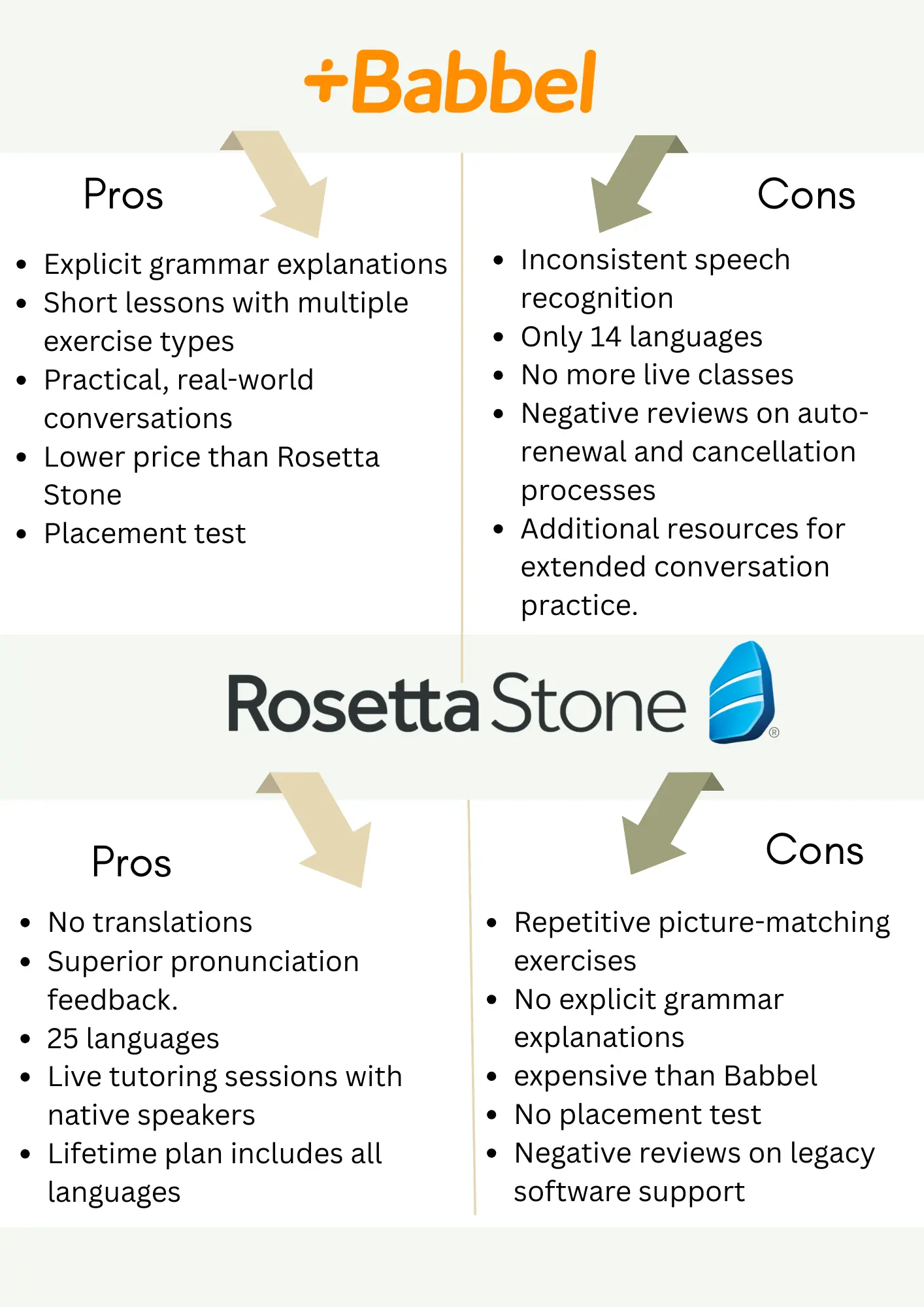
The following table of pros and cons might further help you decide which platform is right for you.
Pros
- Explicit grammar explanations help you understand why sentences work a certain way.
- Short, varied lessons (10-15 minutes) with multiple exercise types keep learning engaging.
- Courses focus on practical, real-world conversations you can use immediately.
- Lower price point than Rosetta Stone across most subscription options.
- Placement test lets you skip basics if you already have some knowledge.
- Spaced repetition system adapts to focus on words you struggle with most.
Cons
- Speech recognition can be inconsistent and does not always recognize what you say.
- Only 14 languages available compared to Rosetta Stone's 25.
- Live classes are no longer available for individual consumers.
- You may need additional resources for extended conversation practice.
- Some users report frustration with auto-renewal and cancellation processes.
Pros
- Full immersion approach with no translations helps you think directly in the target language.
- TruAccent speech recognition technology provides superior pronunciation feedback.
- 25 languages available, including less common options like Farsi, Tagalog, and Latin.
- Live tutoring sessions with native speakers available for additional practice.
- Lifetime plan includes all languages, offering excellent value for polyglots.
- 30-day money-back guarantee gives you more time to evaluate than Babbel's 20 days.
Cons
- Repetitive picture-matching exercises can become monotonous over time.
- No explicit grammar explanations may frustrate learners who want to understand rules.
- Generally more expensive than Babbel for equivalent subscription lengths.
- No placement test means beginners and experienced learners start at the same point.
- Mixed Trustpilot reviews (3.3 stars) with complaints about legacy software support.
13. Use-case scenarios
Different goals call for different tools. Here is my recommendation for common language learning scenarios in the Babbel vs Rosetta Stone comparison.
Scenario 1: Travel in 30 days
Winner: Babbel
If you need practical phrases fast, Babbel's focused lessons on real-world situations will serve you better. The shorter lesson format lets you fit more practice into busy pre-trip schedules. Travel-specific courses cover ordering food, asking directions, and basic conversation.
Scenario 2: Pass a basic conversation test
Winner: Babbel
Babbel's explicit grammar instruction helps you understand sentence structure, which is essential for conversation tests. The placement test ensures you start at the right level, and lessons progress through defined proficiency milestones.
Scenario 3: Improve pronunciation
Winner: Rosetta Stone
TruAccent is widely considered superior for pronunciation feedback. The immersive method forces you to speak frequently throughout lessons. Live tutoring sessions provide additional feedback from native speakers.
Scenario 4: Build a daily habit
Winner: Tie (depends on preference)
Both platforms offer reminders and progress tracking. Babbel's shorter lessons may fit better into packed schedules. Rosetta Stone's personalized study plans help structure longer-term learning. Choose based on whether you prefer quick daily sessions (Babbel) or more immersive practice (Rosetta Stone).
14. Final scorecard
Based on my comprehensive research, here is how Babbel vs Rosetta Stone compare across key criteria.
| Criteria | Weight | Babbel | Rosetta Stone |
|---|---|---|---|
| Value for money | 25% | 8/10 | 7/10 |
| Speaking/pronunciation | 25% | 7/10 | 9/10 |
| Ease of use | 20% | 9/10 | 8/10 |
| Content quality | 20% | 8/10 | 8/10 |
| Customer support | 10% | 7/10 | 6/10 |
| Weighted total | 100% | 7.85/10 | 7.70/10 |
Score breakdown:
- Value: Babbel wins due to lower subscription costs and equivalent features
- Speaking: Rosetta Stone wins with superior TruAccent technology and live tutoring
- Ease of use: Babbel wins with shorter lessons and clearer navigation
- Content quality: Tie—both offer well-designed curricula from language experts
- Support: Babbel wins with higher Trustpilot ratings and responsive service
15. Conclusion
The Babbel vs Rosetta Stone debate does not have a universal winner. Both platforms are legitimate language learning tools with distinct strengths.
I recommend Babbel for most learners. Its combination of explicit grammar instruction, varied exercises, shorter lessons, and lower price makes it accessible and effective. The 4.4-star Trustpilot rating reflects strong user satisfaction. If you want to understand why a language works a certain way—not just memorize patterns—Babbel delivers.
However, Rosetta Stone remains the better choice for pronunciation-focused learners and those who thrive with immersive methods. If you plan to learn multiple languages over time, the lifetime plan covering 25 languages represents excellent value. The TruAccent technology is genuinely impressive for developing native-like pronunciation.
My final advice: take advantage of both platforms' free trials before committing. Babbel's free first lessons and Rosetta Stone's 3-day trial let you experience each approach firsthand. The right choice depends on how you learn best—and only you can determine that by trying them yourself.