
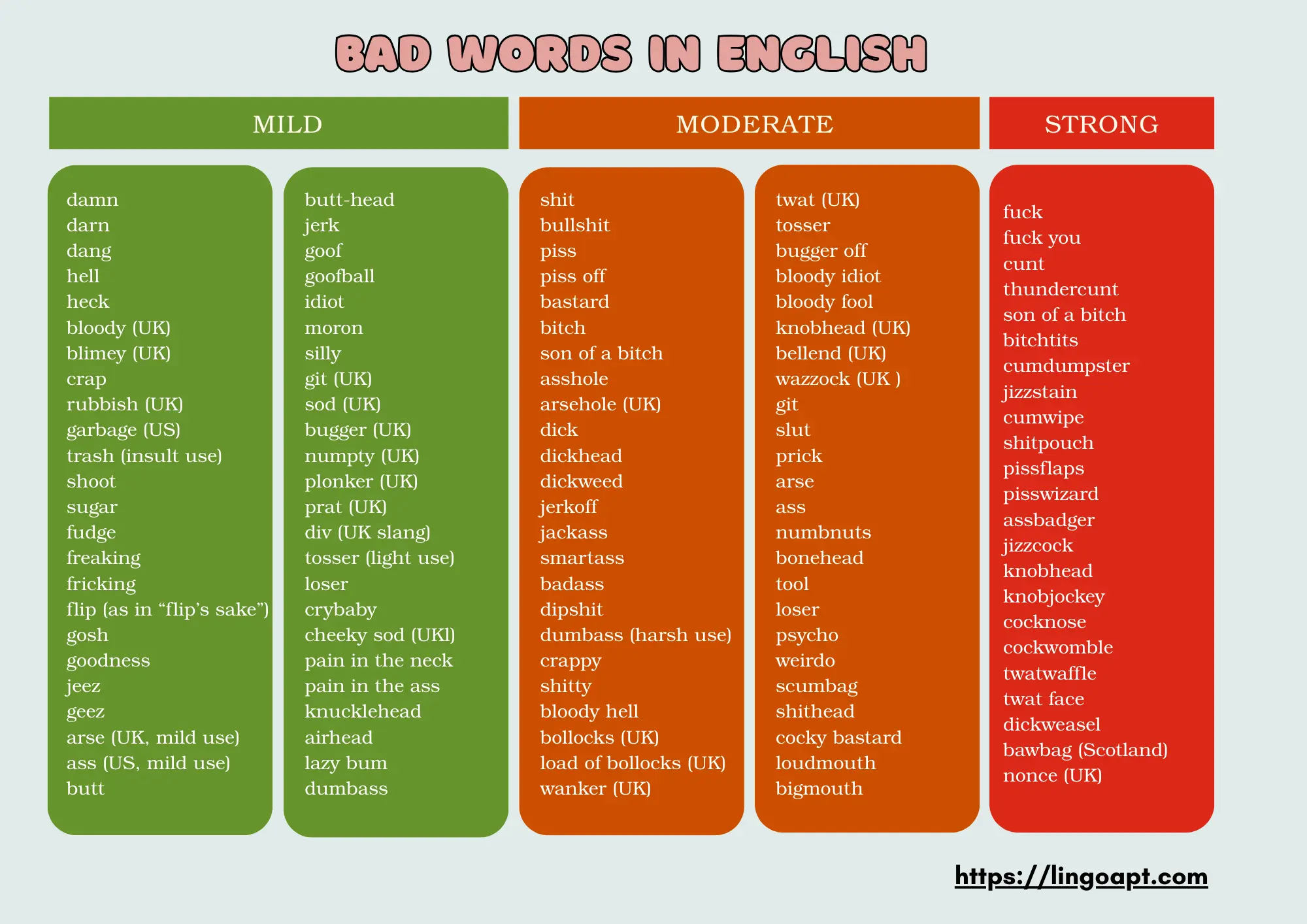
Learning bad words in English helps you understand what people actually say in movies, on social media, in music, during an argument, etc. Knowing them does not mean you should use them. I have listed here the most common bad words in English and categorised them based on their severity. If you decide to use bad words yourself, you should understand their weight.
1. Severity scale
1.1 Mild
These are words adults use without thinking twice. You'll hear them on daytime television in the UK, and they rarely cause offence in casual conversation. Words like damn, bloody (in British English), crap, hell, and arse/ass fall into this category. A grandparent might tut if a child says them, but among adults they're essentially harmless.
1.2 Moderate
These words are common among friends and in informal settings, but you wouldn't use them at a job interview or around people you don't know well. Shit, bastard, bollocks (British), piss, and bitch sit at this level. They're everyday words in many social circles, but they carry enough weight that using them at the wrong time will make people uncomfortable.
1.3 Strong
These words can offend people. Fuck and motherfucker are strong in both American and British English. The word cunt is extremely offensive in American English, and while it's used more loosely in British English (especially in Scotland and Australia), it still can provoke someone.
The UK broadcasting regulator Ofcom has surveyed hundreds of people about how offensive they find various words. Their research places racial and discriminatory slurs above general swear words in terms of offensiveness. This is interesting because the most hurtful words in English aren't the "classic" swear words but the ones that target someone's identity.
2. Common bad words and their meaning
Let's go through the words you're most likely to hear, roughly ordered from mild to strong.
2.1 Damn and hell
Both of these started as religious curse words (damning someone to hell was once a serious matter). Today, they've lost almost all of that religious punch. "Damn it!" is what you say when you spill coffee on your shirt. You can use "What the hell?" to express surprise or confusion. Neither will offend most people in casual settings.
2.2 Crap and rubbish
"Crap" means the same as "shit" (faeces) but is much milder. If someone says, "This film is crap", it just means it's bad. "Rubbish" (common in British English) is gentler than "Shit". Americans rarely say "rubbish" and tend to use "garbage" or "trash" instead, though those aren't swear words.
2.3 Shit
This is probably the most versatile moderate swear word in English. It works as a noun ("this is shit"), a verb ("I really shat myself," meaning I was terrified), an exclamation ("Shit!"), and an adjective ("a shitty day"). "The shit" (with "the") means something is excellent, which confuses a lot of learners. "This pizza is shit" means it's terrible, but "this pizza is the shit" means it's fantastic.
2.4 Bitch
The literal meaning is a female dog. As a swear word, it's used as an insult (usually directed at women, though not exclusively). The context matters enormously here. "That test was a bitch" just means the test was difficult. But calling someone a bitch directly is a strong insult that most people will take personally. Among some friend groups, it's used casually and affectionately, but as a learner, it's safer to avoid this one until you're very confident about the social dynamic.
2.5 Bastard
Bastard originally meant a child born outside of marriage. That meaning has faded almost entirely. In British English, it's relatively tame and might be one of the first swear words a child picks up in the playground. "You lucky bastard" is common and usually friendly. In American English, it carries a bit more bite.
2.6 Fuck
This word can function as nearly every part of speech: noun, verb, adjective, adverb, and exclamation. "Fuck!" on its own expresses frustration. "What the fuck?" expresses confusion or shock. "That's fucking brilliant" uses it as a positive intensifier. However, "Fuck you" is a direct insult. "I don't give a fuck" means you don't care at all.
You may have heard native speakers using "fuck" constantly among friends. Thus, you may think that it's no big deal. It is still a strong swear word, though. Native speakers adjust their language depending on who they're talking to. Among close mates, it flows freely. In a work meeting, at a family dinner, or with people you've just met, using it will change how people perceive you.
2.7 Cunt
In American English, this is considered the most offensive general swear word. Using it in almost any context will be seen as extremely disrespectful. In British English, and especially in Scottish English, it's still strong but gets used more casually. In Australia, calling a friend "a good cunt" is actually a compliment. As a learner, my advice is simple: don't use it. Even if you hear native speakers throwing it around, the risk of getting it wrong is too high.
3. British bad words
British English has its own collection of swear words that often sound either charming or meaningless to American ears. That's exactly why they can catch learners off guard, because something that seems harmless might actually be quite rude in the UK.
3.1 Bloody
"Bloody hell!" expresses surprise or frustration. "That's bloody brilliant" intensifies the adjective. In the UK, it's mild (roughly equivalent to "damn"). In American English, "bloody" almost exclusively means "covered in blood," and Americans tend to see the British use as quaint rather than offensive. Its origin is debated, but one popular theory links it to the oath "by Our Lady."
3.2 Bollocks
Literally means testicles, but its most common use is to call something nonsense ("that's a load of bollocks"). It also works as an exclamation of frustration: "Bollocks! I forgot my keys." Confusingly, "the dog's bollocks" means something is excellent. Americans tend to treat this word as roughly equivalent to "crap," but in the UK it's noticeably stronger, sitting at a moderate level. A Disney remake once used this word, which surprised quite a few British parents.
3.3 Wanker
Literally refers to someone who masturbates, but it's used more broadly to describe someone foolish or unpleasant. It's a staple British insult and sits at a moderate-to-strong level. Americans rarely use it and sometimes don't even register it as a real swear word, which has led to it appearing in PG-13 American films.
3.4 Bugger
"Bugger!" is a common British exclamation (similar to "damn"). "Bugger off" means "go away." "I can't be buggered" means "I can't be bothered." The word technically refers to anal intercourse, but almost nobody thinks of that meaning in everyday use. Hugh Grant says it about five thousand times in Four Weddings and a Funeral. In the UK, it's mild to moderate. Americans find it amusing rather than offensive.
3.5 Git and sod
"Git" is a mild British insult meaning a foolish or annoying person. "You silly git" is almost affectionate. "Sod" works similarly: "sod off" means "go away" (milder than "piss off"), and "sod it" expresses mild frustration. Neither of these words has any real currency in American English.
3.6 Twat
In British English, this rhymes with "cat" and means a foolish person (its literal meaning is vagina, but the insult use is more common). It's moderate; stronger than "git" but weaker than "cunt." In American English, some people pronounce it to rhyme with "cot," which irritates many British speakers.
4. American swear words
The flow goes both ways. Some words that carry real weight in American English land softer in Britain.
5.1 Ass and asshole
Americans use "ass" constantly: "badass" (a compliment), "dumbass" (an insult), "get your ass over here" (hurry up). In British English, the equivalent is "arse" and "arsehole." The British versions sound slightly more blunt to American ears, while the American versions sound slightly softer to Brits. "Asshole" is a moderate insult in the US; "arsehole" carries about the same weight in the UK.
4.2 Jerk and douchebag
"Jerk" is a mild American insult for someone rude or annoying. The British equivalent would be something like "prat" or "plonker." "Douchebag" is more specifically American and refers to a self-important, obnoxious person. It's moderate in the US but barely used in the UK, where "tosser" or "wanker" serve a similar purpose.
5. Same word, different meaning
Several English words have completely different meanings depending on which side of the Atlantic you're on. Getting these wrong can lead to hilarious (or horrifying) misunderstandings.
| Word | American meaning | British meaning |
|---|---|---|
| pissed | angry | drunk |
| fanny | buttocks (mild, almost childish) | vagina (genuinely rude) |
| pants | trousers | underwear |
| taking the piss | rarely used; sounds crude | making fun of someone (very common) |
| bloody | covered in blood (literal only) | mild swear word / intensifier |
| shag | type of carpet / rug | to have sex |
The pissed one catches people out the most. If a British person says "I was so pissed last night," they mean they were drunk. If an American says the same thing, they were angry. "Pissed off" means angry in both varieties, which is at least one small mercy.
The fanny mix-up is legendary. In American English, a "fanny pack" is a small bag worn around the waist. Say "fanny pack" in Britain and people will giggle, because "fanny" is slang for female genitalia. The British call it a "bum bag" instead.
7. Euphemisms and safer alternatives
English speakers have invented a whole vocabulary of softer words to replace swear words. If you want to express frustration or surprise without offending anyone, these are your safest options.
| Instead of | You can say |
|---|---|
| fuck | fudge, flipping, freaking, for flip's sake |
| shit | shoot, sugar, shucks |
| damn | darn, dang |
| hell | heck |
| bloody hell | blooming heck, blimey |
| oh my God | oh my gosh, oh my goodness |
| Jesus! | jeez, geez |
| son of a bitch | son of a gun |
| bollocks | rubbish, nonsense, codswallop |
| bullshit | baloney, hogwash, codswallop |
These euphemisms are used by native speakers all the time, not just children. You'll hear "shoot" and "fudge" in American workplaces, and "blooming" and "blimey" in British ones. Using them won't make you sound childish; it'll make you sound like someone who knows how to navigate different social settings.
8. When to use bad words (and when to never use them)
The golden rule is that if you're not sure whether it's appropriate, don't. Native speakers calibrate their language based on years of social experience. They know who can handle "fuck" and who can't, almost instinctively. As a learner, you're still building that instinct, so being cautious is always smarter than being bold.
8.1 Probably safe
Among close friends who swear themselves, in very casual social settings, and when you're reacting emotionally to something (stubbing your toe, dropping your phone). Mild words like "damn," "crap," and "hell" are acceptable in most informal situations.
8.2 Never appropriate
At work (unless your workplace culture is exceptionally relaxed and you know everyone well), in formal writing, around children, around people you've just met, and in academic settings. Strong words should be avoided with people you don't know well, regardless of the setting. And slurs based on race, gender, sexuality, or disability are never acceptable, full stop. These aren't "swear words" in the traditional sense; they're hate speech, and native speakers treat them far more seriously than any of the words covered above.
8.3 Grey area
Many British workplaces are more relaxed about moderate swearing than American ones. A "bloody hell" in a British office is unremarkable; dropping an f-bomb in many American offices would raise eyebrows. This is a generalisation, of course, but it's worth keeping in mind if you work internationally.