
1. Concrete vs abstract - easiest explanation
If you can see it, touch it, hear it, smell it, or taste it, it is a concrete noun. A abstract noun refers to something you cannot experience with your five senses. It exists only as an idea, feeling, or concept in your mind.
Chair and comfort are two nouns, which one is concrete? Well, you can see and touch a chair. You can even sit on it. So, chair is a concrete noun. But you cannot touch or see comfort itself. You might feel comfortable, but comfort as a thing does not exist in the physical world. That makes comfort an abstract noun.
2. Categories
2.1 Concrete nouns
Concrete nouns fall into several categories based on which sense you use to perceive them:
- Sight: mountain, flower, cat, building, star
- Touch: fabric, keyboard, water, sand, coin
- Hearing: thunder, whistle, voice, music, bell
- Smell: perfume, smoke, coffee, bread
- Taste: chocolate, salt, lemon, honey
Many concrete nouns can be perceived by more than one sense. For example, you can see, touch, and taste an apple. You can see and hear a bird. The point is that at least one of your senses can detect it.
You may find it surprising that invisible things can be concrete nouns. Air is a concrete noun because you can feel it on your skin. Bacteria are concrete nouns because they exist physically, even though you need a microscope to see them. We cannot see atoms, but they exist physically.
Even fictional things can be concrete nouns. A dragon, a unicorn, or a character like Harry Potter are concrete nouns. Why? Because within their fictional worlds, they represent beings you could see and touch if they were real.
2.2 Abstract nouns
Abstract nouns cover a wide range of meanings:
- Emotions and feelings: happiness, anger, fear, love, jealousy, pride
- Qualities and traits: honesty, bravery, kindness, intelligence, beauty
- Ideas and concepts: freedom, democracy, justice, truth, equality
- States and conditions: childhood, poverty, health, peace, silence
- Time-related concepts: moment, century, past, future
Notice that none of these can be touched, seen, pointed at, or sensed directly. You might see someone acting bravely, but you cannot see bravery itself. Poverty does not have physical form.
3. Spotting abstract nouns through suffixes
Many abstract nouns are formed by adding a suffix to an adjective, verb, or concrete noun. Recognising these suffixes can help you identify abstract nouns quickly:
| Suffix | Base word | Abstract noun |
|---|---|---|
| -ness | kind (adjective) | kindness |
| -ity | possible (adjective) | possibility |
| -ment | enjoy (verb) | enjoyment |
| -tion / -sion | educate (verb) | education |
| -dom | free (adjective) | freedom |
| -ship | friend (noun) | friendship |
| -hood | child (noun) | childhood |
| -ance / -ence | patient (adjective) | patience |
| -th | strong (adjective) | strength |
If you see a noun ending in one of these suffixes, there is a good chance it is abstract. However, this is not a perfect rule; some words formed this way can still be concrete depending on context.
The concrete vs abstract difference is not always clear. Even native speakers can be confused. Let me walk you through the most common problem areas.
4. The same word can be concrete or abstract
Some nouns shift between concrete and abstract depending on how you use them. The word work is a perfect example:
- His works hang in the museum. (concrete; referring to paintings you can see)
- This project requires hard work. (abstract; referring to effort, which is intangible)
The word atmosphere works similarly:
- The Earth's atmosphere contains nitrogen and oxygen. (concrete; the physical layer of gases)
- The restaurant had a welcoming atmosphere. (abstract; referring to a feeling or mood)
When you encounter these words, look at the sentence context. Ask yourself whether the word refers to something physical or something conceptual.
What about pain? You certainly feel it. Does that make it concrete?
Most grammarians classify pain as abstract. Here is why: while you experience pain, pain itself has no physical form. You cannot show someone your pain or photograph it. What you feel is a signal from your nervous system, processed by your brain. The sensation is real, but the noun names something intangible.
This applies to other physical sensations too. Hunger, sleep, adulthood, confusion, thirst, and exhaustion are typically considered abstract because they describe states rather than physical objects.
5. Why the distinction matters for English learners
You might wonder whether this is just grammar theory with no practical use. Actually, understanding concrete vs abstract nouns helps you in several ways.
5.1 Writing more clearly
Abstract nouns can be vague. When you write "She showed courage," readers might picture different things. But when you add concrete details ("She ran into the burning building"), your meaning becomes vivid and precise.
Skilled writers combine both types. They use abstract nouns to name concepts and concrete nouns to illustrate them. This technique appears constantly in English literature and everyday communication.
5.2 Working with countable and uncountable nouns
Most abstract nouns are uncountable. You say "information" not "informations." You say "advice" not "advices." Recognising a noun as abstract can help you predict whether it takes a plural form or needs an article.
Concrete nouns are often countable (three books, two chairs), though some are not (water, furniture). Knowing the concrete/abstract distinction gives you a starting point for making these grammar decisions.
5.3 Understanding figurative language
English speakers constantly describe abstract things using concrete language. Phrases like "a mountain of debt" or "drowning in work" use concrete images (mountain, drowning) to express abstract ideas (debt, too much work). This figurative language is common in English.
Once you understand the difference between concrete and abstract, you can appreciate why these expressions work and create similar images in your own speaking and writing.
6. Common examples to practise with
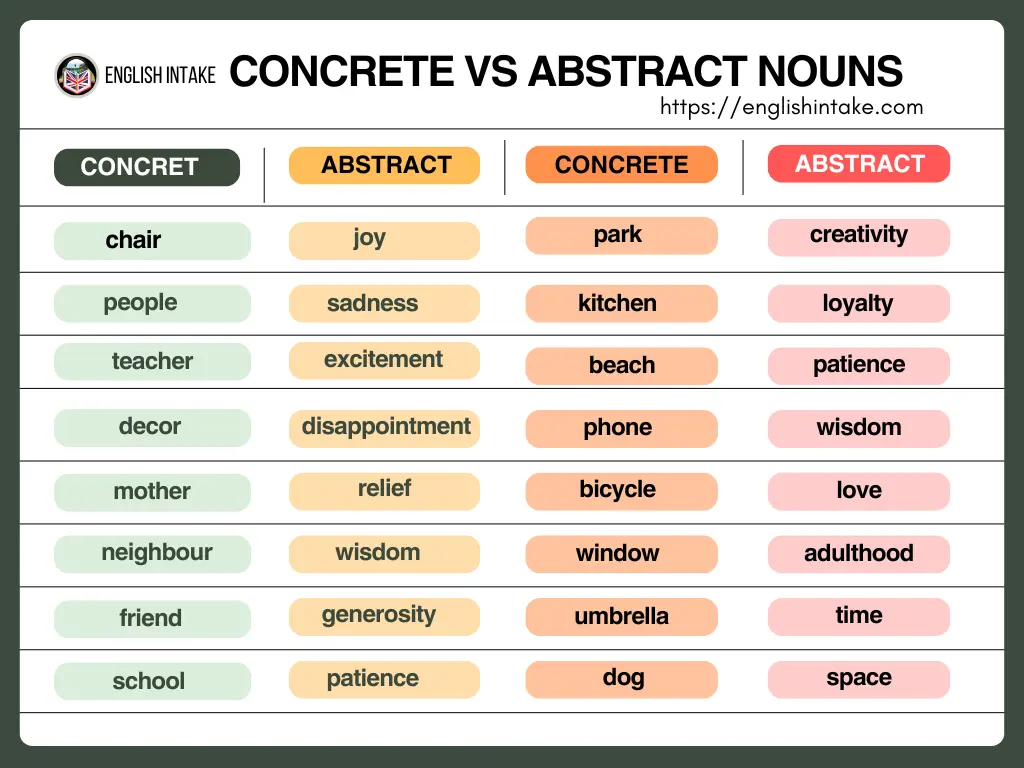
Here are some everyday nouns sorted into concrete and abstract categories. Study them, then try identifying nouns in your own reading.
6.1 Concrete nouns
People: teacher, doctor, mother, friend, neighbour
Places: park, school, kitchen, London, beach
Objects: phone, bicycle, window, umbrella, camera
Animals: dog, butterfly, whale, spider
Natural things: rain, cloud, river, tree, stone
Things you hear: song, alarm, whisper, explosion
6.2 Abstract nouns
Emotions: joy, sadness, excitement, disappointment, relief
Qualities: wisdom, generosity, patience, creativity, loyalty
Ideas: knowledge, opportunity, success, failure, culture
States: sleep, youth, adulthood, confusion, awareness
Concepts: time, space, belief, theory, progress
7. A practical approach
Rather than memorising concrete vs abstract nouns lists, develop a habit of asking questions. Can I see it? Touch it? Hear it? If yes, concrete. If the noun names a feeling, idea, or quality that exists only in the mind, abstract.
For borderline cases, do not stress too much. Even linguists disagree on some words. The important thing is understanding the general principle: concrete nouns have physical reality; abstract nouns exist as mental concepts.
With practice, this distinction will become automatic. You will start noticing how writers use both types to create clear, vivid, and meaningful sentences. And your own English will grow richer as you learn to balance the tangible and the intangible in your communication.