
Find many connotation examples to understand how word choice can make you sound rude, neutral, or respectful. I remember one of my student described his mother "nosy". However, what he wanted to say was that she was caring and attentive. Do you see the importance of word choice?
1. What is connotation?
Every word carries two types of meaning. The first is its denotation (the dictionary definition); the second is its connotation (the feeling or emotion the word triggers).
Consider the word "home." Its denotation is simply "a place where someone lives." However, the connotation of "home" includes warmth, family, safety, and belonging. That is why estate agents sell "homes" rather than "houses"; they want buyers to feel an emotional connection.
Mark Twain once wrote, "The difference between the right word and the almost right word is the difference between lightning and a lightning bug." This perfectly captures why connotation matters so much in English communication.
2. Connotation vs denotation
Denotation refers to a word's literal, dictionary meaning. It is objective and factual. If you describe something using its denotation, you are stating what it is without adding feelings.
Connotation is the emotional or cultural meaning a word carries beyond its literal definition. These associations can be positive, negative, or neutral; and they often vary between cultures, generations, and individuals.
Here is a simple comparison:
| Word | Denotation | Connotation |
|---|---|---|
| Snake | A long, limbless reptile | Danger, betrayal, deceit |
| Dove | A type of bird | Peace, innocence, purity |
| Hollywood | A district in Los Angeles | Glamour, fame, entertainment |
3. The three types of connotation
Words can carry positive, negative, or neutral connotations. The same basic meaning can be expressed in very different ways depending on which type of word you choose.
3.1 Positive connotation
Words with positive connotations create favourable impressions. They make readers or listeners feel good about the subject being discussed. Writers and advertisers frequently select these words to persuade audiences.
For example, calling someone "confident" suggests self-assurance in a healthy way. Describing a meal's smell as an "aroma" implies it is pleasant and appetising. A "youthful" person sounds vibrant and energetic.
3.2 Negative connotation
Words with negative connotations create unfavourable impressions. Even when the literal meaning is similar to a positive word, the emotional response is very different.
Calling that same person "arrogant" implies excessive self-importance. Describing the meal's smell as a "stench" suggests it is unpleasant. Calling someone "childish" (rather than youthful) implies immaturity.
3.3 Neutral connotation
Neutral words state facts without adding emotional colour. They are useful when you want to be objective or avoid influencing your audience.
Rather than "confident" or "arrogant," you might simply say someone is "self-assured." Instead of "aroma" or "stench," you could use the neutral word "smell." These choices work well in academic writing, journalism, and professional contexts.
4. Connotation examples
Below is a table showing how words with the same denotation can have very different connotations. I recommend studying these carefully, as choosing the wrong word can completely change your message.
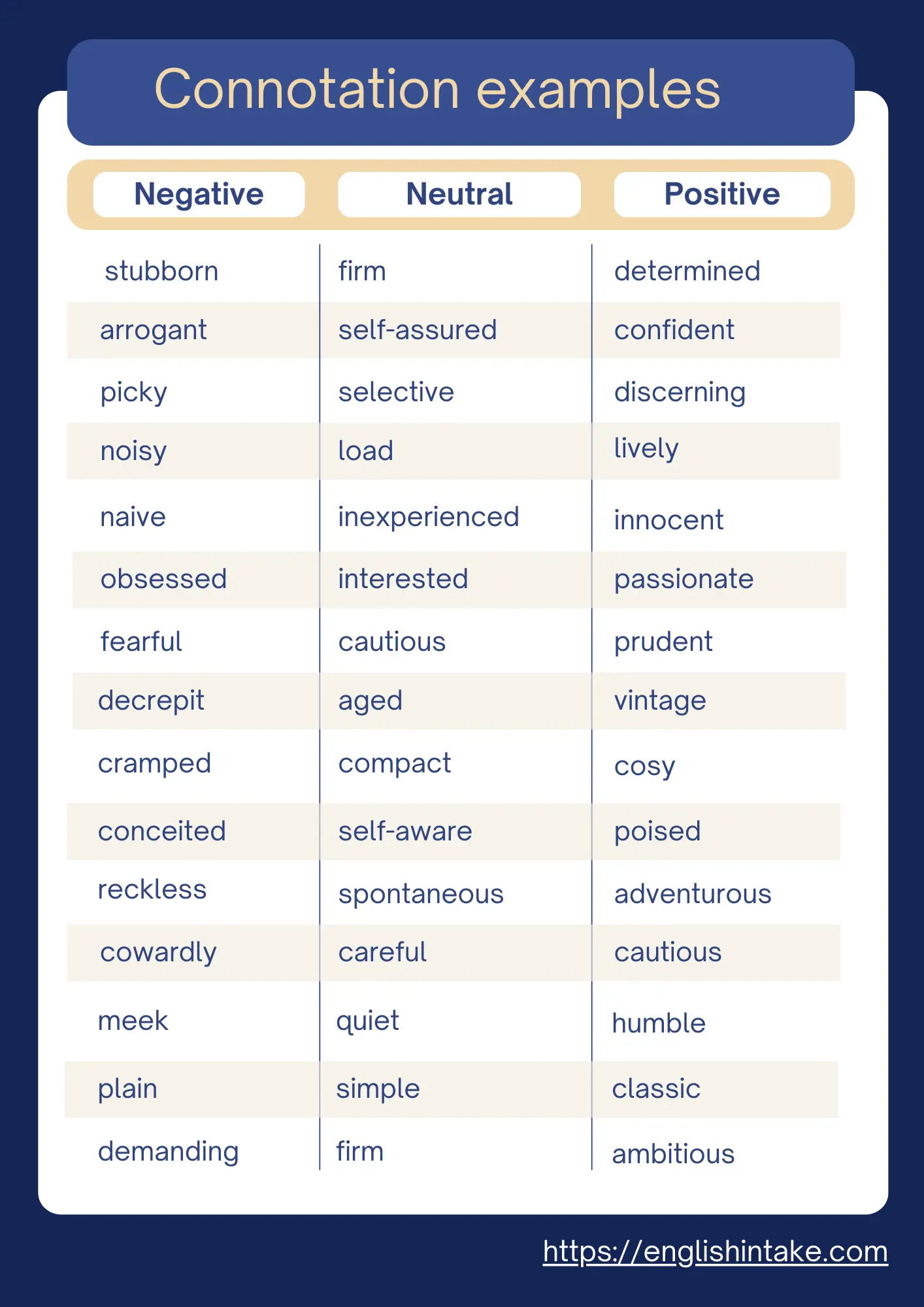
| Negative connotation | Neutral connotation | Positive connotation |
|---|---|---|
| Skinny | Thin | Slender |
| Cheap | Inexpensive | Affordable |
| Stubborn | Determined | Tenacious |
| Nosy | Curious | Inquisitive |
| Stench | Smell | Aroma |
| Childish | Youthful | Childlike |
| Pushy | Assertive | Confident |
| Old | Mature | Experienced |
| Mutt | Dog | Purebred |
| Scrawny | Lean | Slim |
| Stingy | Frugal | Economical |
| Weird | Different | Unique |
| Lazy | Relaxed | Easygoing |
| Cunning | Clever | Shrewd |
| Clique | Group | Club |
5. Connotation examples in sentences
Seeing words in context helps you understand how connotation works in real communication and avoid being rude by accident. Below are sentence pairs that demonstrate how word choice changes meaning.
5.1 Describing people
Negative: "My brother is arrogant."
Positive: "My brother is confident."
Both sentences describe someone who believes in themselves. However, "arrogant" suggests this person thinks they are better than others, while "confident" implies healthy self-assurance.
Negative: "She's scrawny and needs to eat more."
Positive: "She's slender and looks elegant."
Both describe a thin person. The word "scrawny" suggests an unattractive, unhealthy thinness. The word "slender" implies grace and attractiveness.
5.2 Describing places and things
Negative: "The restaurant was filled with the stench of fish."
Positive: "The restaurant was filled with the aroma of fresh seafood."
Both describe a smell of fish. Using "stench" makes the restaurant sound unpleasant; using "aroma" makes it sound appetising.
Negative: "This shirt is cheap."
Neutral: "This shirt is inexpensive."
"Cheap" suggests poor quality, while "inexpensive" simply means it does not cost much. This distinction is crucial when shopping or writing product reviews.
5.3 Describing behaviour
Negative: "He's so nosy about everyone's business."
Positive: "He's curious about the world around him."
Both describe someone who asks questions. "Nosy" implies unwanted interference in private matters; "curious" suggests a healthy desire to learn.
6. Avoiding misunderstandings
Choosing words with the wrong connotation is one of the most common mistakes English learners make. You might use a word that is technically correct but sounds rude, childish, or strange to native speakers.
For instance, calling someone's grandmother "old" is factually accurate but potentially offensive. Saying she is "elderly" or "experienced" shows more respect. Similarly, telling a colleague their idea is "weird" sounds insulting, whereas "unusual" or "innovative" sounds professional.
Understanding connotation also helps you interpret messages correctly. If a British person says your cooking has a "distinct" taste, they might actually mean they do not like it (polite understatement is common in British English). Learning these subtle meanings takes time, but it dramatically improves your communication skills.
7. Connotation across cultures
Connotations often differ between cultures, which can create misunderstandings for English learners. What sounds positive in one culture may sound negative in another.
7.1 Colour connotations
The colour white connotes purity, weddings, and innocence in Western cultures. However, in many East Asian cultures, white is associated with death and mourning. Black connotes elegance and formality in Western fashion but represents evil or death in other contexts.
7.2 Animal connotations
In English, "dog" often carries positive connotations. Expressions like "a lucky dog" (a fortunate person) or "top dog" (the leader) reflect this. However, in some cultures, calling someone a dog is highly insulting.
Owls symbolise wisdom in Western cultures, but in some other cultures they represent bad luck. Dragons are fearsome and dangerous in European traditions but lucky and powerful in Chinese culture.
7.3 Food connotations
In the United States, "apple pie" carries strong cultural connotations of home, tradition, and American identity. The phrase "as American as apple pie" means something is quintessentially American. Other cultures have similar food-related expressions that foreigners might not understand immediately.
8. Advertising and marketing
Advertisers choose words carefully to influence your emotions. Understanding their techniques helps you become a more critical reader and a better writer.
A real estate agent will never describe a small flat as "cramped" (negative). Instead, they use "cosy" (positive) because it suggests warmth and comfort. A car dealership will not sell "used" vehicles (negative); they sell "pre-owned" ones (neutral or slightly positive).
Food packaging uses words like "artisan," "farm-fresh," and "hand-crafted" because these words connote quality and care. "Processed" and "mass-produced" carry negative connotations, so companies avoid them even when technically accurate.
Similarly, cosmetics are described as helping you achieve a "youthful" appearance rather than making you look "juvenile." Both words relate to being young, but "juvenile" connotes immaturity while "youthful" connotes energy and vitality.
9. In literature
Writers use connotation to create atmosphere, develop characters, and convey themes without stating them directly. Recognising these techniques deepens your reading comprehension.
9.1 Character names
In George Orwell's Animal Farm, the corrupt leaders are pigs; a word that connotes greed and uncleanliness. One untrustworthy human character is named "Mr Whymper," which sounds similar to "whimper" and connotes weakness and cowardice.
9.2 Word choice in descriptions
In The Monkey's Paw by W.W. Jacobs, phrases like "sharp and unnecessary perils" and "fatal mistake" in the opening passages create a sense of danger before anything bad actually happens. The connotations of these words prepare readers for disaster.
9.3 Poetry and metaphor
When Shakespeare writes "Shall I compare thee to a summer's day?" in Sonnet 18, summer connotes beauty, warmth, and pleasure. Robert Frost's poem "The Road Not Taken" uses "road" and "path" to connote life choices and personal journeys.
10. Learning tips
Mastering connotation takes time because it requires cultural knowledge and exposure to natural English. However, several strategies can speed up your learning.
10.1 Use a thesaurus carefully
A thesaurus gives you synonyms, but not all synonyms are interchangeable. Always check example sentences to understand each word's connotation before using it. Online dictionaries like Cambridge and Oxford often include usage notes about positive or negative connotations.
10.2 Read widely
Reading novels, newspapers, and magazines exposes you to words in context. Pay attention to which words writers choose in different situations. Notice how descriptions change depending on whether the writer wants you to like or dislike something.
10.3 Ask native speakers
If a teacher or native speaker corrects your word choice, ask why. Understanding the connotation behind their correction helps you avoid similar mistakes in the future. Native speakers absorb these distinctions naturally, so they can often explain nuances that dictionaries miss.
10.4 Practise with word pairs
Try this exercise: take a person, place, or thing, and describe it in two ways. First, use words with positive connotations; then describe the same thing using negative words. For example, describe an older person as "silver-haired" (positive) versus "grey-haired" (neutral) versus "faded" (negative).
11. Frequent mistakes
English learners often make the following errors when choosing words. Being aware of these patterns can help you communicate more effectively.
11.1 Confusing similar words
Many learners use "adequate" and "sufficient" interchangeably. While both mean "enough," "adequate" connotes barely meeting the minimum standard, whereas "sufficient" suggests comfortably meeting needs. Saying your workspace has "adequate space" sounds cramped; "sufficient space" sounds comfortable.
11.2 Using overly formal words
Some learners choose formal words when casual ones would be more appropriate. Saying "I shall commence my studies" sounds stiff and old-fashioned. "I'll start studying" is more natural in everyday conversation.
11.3 Ignoring context
The same word can have different connotations depending on context. Calling a child "innocent" is positive (pure and uncorrupted), but calling an adult "innocent" in a business context might imply naivety (lacking experience).