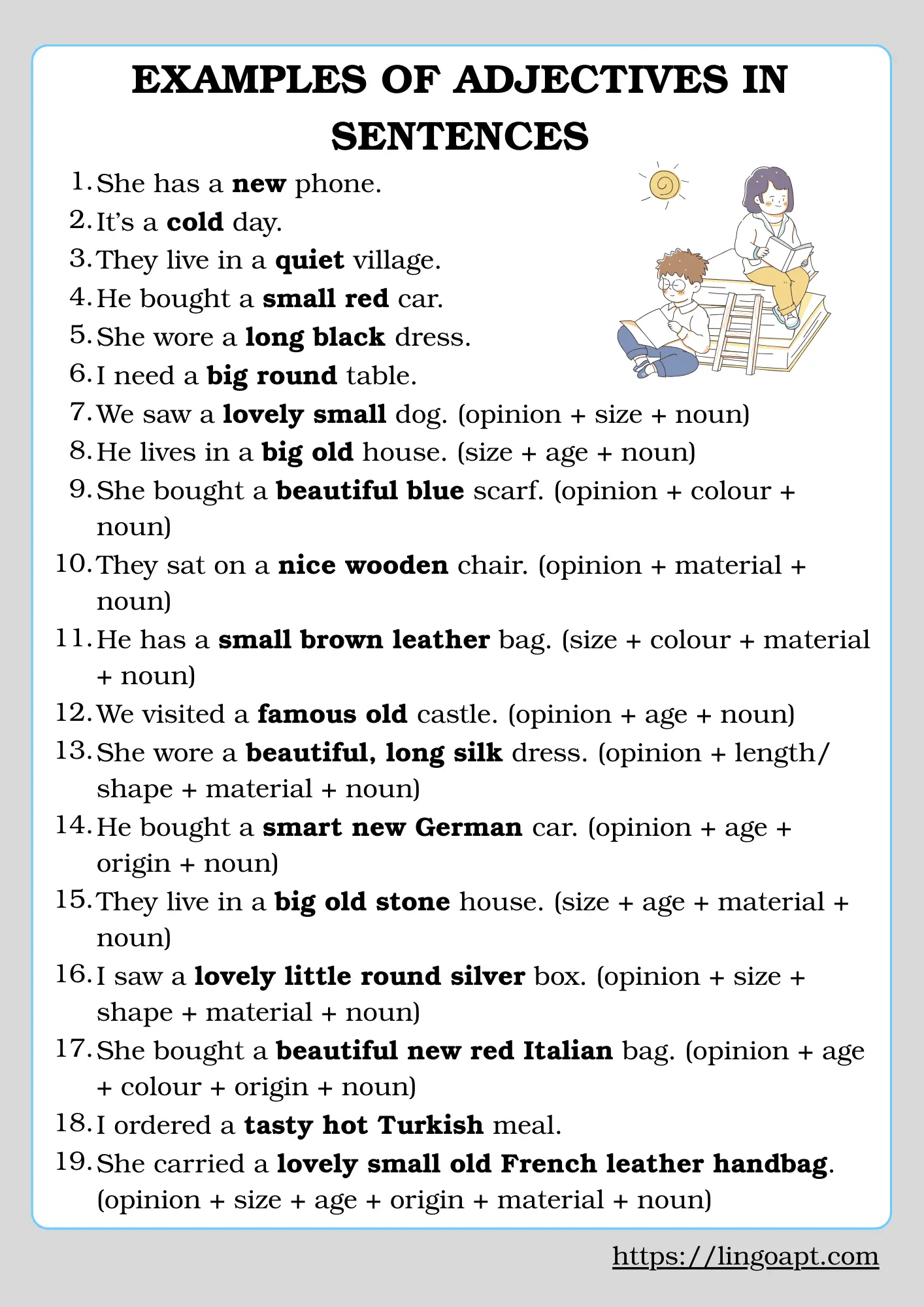
Find below many examples of adjectives in sentences to help you understand their positions and order. I have also included an exercise to test your understanding.
1. Examples of descriptive adjectives in sentences
Descriptive adjectives tell you about the quality, size, shape, colour, or condition of a noun. They answer the question "What is it like?"
1.1 Appearance
These adjectives describe how something or someone looks.
- The tall man stood at the back of the queue.
- She has curly hair and green eyes.
- We moved into a tiny flat near the station.
- He was wearing a torn jacket and muddy boots.
- The narrow path led through a dense forest.
1.2 Personality and emotion
They describe someone's character or how they feel.
- My neighbour is a generous person.
- The children were excited about the trip.
- He seemed nervous before the interview.
- She's always been patient with her students.
- The coach gave the team a motivating speech.
1.3 Condition and quality
These tell you about the state or quality of something.
- The bread was stale, so I threw it away.
- We need clean water and fresh air.
- The road was slippery after the rain.
- This is an expensive restaurant, but the food is excellent.
- The old bridge looked unsafe.
2. Examples of quantitative adjectives in sentences
Quantitative adjectives tell you how much or how many of something there is. They include specific numbers (one, two, three) and vaguer quantities (some, many, few).
- I have three brothers and two sisters.
- There are several options to choose from.
- We didn't get much sleep last night.
- She ate half the cake by herself.
- Few students passed the exam without studying.
- He has enough money to buy a car.
Notice the difference between few and a few. "Few students passed" suggests a disappointingly small number. "A few students passed" simply means a small number, without the negative feeling.
3. Demonstrative
Demonstrative adjectives point to a specific noun. In English there are four: this, that, these, and those. Use this and these for things nearby; use that and those for things further away.
- This book is mine, but that one belongs to Sarah.
- Can you pass me those plates on the top shelf?
- These shoes are more comfortable than my old ones.
- I remember that day very clearly.
A common question learners ask is: "How do I know if this is an adjective or a pronoun?" The answer is simple. If the word comes before a noun, it is an adjective. If it stands alone and replaces the noun, it is a pronoun. Compare "This cake is delicious" (adjective before cake) with "This is delicious" (pronoun replacing the noun).
4. Possessive
Possessive adjectives show who owns or is connected to something. The possessive adjectives in English are my, your, his, her, its, our, and their.
- My sister lives in Edinburgh.
- Is this your umbrella?
- The cat licked its paw after the meal.
- Their house is at the end of the road.
- We finished our homework before dinner.
Do not confuse its (possessive adjective) with it's (short for "it is" or "it has"). "The dog wagged its tail" is correct. "The dog wagged it's tail" is wrong.
5. Interrogative
Interrogative adjectives appear in questions. They come before a noun and help you ask which, what, or whose.
- Which colour do you prefer?
- What time does the film start?
- Whose bag is this?
- What kind of music do you listen to?
- Which route is the quickest?
Just like demonstrative adjectives, interrogative words only count as adjectives when they appear before a noun. "Which do you want?" uses which as a pronoun. "Which shirt do you want?" uses it as an adjective.
6. Proper adjectives in sentences
Proper adjectives come from proper nouns (names of places, people, or things) and are always capitalised. They often describe nationality, origin, or a connection to a specific person or place.
- She studied Japanese literature at university.
- I love Italian food, especially pasta.
- The Victorian buildings in Bath are stunning.
- He plays Shakespearean roles on the London stage.
- We had Greek yoghurt with honey for breakfast.
7. Positions
In English, adjectives usually sit in one of two positions. Understanding these two positions is key to building natural-sounding sentences.
7.1 Before the noun (attributive position)
This is the most common position. The adjective comes directly before the noun it describes.
- She drives a fast car.
- We watched a brilliant documentary last night.
- He ordered a cold drink.
7.2 After a linking verb (predicative position)
Linking verbs like be, seem, feel, look, sound, taste, smell, and become connect the subject to an adjective that describes it. In this case, the adjective comes after the verb.
- The soup tastes delicious.
- She seems happy today.
- The fabric feels soft.
- That idea sounds interesting.
- He became famous overnight.
One mistake learners make here is using an adverb instead of an adjective after a linking verb. You say "She looks beautiful" (adjective), not "She looks beautifully" (adverb). The adjective describes the subject (she), not the action of looking.
8. order
Adjectives follow a specific order in sentences. The standard order is: opinion, size, age, shape, colour, origin, material, purpose.
| Position | Category | Examples |
|---|---|---|
| 1 | Opinion | lovely, ugly, brilliant |
| 2 | Size | big, small, tall |
| 3 | Age | old, young, new |
| 4 | Shape | round, flat, square |
| 5 | Colour | red, blue, green |
| 6 | Origin | French, Chinese, British |
| 7 | Material | wooden, cotton, metal |
| 8 | Purpose | sleeping (bag), running (shoes) |
Here are some examples of this order in sentences.
- A lovely little old cottage. (opinion + size + age)
- A big round wooden table. (size + shape + material)
- A beautiful long red Italian silk scarf. (opinion + size + colour + origin + material)
- An ugly small square box. (opinion + size + shape)
You would never say "a wooden round big table." It sounds wrong to any English speaker, even though the words are all correct individually. The order is what makes it natural.
In practice, you rarely stack more than two or three adjectives before a noun. If you find yourself using four or more, consider rewriting the sentence. Instead of "a beautiful small old round brown wooden box," try "a beautiful old wooden box" and describe the rest separately.
9. Comparative and superlative adjectives in sentences
Adjectives have three forms or degrees: the base form, the comparative, and the superlative forms. The comparative compares two things; the superlative picks out the most extreme in a group of three or more.
9.1 How to form them
| Rule | Base | Comparative | Superlative |
|---|---|---|---|
| One syllable: add -er / -est | tall | taller | tallest |
| One syllable ending in -e: add -r / -st | large | larger | largest |
| One syllable, short vowel + consonant: double the consonant | big | bigger | biggest |
| Two syllables ending in -y: change y to -ier / -iest | happy | happier | happiest |
| Two or more syllables: use more / most | beautiful | more beautiful | most beautiful |
| Irregular | good | better | best |
| Irregular | bad | worse | worst |
| Irregular | far | farther / further | farthest / furthest |
9.2 Comparative
- My flat is smaller than yours.
- This exercise is more difficult than the last one.
- She's better at maths than her brother.
- London is more expensive than Manchester.
- Today is colder than yesterday.
9.3 Superlative
- That was the worst film I've ever seen.
- She's the tallest person in the class.
- This is the most interesting book I've read this year.
- He's the best player on the team.
- It was the happiest day of my life.
10. -ed and -ing adjectives in sentences
Many adjectives in English come in pairs; one ending in -ed and one ending in -ing. They look similar but mean different things.
The -ed form describes how someone feels. The -ing form describes the thing (or person) that causes the feeling.
| -ed adjective (the feeling) | -ing adjective (the cause) |
|---|---|
| I'm bored. | This lesson is boring. |
| She was surprised by the news. | The news was surprising. |
| We're excited about the concert. | The concert sounds exciting. |
| He felt confused by the instructions. | The instructions were confusing. |
| I'm tired after the walk. | The walk was tiring. |
| They were frightened by the noise. | The noise was frightening. |
If you say "I am boring," you're not saying you feel bored. You're saying that you cause boredom in other people. That's probably not what you mean. The correct sentence is "I am bored." Keep this rule in mind: use -ed for feelings, -ing for causes.
Here are more examples in full sentences to help this stick:
- The documentary was fascinating. I was completely fascinated.
- It's embarrassing when you forget someone's name. I was so embarrassed.
- The match was disappointing. The fans were disappointed.
- That horror film was terrifying. The children were terrified.
11. Compound adjectives in sentences
A compound adjective is made up of two or more words that work together as a single adjective. When a compound adjective comes before the noun, you usually join the words with a hyphen.
- She's a well-known author.
- He lives in a three-bedroom house.
- We had a last-minute change of plan.
- That was a mouth-watering dessert.
- He's a left-handed tennis player.
- They serve sugar-free drinks at the café.
When the compound adjective comes after the noun (in predicative position), you often drop the hyphen. For example, "She is well known" (no hyphen) but "She is a well-known writer" (hyphen before the noun).
12. Common mistakes with adjectives in sentences
Here are the errors I see most often from English learners, along with corrections.
| Mistake | Why it's wrong | Correct version |
|---|---|---|
| She is more taller than me. | Don't use "more" with -er comparatives. | She is taller than me. |
| I am very agree. | "Agree" is a verb, not an adjective. You can't modify it with "very." | I completely agree. / I am in full agreement. |
| The informations are useful. | "Information" is uncountable; also, the adjective placement is fine here, but the noun is wrong. | The information is useful. |
| I am very boring today. | -ing describes the cause, not the feeling. | I am very bored today. |
| She looks beautifully. | After a linking verb, use an adjective, not an adverb. | She looks beautiful. |
| He is a eight-year-old boy. | "Eight" starts with a vowel sound, so use "an." | He is an eight-year-old boy. |
| I have a car red. | In English, adjectives go before the noun (unlike some other languages). | I have a red car. |
| The childrens are happys. | Adjectives in English never change form for plurals. | The children are happy. |
Adjectives in English do not have a plural form. Whether you describe one child or ten children, the adjective stays the same. You say "one happy child" and "ten happy children," never "ten happys children."
13. Adjectives with different linking verbs
Learners often practise adjectives only with the verb "be" (is, am, are, was, were). But other linking verbs are equally common, and using them makes your English sound more natural and varied.
| Linking verb | Example sentence |
|---|---|
| seem | He seems tired after the flight. |
| become | The weather became warmer in the afternoon. |
| appear | She appeared calm, but she was actually nervous. |
| feel | The blanket feels soft. |
| look | You look great in that outfit. |
| sound | That sounds wonderful. |
| smell | The kitchen smells amazing. |
| taste | This coffee tastes bitter. |
| grow | The crowd grew restless. |
| remain | He remained silent throughout the meeting. |
After all of these verbs, we use an adjective (not an adverb). We say "The soup tastes good" (adjective), not "The soup tastes well" (adverb). The adjective describes the subject (the soup), not the action of tasting.
14. Adjectives that only work in one position
Most adjectives can go before a noun or after a linking verb. However, some adjectives can only appear in one position. Knowing these will save you from awkward-sounding sentences.
14.1 Attributive only (before the noun)
Some adjectives sound wrong after a linking verb. They only make sense directly before the noun they describe.
- He is the main suspect. (You wouldn't say "The suspect is main.")
- She is an elder sister. (You wouldn't say "The sister is elder.")
- It was a mere coincidence.
- That is utter nonsense.
14.2 Predicative only (after a linking verb)
Other adjectives only appear after a linking verb and never sit before a noun.
- The baby is asleep. (You wouldn't say "the asleep baby.")
- She felt afraid. (You wouldn't normally say "an afraid girl.")
- He was alone in the house.
- The dog is alive.
- She looked awake.
Most of the predicative-only adjectives begin with the letter "a" (asleep, alive, alone, afraid, awake, aware, alike). This pattern can help you remember them.
15. Exercise
Put the adjectives in brackets into the correct position in each sentence. Some go before the noun; some go after a linking verb.
1. She bought a dress for the wedding. (beautiful / silk / long)
2. The children seem after the long car ride. (tired)
3. He lives in a house near the lake. (old / big / stone)
4. The exam was , but I felt about my answers. (difficult / confident)
5. We visited a museum in the city centre. (fascinating / small / Japanese)
16. Learning material