
When you open a novel and read the word "I," you step inside another person's mind. This is the power of first person point of view, and understanding how one pronoun shapes entire narratives is essential for anyone learning to read, write, or analyse English texts.
1. What is first person point of view?
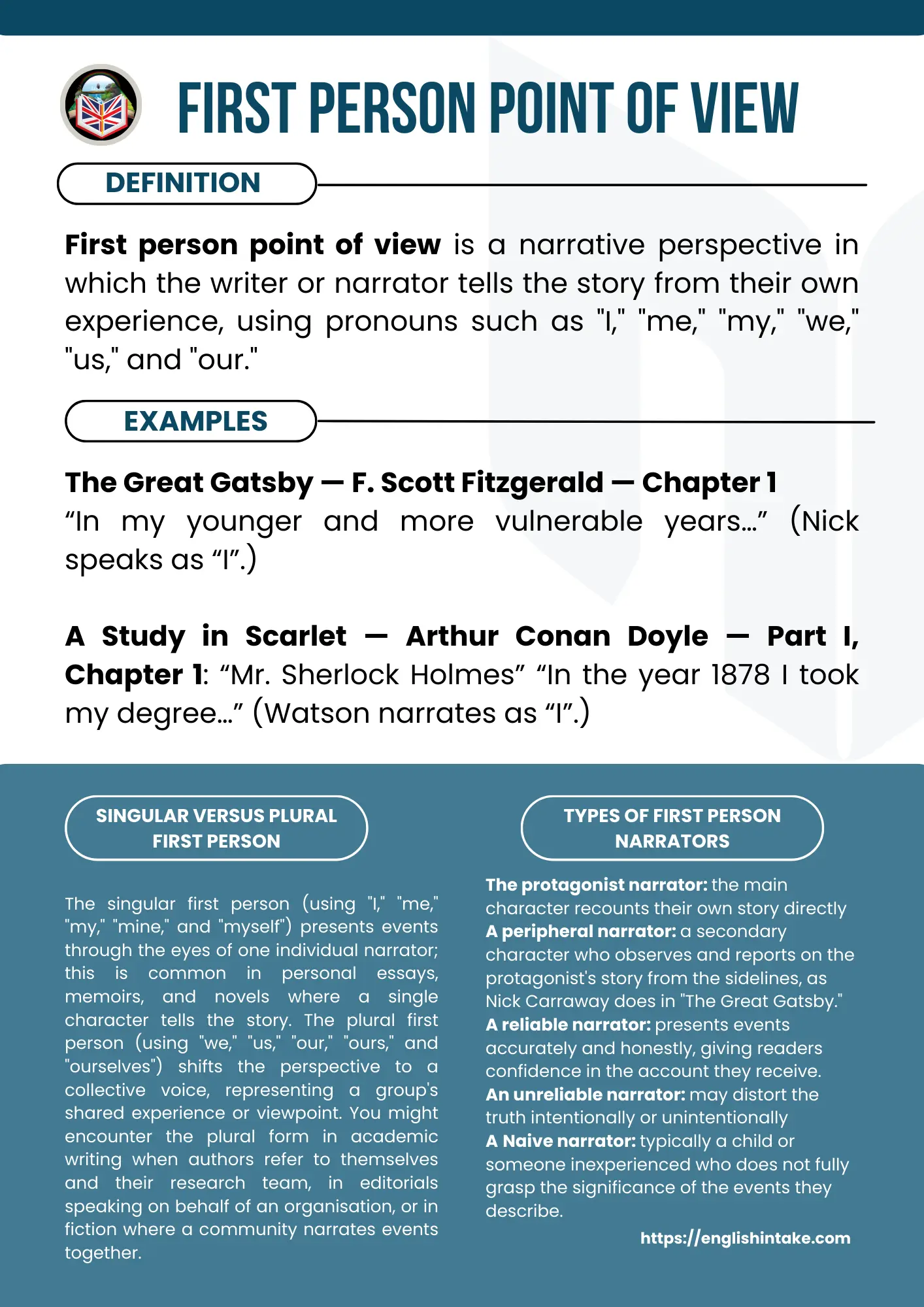
First person point of view is a narrative literary device in which the writer or narrator tells the story from their own experience, using pronouns such as "I," "me," "my," "we," "us," and "our." When you read or write in first person, you are essentially placing yourself inside the narrator's mind, experiencing the world through their eyes.
This perspective is considered the most natural way of storytelling because it mirrors how we communicate in everyday life. When you tell a friend about your weekend or explain how you felt during an important moment, you instinctively use first person.
1.1 The key pronouns of first person
Understanding which pronouns belong to first person is essential for identifying and using this point of view correctly. Here is a complete breakdown of first person pronouns and their grammatical functions:
| Type | Singular | Plural |
|---|---|---|
| Subject pronouns | I | we |
| Object pronouns | me | us |
| Possessive determiners | my | our |
| Possessive pronouns | mine | ours |
| Reflexive pronouns | myself | ourselves |
When you see these pronouns used by a narrator, you know you are reading first person point of view. The narrator is directly involved in the story they are telling.
2. How first person differs from other points of view
To truly understand first person, it helps to see how it contrasts with other narrative perspectives. Each point of view creates a different relationship between the reader, the narrator, and the story.
In first person, the narrator says "I walked to the park." In second person point of view, the narrator addresses the reader directly with "You walked to the park." Meanwhile, in third person point of view, an external narrator describes the action as "She walked to the park."
2.1 The intimacy factor
First person creates the most intimate reading experience because readers gain direct access to the narrator's thoughts, feelings, and interpretations. There is no intermediary between you and the character's inner world.
According to the Oregon State Guide to English Literary Terms, first person is fascinating because readers learn about the narrator both from the events of the story and from how the narrator chooses to tell that story. This dual layer of meaning makes first person uniquely powerful for character development.
3. Singular versus plural first person
First person can be expressed through singular pronouns (I, me, my) when one individual is narrating, or through plural pronouns (we, us, our) when the narrator speaks on behalf of a group.
The singular form is far more common in fiction. A single narrator tells their personal story, such as: "I remember the day I first arrived in London. My heart was pounding as I stepped off the train."
3.1 When "we" becomes the narrator
Plural first person is less common but creates a distinctive effect. The narrator speaks as part of a collective, which can represent a community, a family, or a group sharing a common experience.
A notable example is Jeffrey Eugenides' novel The Virgin Suicides, where the neighbourhood boys narrate as "we," creating a sense of shared memory and communal observation. This technique emphasises the collective nature of their experience rather than any single individual's perspective.
4. Types of first person narrators
Not all first person narrators function the same way in a story. Understanding the different types helps you recognise narrative techniques in your reading and make informed choices in your own writing.
4.1 First person central (or protagonist narrator)
In this most common form, the narrator is also the main character of the story. They tell their own story directly, sharing their experiences, thoughts, and emotional journey.
Charlotte Brontë's Jane Eyre exemplifies this approach. Jane narrates her life from childhood through adulthood, and the reader experiences every moment through her perspective. The story is entirely hers to tell.
4.2 First person peripheral (or observer narrator)
Sometimes the first person narrator is not the main character but rather a witness to the protagonist's story. This creates a layer of distance whilst still maintaining the intimacy of first person.
F. Scott Fitzgerald's The Great Gatsby demonstrates this technique brilliantly. Nick Carraway narrates in first person, but the true protagonist is Jay Gatsby. Nick observes and reports on Gatsby's story, providing his own interpretations and judgements whilst maintaining some mystery around the central character.
Arthur Conan Doyle used the same approach with Dr Watson narrating Sherlock Holmes' adventures. The detective remains somewhat enigmatic precisely because we see him through Watson's eyes rather than directly accessing his thoughts.
5. The unreliable narrator phenomenon
One of the most fascinating aspects of first person point of view is its potential for unreliability. Because readers only receive information filtered through the narrator's perspective, that narrator can be mistaken, biased, or even deliberately deceptive.
Literary critic Wayne C. Booth coined the term "unreliable narrator" in his 1961 book The Rhetoric of Fiction. He observed that a narrator's credibility can be compromised by various factors, from mental instability to deliberate manipulation.
5.1 Why all first person narrators are somewhat unreliable
To some extent, every first person narrator is unreliable. Human beings naturally filter experiences through their own beliefs, biases, and emotional states. No narrator can provide a completely objective account of events.
Consider how two people might describe the same party differently. One narrator might see an elegant gathering whilst another perceives an ostentatious display of wealth. Neither is lying; they simply interpret reality through different lenses.
5.2 Types of unreliable narrators
Literary scholar William Riggan identified several categories of unreliable first person narrators in his analysis. The "naïf" is a narrator whose youth or inexperience limits their understanding; think of Scout in To Kill a Mockingbird or Holden Caulfield in The Catcher in the Rye.
The "madman" narrator is unreliable due to psychological disturbance, as seen in Edgar Allan Poe's "The Tell-Tale Heart." The narrator insists upon their sanity whilst describing irrational actions, forcing readers to question everything they report.
Then there is the "liar," who deliberately misleads readers. Agatha Christie shocked readers in The Murder of Roger Ackroyd when the seemingly trustworthy first person narrator was revealed to be the murderer.
6. Advantages of writing in first person
Writers choose first person for specific narrative effects. Understanding these advantages helps you appreciate why an author made this choice and whether it suits your own writing projects.
6.1 Immediate emotional connection
First person creates an instant bond between reader and narrator. The use of "I" establishes a sense of confidentiality, as though the narrator is sharing their story directly with you. This makes readers care more deeply about the character's fate.
This emotional proximity is particularly valuable in genres like young adult fiction, romance, and memoir, where readers want to feel closely connected to the protagonist's emotional journey.
6.2 Authentic voice and personality
Because first person narration comes directly from a character, it allows their unique voice to permeate every sentence. Word choices, sentence rhythms, and observations all reflect the narrator's personality.
A sarcastic narrator will describe events with dry wit. A poetic narrator will notice beauty in unexpected places. A practical narrator will focus on concrete details. The narrative voice becomes an extension of characterisation.
6.3 Natural mystery and suspense
First person automatically limits what readers can know. They only have access to what the narrator experiences and understands. This limitation is perfect for mystery and thriller genres, where controlling information creates tension.
Readers cannot see around corners the narrator has not turned or know facts the narrator has not discovered. This shared discovery keeps readers engaged and turning pages.
7. Challenges and limitations of first person
Despite its strengths, first person point of view presents distinct challenges that writers must navigate carefully. Being aware of these pitfalls helps you avoid common mistakes.
7.1 The information bottleneck
Your narrator can only share what they know, see, and experience. If important events happen elsewhere, you must find creative ways to convey this information; perhaps through dialogue, letters, or the narrator hearing about events secondhand.
This constraint requires careful plotting. You cannot simply jump into another character's head to show their perspective or reveal information your narrator could not reasonably know.
7.2 The "I" trap
Beginning writers often struggle with sentence variety in first person. Starting every sentence with "I" becomes monotonous: "I walked to the door. I opened it. I saw my friend standing there."
Skilled writers vary their sentence structures to avoid this repetition. They might describe the environment, use dialogue, or begin sentences with different elements whilst maintaining the first person perspective throughout.
7.3 Showing versus telling
First person narration can tempt writers into excessive telling rather than showing. Because the narrator is recounting their experience, it becomes easy to fall into summary mode: "I was angry" rather than demonstrating that anger through action and dialogue.
Strong first person writing balances internal reflection with external action, allowing readers to experience scenes rather than simply receiving reports about them.
8. Using multiple first person narrators
Some stories feature more than one first person narrator, alternating between different characters' perspectives across chapters or sections. This technique combines the intimacy of first person with broader narrative scope.
8.1 Making multiple voices distinctive
The greatest challenge with multiple first person narrators is ensuring each voice is distinctly recognisable. If all your narrators sound the same, readers will struggle to remember whose perspective they are reading.
Each narrator should have their own vocabulary, speech patterns, observations, and emotional responses. A reader should be able to identify the narrator from the prose alone, without relying solely on chapter headings.
8.2 Avoiding repetition across narrators
When multiple narrators share a story, resist the temptation to show the same events from different perspectives unless this repetition serves a clear purpose. Each narrator's section should move the plot forward and provide new information.
The power of multiple viewpoints lies in showing different aspects of a story, not in redundant coverage of the same scenes.
9. First person in academic and formal writing
Beyond creative writing, first person has specific conventions in academic and professional contexts. Understanding these rules helps you navigate different writing situations appropriately.
9.1 Traditional restrictions
Academic writing has historically avoided first person pronouns. The reasoning was that third person creates a more objective, impersonal tone suitable for scholarly discourse. Phrases like "the researcher conducted" were preferred over "I conducted."
According to the University of North Carolina Writing Centre, this tradition stemmed from the belief that removing self-references would make writing clearer and more objective.
9.2 Changing attitudes
Many academic disciplines now accept or even encourage first person in certain contexts. Scientific papers increasingly use "we" when describing research methods. Reflective writing and personal statements require first person by nature.
The key is understanding your specific context. Check your assignment guidelines, disciplinary conventions, and instructor preferences. When first person is appropriate, use it purposefully rather than as filler; reserve "I" for moments when your personal perspective genuinely matters to the argument.
10. Famous examples of first person point of view
Studying how skilled authors use first person illuminates the technique's possibilities. These examples span different genres and demonstrate various approaches to first person narration.
10.1 Classic literature
Charlotte Brontë's Jane Eyre (1847) established many conventions of first person narration. Jane's voice is so distinctive that readers feel they know her personally, experiencing her struggles and triumphs as their own.
Herman Melville's Moby-Dick opens with one of literature's most famous first person declarations: "Call me Ishmael." This single sentence establishes the narrator's voice and invites readers into a personal relationship with the storyteller.
10.2 Modern and contemporary fiction
Suzanne Collins' The Hunger Games uses first person present tense to create immediacy. Readers experience each moment alongside Katniss, never knowing what will happen next because she does not know either.
Kazuo Ishiguro's Never Let Me Go demonstrates how first person can explore memory and reliability. The narrator Kathy's gradual revelations keep readers questioning what is true and what has been obscured by time and emotion.
11. Practical tips for writing in first person
Whether you are writing fiction, personal essays, or reflective pieces, these guidelines will help you use first person effectively.
11.1 Develop your narrator's voice
Before you begin writing, understand who your narrator is. Consider their background, education, personality, and emotional state. These factors should influence their vocabulary, sentence structure, and what they notice about the world around them.
A scientist narrator might describe a sunset in terms of light wavelengths. A poet might focus on colours and emotions. Let your narrator's character shape every word choice.
11.2 Balance interiority and action
First person excels at revealing inner thoughts, but a story cannot live entirely inside a character's head. Alternate between reflection and action, ensuring your narrative moves forward whilst maintaining the intimate voice first person provides.
Use the narrator's internal responses to deepen external events rather than replacing them.
11.3 Stay consistent with your narrator's knowledge
Your narrator cannot know what other characters are thinking unless those characters express themselves through dialogue or action. Avoid the temptation to slip into other characters' minds or reveal information your narrator could not possess.
This limitation requires discipline but ultimately strengthens your narrative by maintaining credibility and building mystery.
12. Common mistakes to avoid
Even experienced writers can fall into these traps when working in first person. Being aware of these pitfalls helps you write stronger, more polished narratives.
12.1 Head-hopping
Stay within your narrator's perspective throughout each scene. Jumping into other characters' thoughts mid-scene breaks the first person contract with readers and creates confusion.
If you need multiple perspectives, use clear breaks between sections or chapters, ensuring readers always know whose "I" they are reading.
12.2 Awkward self-description
Having a first person narrator describe their own appearance often feels forced. The classic "I looked in the mirror and saw my blue eyes and blonde hair" approach is clichéd and unnatural; people rarely catalogue their own features this way.
Instead, weave physical details naturally through action, dialogue, or other characters' reactions. Or simply leave some details to readers' imagination.
12.3 Inconsistent voice
Your narrator's voice should remain consistent throughout the narrative. If they speak informally in chapter one, they should not suddenly become formal in chapter five without explanation.
This does not mean the voice cannot evolve; a narrator telling a story years later might reflect differently on past events. But unexplained shifts in voice undermine credibility.
13. Conclusion
First person point of view remains one of the most powerful tools available to writers precisely because it mirrors how humans naturally share experiences. When you tell someone about your day, you do not narrate in third person; you say "I did this" and "I felt that."
This naturalness creates immediate connection with readers, drawing them into the narrator's world and making them care about what happens next. The limitations of first person; the restricted knowledge, the subjective interpretations, the potential unreliability; are not weaknesses but features that skilled writers exploit for narrative effect.
Whether you are reading classic literature, contemporary fiction, or writing your own stories, understanding how first person point of view functions will deepen both your appreciation and your craft. The "I" that opens a narrative is an invitation into another consciousness, and accepting that invitation is one of reading's greatest pleasures.