
1. What are reciprocal pronouns?
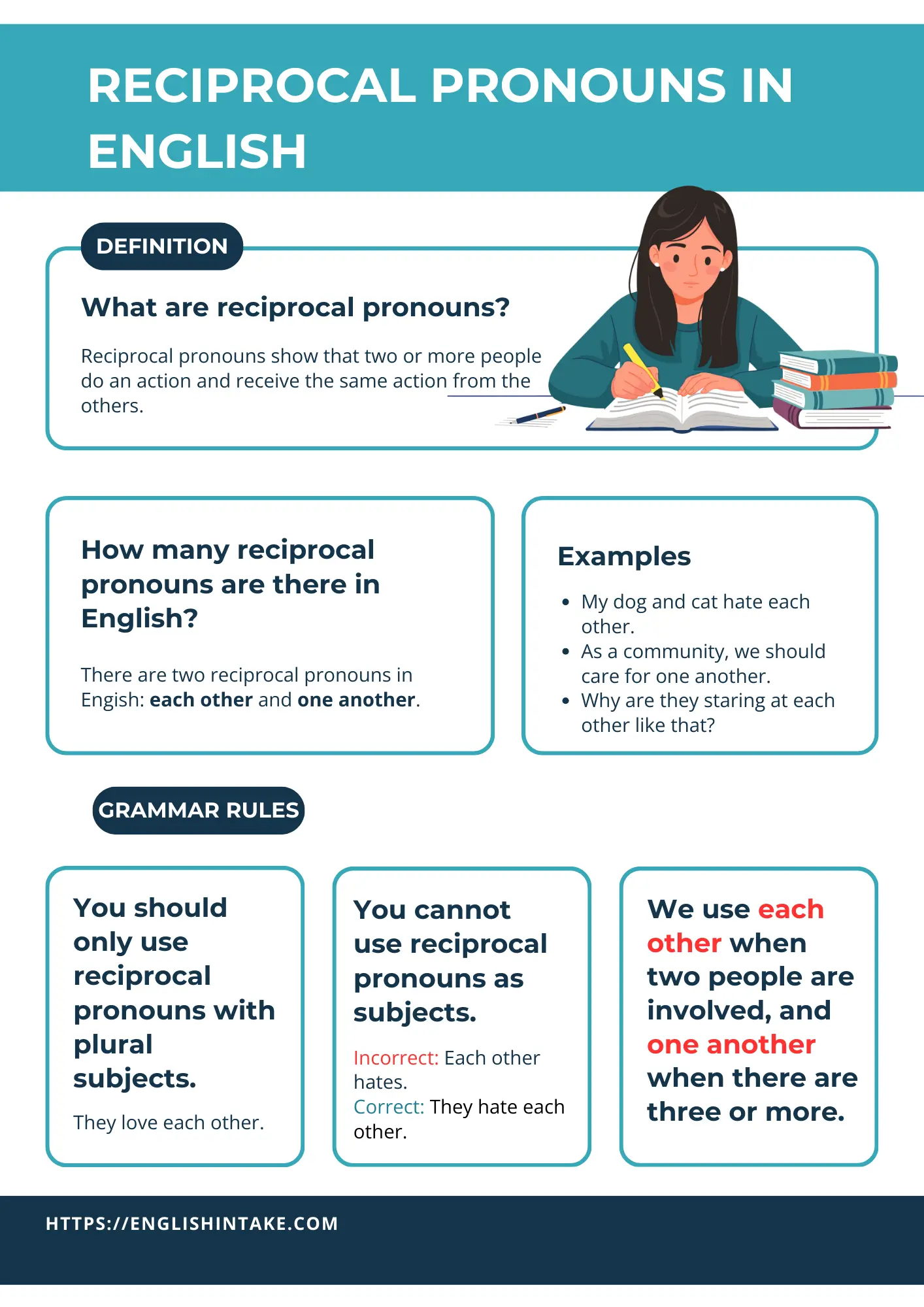
Reciprocal pronouns show that two or more people do an action and receive the same action from the others.
There are two reciprocal pronouns in English:
- each other
- one another
They mean the same thing and can be used interchangeably. In this lesson, we will look at example sentences and grammar rules to help you use them correctly.
2. How to use reciprocal pronouns in sentences?
2.1 Positive sentences
When Lucas helped George, and George helped Lucas, we say:
Lucas and George helped each other.
Other examples:
- I saw Mary and her boyfriend exchanging Christmas cards with each other this morning.
- A. Are they still mad at each other? B. I think so. They haven’t spoken to each other for days.
- The students looked at one another when the teacher started to sing.
2.2 Possessive case
We can use reciprocal pronouns in possessive forms.
- I think it’s not a good idea to ask students to mark each other’s papers.
- My mother is a lawyer. My father is a police officer. They hate each other’s work. (My mother hates my father’s work. My father hates my mother’s work.)
- People usually compare one another’s success.
2.3 Negative sentences
We can use reciprocal pronouns in negative sentences.
- My girlfriend and I do not look at each other’s phones.
- There was a couple on the train yesterday. They looked madly in love. Suddenly, they had an argument and hadn’t spoken to each other since then.
- My dog and cat do not love each other.
- People in this neighbourhood do not care with one another.
3. Grammar rules
1. Normally, we use each other when only two people are involved. For example, Peter and Mary love each other.
When three or more people are involved, we use one another. For example, I have three sisters, and we borrow one another’s clothes.
This distinction is recognised by grammar experts, but in everyday conversation, native speakers use the two reciprocal pronouns interchangeably.
2. Reciprocal pronouns are always used with plural subjects because they describe actions that happen between two or more people. You cannot use them with a singular subject, since the idea of reciprocity requires at least two participants.
- Emma and Julia call each other every day.
- The cat and the dog stared at each other.
- My parents love each other.
- The children exchanged Christmas gifts with one another
- I have always told my children to love one another even when I am no longer part of this world. In this sentence, the reciprocal pronoun each other refers to the plural subject children, not to I.
3. You cannot use reciprocal pronouns as subjects.
4. Exercises
Fill in the blanks with the correct reciprocal pronouns. Pay attention to the grammar rules we have seen in the previous section.
1. Emma and Jack might be in love with . I always see them smiling at in the office.
2. Three inmates escaped from New Orleans prison. When they were caught, they blamed .
3. I was on my way to Paris when I saw two truck drivers involved in a road rage incident. They didn’t dare to fight. They were just staring at angrily.
4. After years of conflict in the early 20th century, France and Germany worked hard to rebuild diplomatic trust. Today, they visit cities for official meetings and exchange ambassadors to strengthen their partnership.
5. The twins know better than anyone else.
6. Vice Admiral Horatio Nelson led the British fleet to fight at the Battle of Trafalgar. As the ships advanced into combat, the soldiers encouraged to be brave.
7. Lily and her brother promised to support no matter what happened.
8. In the reign of King Jehoshaphat of Judah, the armies of Ammon, Moab, and Mount Seir formed an alliance to attack Jerusalem. But as Judah began to praise the Lord, God caused the allied forces to start fighting with .
9. During the time of Gideon, God caused confusion among the Midianite army. When Gideon’s 300 men blew their trumpets, the Midianites panicked in the dark and turned their swords against .
10. During the Wars of the Diadochi, some sources reported that a dust storm caused some soldiers to accidentally attack as they were unable to distinguish their friends from their enemies.