
1. What are stative verbs?
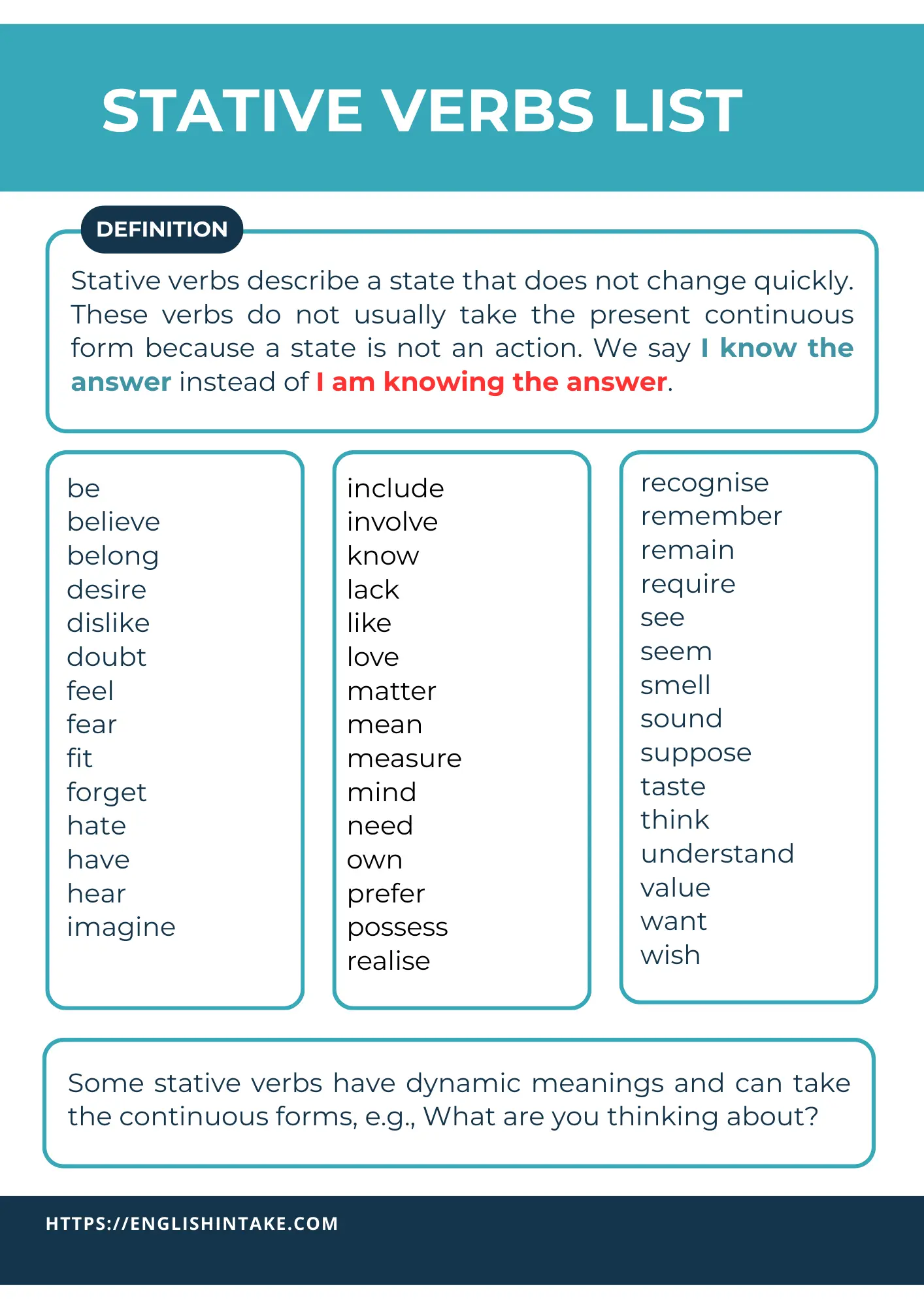
Stative verbs describe a state that does not change quickly. They express how you think, how you feel, what you own, or how things appear. These verbs do not usually take the present continuous form because a state is not an action. We say I know the answer instead of I am knowing the answer.
However, some stative verbs have dynamic meanings and can be used in continuous forms. We will look at this later in this post. Here is a stative verbs list that we are going to learn in this grammar lesson.
- be
- believe
- belong
- desire
- dislike
- doubt
- feel
- fear
- fit
- forget
- hate
- have
- hear
- imagine
- include
- involve
- know
- lack
- like
- love
- matter
- mean
- measure
- mind
- need
- own
- prefer
- possess
- realise
- recognise
- remember
- remain
- require
- see
- seem
- smell
- sound
- suppose
- taste
- think
- understand
- value
- want
- wish
2. Stative verbs list by category
2.1 Thought and knowledge
You can use the following verbs when you want to talk about what you think, know, believe, or understand.
believeI believe in God.
I don’t believe what you’re saying.
knowI know who stole your phone.
I know what she wants.
understandI understand you.
Now I understand what he was trying to say.
thinkI think this is a good idea.
Do you think the test was difficult?
forgetI always forget his name.
Don’t forget your keys on the table.
rememberI still remember the first day we met.
I remember it now.
realiseI realise that I made a mistake.
She didn’t realise how late it was.
recogniseI didn’t recognise him with his new haircut.
Do you recognise this song?
meanWhat does this word mean?
I didn’t mean to hurt you.
supposeI suppose you are busy today.
I suppose we should leave early.
imagineCan you imagine the struggle your father had when he was poor?
I often imagine myself being rich one day.
doubtI doubt he will arrive on time.
Do you doubt my explanation?
considerI consider this a serious problem.
I consider her a reliable person.
guessI guess he is about thirty years old.
Can you guess the correct answer?
figureI can’t figure it out.
I finally figured out the way to solve this Rubik's puzzle.
2.2 Feelings and attitudes
The following list of stative verbs express feelings and attitudes.
loveI love you so much.
They love each other.
likeI like spending time by myself.
My son likes learning new languages.
dislikeWhat I dislike the most during my time in the military is waking up too early.
He dislikes the taste of coffee.
hateI hate being late for appointments.
I think she hates me.
preferI prefer tea to coffee.
My father prefers staying home on weekends.
wantI want ice cream.
Do you want something to drink?
desireHe desires a peaceful life in the countryside.
I desire nothing more than being with you.
fearI fear we may be too late.
She fears losing her job.
appreciateI appreciate your honesty.
We appreciate everything you have done for us.
valueI value your opinion.
They don’t value my work much.
careI care about you.
I don’t care what people think about me.
mindI don’t mind waiting a few minutes.
Do you mind if I open the window?
wishI wish I could stay longer, but I have to go now.
I wish I were rich
2.3 Necessity
Use these stative verbs when you want to talk about needs and requirements.
needI need more time to finish this task.
I need you by my side during this difficult time.
requireThis task requires full attention.
The position requires strong communication skills.
2.4 Senses and appearance
You can use the following verbs when you talk about what something looks like, tastes like, or smells like.
seeI see nothing here.
Do you see what I mean?
hearI hear footsteps outside the door.
I hear you.
smellDo I smell good?
This room smells a bit musty today.
tasteThis soup tastes horrible.
How does it taste?
feelI feel tired now.
He feels confident about the presentation.
lookYou look great.
He looks handsome.
soundThis headphone sounds great.
How does the new headphone sound?
appearShe appears nervous in front of the crowd.
It appears that nobody here realises how dangerous HIV is.
seemYou seem happier today.
The instructions seem unclear.
2.5 Possession
You can use the following verbs when you want to talk about what belongs to you.
haveI have a meeting this afternoon.
Do you have everything you need for the trip?
ownI own a small apartment near the city centre.
My sister owns several vintage cameras.
possessThis guy possesses great musical talent.
It appears that all candidates possess the skills required for the job.
includeThe price includes breakfast.
The list in this lesson includes virtually all stative verbs in English.
containWhere have you put the box that contains my jewellery?
This bottle contains holy water from Lourdes.
consistThe committee consists of five members.
Her job consists mainly of answering emails.
lackI still lack experience in Python programming.
My son lacks patience.
oweI still owe you 10$.
My uncle owes a lot of money to the bank.
2.6 Measurement and comparison
The list below contains stative verbs that can be used to talk about weight, cost, or other fixed measures.
costThe jacket costs fifty euros.
It costs more than I expected.
weighThe package weighs almost two kilos.
Your suitcase weighs more than the limit.
measureThe room measures twelve metres across.
This table measures exactly one metre wide.
equalTwo plus two equals four.
Your responsibilities equal your capabilities.
fitThe new cover fits the sofa perfectly.
These shoes fit me better than the others.
matchI want to buy curtains that match the colour of the walls.
Your description matches what he told me.
2.7 Existence and relationships
To show that something exists or to describe how things are related, you can use the following stative verbs.
beI am here to help you.
The instructions are simple to follow.
existGod exists.
Female genital mutilation still exists in some parts of Africa.
remainThe results remain unchanged after several tests.
He remained calm during the operation.
dependYour success depends on consistent practice.
The outcome depends on several factors.
concernYour well being concerns me a lot.
This decision concerns the entire team.
involveThe project involves several stages of review.
Her role involves working with international clients.
belongThis pen belongs to me.
My life belongs to God.
matterOf course, your success matters to me.
It does not matter what others think.
3. Stative verbs that can be used in progressive forms
Some stative verbs can be both stative and active. The meaning changes when you use them in the continuous forms.
I’m going to give you a some example sentences to help you understand what I’m talking about.
- think (opinion): I think you are right.
thinking (mental process): What are you thinking about? - have (possession): I have a car.
having (action): I am having lunch. - see (perceive): I see what you mean.
seeing (meet): I am seeing a doctor tomorrow. - feel (have an opinion): I feel that this plan is risky.
feeling (physical touch): I am feeling something rough under my feet.
4. Stative verbs list in alphabetical order
Glossary of common stative verbs with definitions and examples
to feel respect or approval for someone or something
I admire your patience.
adoreto feel deep love or strong affection
She adores her little nephew.
agreeto share the same opinion as someone else
I agree with your plan.
appearto seem or give the impression of something
He appears tired today.
appreciateto value something or understand its importance
I appreciate your help.
approveto believe something is good or acceptable
They approve of the new rules.
to exist or to describe a state or condition
I am happy today.
believeto think something is true
I believe you are right.
belongto be the property of someone or something
This book belongs to me.
careto feel concern or interest
I care about your progress.
concernto matter or be important to someone
Your safety concerns me.
considerto have an opinion about something
I consider this a good opportunity.
containto hold inside
The box contains old photos.
costto have a specific price
The shirt costs twenty euros.
to be worthy of something
You deserve a break.
desireto want something strongly
I desire a peaceful life.
detestto dislike something very strongly
I detest waiting in long lines.
disagreeto not share the same opinion
I disagree with this decision.
disliketo not like something
She dislikes cold weather.
doubtto feel uncertain about something
I doubt he will come.
to take pleasure in something
I enjoy listening to music.
estimateto form a rough idea or judgment
I estimate the project will take two weeks.
expectto believe something will happen
I expect good results.
existto be real or present
This rule still exists.
to like or want something
I fancy a cup of tea with my loved ones.
fearto feel afraid of something
I fear the situation may get worse.
feelto experience an emotion or physical state
I feel tired today.
fitto be the right size or shape
The shoes you bought me yesterday fit me well.
forgetto fail to remember something
I forgot the date.
to feel strong dislike
I hate chocolate.
haveto possess or own something
I have a new laptop.
hearto notice sound
I hear someone outside.
hopeto want something to happen
I hope things improve soon.
to form an idea or picture in your mind
I imagine the day will be busy.
impressto cause admiration or respect
The presentation impressed me.
includeto contain something as part of a whole
The price includes breakfast.
involveto include something as a necessary part
The job involves teamwork.
knowto be aware of or familiar with something
I know the answer.
to not have enough of something
The new appointee lacks experience.
liketo enjoy or feel pleased with something
I like this idea.
loveto feel deep affection for someone or something
I love my family.
to be important
Your well being matters to me.
meanto express or intend something
I mean what I said.
measureto have a specific size
The room measures ten metres.
mindto object or worry about something
I do not mind the noise.
to require something
I need more time.
to be in debt to someone
I owe you an explanation.
ownto possess something
They own three houses.
to understand or interpret something in a particular way
I perceive a change in his attitude.
possessto have or own something
She possesses great talent.
preferto choose one thing over another
I prefer quiet environments.
to become aware of something
I realise the mistake now.
recogniseto know someone or something by sight or experience
I recognise her face.
rememberto recall something from the past
I remember the meeting.
resembleto look similar to someone or something
He resembles his father.
remainto stay in the same state or condition
The situation remains unclear.
requireto need something
The task requires patience.
to notice something with your eyes
I see a bird outside.
seemto appear a certain way
You seem worried.
smellto notice a scent
I smell fresh bread.
soundto appear a certain way based on what you hear
Your idea sounds interesting.
supposeto think something is true without certainty
I suppose you are right.
to have a particular flavour
The soup tastes good.
thinkto have an opinion
I think this is a good idea.
to know the meaning of something
I understand your concern.
to consider something important
I value your honesty.
to wish for something
I want a new notebook.
wishto hope something will happen
I wish you the best.