
Many students do not know how to use a semicolon in a sentence. A semicolon ( ; ) makes a pause that is longer than a comma, but shorter than a full stop. It links two ideas that are closely related without separating them into two sentences.
Before looking at the rules, you need to understand what an independent clause is. An independent clause is a group of words that contains a subject and a verb and expresses a complete thought. It can stand alone as a sentence. A correct use of a semicolon involves at least one independent clause on each side.
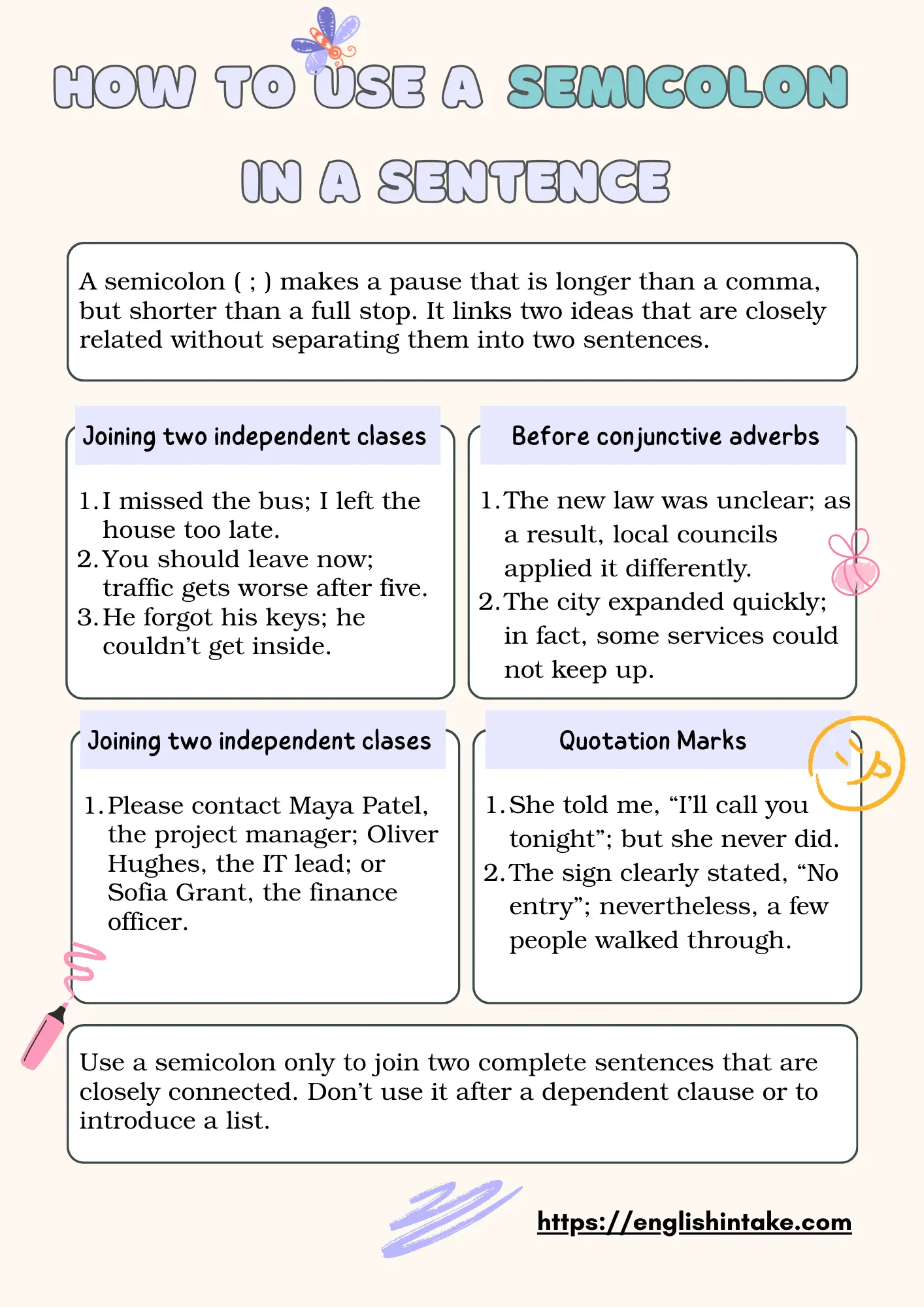
1. Joining two independent clauses (no conjunction)
The most common way to use a semicolon in a sentence is to connect two related independent clauses when there is no coordinating conjunction (and, but, or, so, for, nor, yet) between them. The two clauses must be clearly related in meaning.
If you can replace the semicolon with a full stop and the sentence still makes sense, you are using it correctly.
| Example | Why it works |
|---|---|
| I bought a new laptop; my old one was too slow. | Both clauses are complete. The second explains the first. |
| Lock all the doors before leaving; safety should always be a priority. | The second clause gives the reason for the first. |
| Invest in high-quality tools; they last longer and perform better. | The second clause builds on the advice in the first. |
| The marketing campaign was a success; customer enquiries increased significantly. | The second clause provides evidence for the first. |
In each case, you could put a full stop where the semicolon is. The semicolon simply signals that the ideas are more tightly connected than a full stop would suggest.
You should never use a capital letter after a semicolon unless the word that follows is a proper noun. Unlike a full stop, a semicolon does not end the sentence; the two clauses remain part of the same sentence.
2.1 The comma splice problem
One of the most common errors in English writing is the comma splice. It occurs when you use a comma to join two independent clauses.
| Incorrect (comma splice) | Correct (semicolon) |
|---|---|
| The cow is brown, it is also old. | The cow is brown; it is also old. |
| I like cows, however, I hate the way they smell. | I like cows; however, I hate the way they smell. |
| She's a little bit country, he's a little bit rock 'n' roll. | She's a little bit country; he's a little bit rock 'n' roll. |
A comma on its own is not strong enough to join two independent clauses. As I said before, if you have two complete thoughts and no conjunction between them, you need either a semicolon or a full stop.
2. How to use a semicolon with conjunctive adverbs?
When you use a conjunctive adverb (however, therefore, moreover, consequently, furthermore, nevertheless, thus, in fact, in other words, as a result.) to connect two independent clauses, place a semicolon before it and a comma after it.
The pattern looks like this: independent clause + ; + conjunctive adverb + , + independent clause.
| Example | Conjunctive adverb |
|---|---|
| Technological advancements have greatly improved communication; however, they have also introduced new privacy concerns. | however |
| Electric vehicles are becoming more popular; consequently, several major manufacturers are moving towards greener technologies. | consequently |
| Space travel has become more feasible; nevertheless, it remains risky and expensive. | nevertheless |
| Harvey is a good driver; moreover, he is a friendly one. | moreover |
| It rained heavily during the afternoon; however, we managed to have our picnic anyway. | however |
Many students confuse conjunctive adverbs with coordinating conjunctions. Words like and, but, or, so, and yet are coordinating conjunctions. With those, you use a comma, not a semicolon. Conjunctive adverbs (however, therefore, moreover...) require a semicolon before them. Do not mix these.
Sometimes the conjunctive adverb does not appear at the beginning of the second clause. It may appear in the middle or at the end. In that case, the semicolon still goes between the two independent clauses, and the adverb is set off by commas within its own clause.
For example: The man pleaded innocent; his face, however, looked as guilty as sin. The semicolon separates the two clauses, and however is tucked inside the second clause, surrounded by commas.
3. Complex lists
- I need bread, milk, and eggs.
- She bought apples, bananas, and oranges.
- We visited Paris, Rome, and Madrid.
- Please bring a pen, a notebook, and your ID.
- He likes swimming, running, and cycling.
- They sell coffee, tea, and hot chocolate.
- For breakfast, I had yoghurt, fruit, and toast.
When each item in the list already contains commas of its own, adding more commas to separate the items creates confusion. In those cases, you replace the commas between items with semicolons.
| Confusing (commas only) | Clear (semicolons between items) |
|---|---|
| I bought shiny, ripe apples, small, sweet, juicy grapes, and firm pears. | I bought shiny, ripe apples; small, sweet, juicy grapes; and firm pears. |
| Classic science fiction sagas are Star Trek, with Mr Spock and his large pointed ears, Battlestar Galactica, with its Cylon Raiders, and Star Wars, with Han Solo, Luke Skywalker, and Darth Vader. | Classic science fiction sagas are Star Trek, with Mr Spock and his large pointed ears; Battlestar Galactica, with its Cylon Raiders; and Star Wars, with Han Solo, Luke Skywalker, and Darth Vader. |
| The planned itinerary was either London, Paris, Rome, Paris, Rome, London, or Rome, London, Paris. | The planned itinerary was either London, Paris, Rome; Paris, Rome, London; or Rome, London, Paris. |
You can also use this rule in formal writing when listing people with their titles or roles. For example: The panel includes Dr Emily Clark, a researcher in environmental science; Mr Alan Smith, CEO of Tech Innovators; and Ms Rebecca Lee, founder of Green Solutions. The semicolons make clear where one person's description ends and the next person begins.
This rule comes up regularly with geographical lists, since place names often already contain commas between the city and the country or state. For example: We visited Washington, D.C., in the autumn; Dover, Illinois, in the spring; and Cooperstown, New York, in the middle of a very hot summer. Without the semicolons, the reader has no easy way to tell how many destinations there were.
4. Usage with quotation marks
When a semicolon falls at the end of a clause that contains a quotation, place the semicolon outside the closing quotation marks. This is the opposite of how a comma or full stop behaves in British English, so it is worth paying attention to.
| Example |
|---|
| My father once told me, "One day, we'll be rich"; however, I didn't believe him. |
| He whispered, "Everything will be fine"; yet, I couldn't help feeling anxious. |
| The doctor insisted, "You need to stop smoking, or your condition will worsen"; nonetheless, he kept lighting up. |
| He said, "I love you"; she replied, "I love you too." |
The logic here is straightforward: the semicolon belongs to the sentence structure, not to the quoted material. It shows the relationship between the two independent clauses, so it sits outside the quotation that forms part of the first clause.
5. Before a coordinating conjunction in a complicated sentence
Normally, two independent clauses joined by a coordinating conjunction (and, but, or, etc.) take a comma before the conjunction. However, if the clauses are long or already contain commas, a semicolon before the conjunction improves readability. Here are some examples.
- We can meet on Friday afternoon, after your lesson ends, and review the plan; or we can wait until Monday and do it properly.
- I wanted to call you earlier, but my phone died on the bus, in the rain; and I didn’t have a charger with me.
- The project needs a clear timeline, a budget, and a person in charge; and it also needs weekly check-ins so nothing slips.
- She tried the blue dress, the black one, and the green one; but none of them felt comfortable enough for the event.
- You can send the files by email, through the shared folder, or by WeTransfer; or you can bring them on a USB stick tomorrow.
- We planned to leave at six, before the traffic starts, and stop for petrol on the way; yet we still arrived late.
6. When not to use a semicolon
Knowing what to avoid is just as important as knowing the rules. These are the errors I see most often, including from advanced learners who are comfortable with the basics.
| Incorrect use | Why it's wrong | Correct version |
|---|---|---|
| There are three colours on the Italian flag; green, white, and red. | A list introduced by an independent clause takes a colon, not a semicolon. | There are three colours on the Italian flag: green, white, and red. |
| After we went to get a pizza; we fell asleep. | "After we went to get a pizza" is a dependent clause, not an independent one. Both sides of a semicolon must be able to stand alone. | After we went to get a pizza, we fell asleep. |
| This assignment is extra credit only; but we still need to hand it in. | You cannot use both a semicolon and a coordinating conjunction (but) between two simple clauses. Use one or the other. | This assignment is extra credit only, but we still need to hand it in. OR: This assignment is extra credit only; we still need to hand it in. |
| Although Nate is a kind employee; that new guy is not. | "Although Nate is a kind employee" is a dependent clause. A semicolon cannot follow it. | Although Nate is a kind employee, that new guy is not. |
A colon introduces something: a list, an explanation, or a quotation. A semicolon links two independent clauses of equal standing.
7. Common mistakes to avoid
Here are some common errors that student often make.
| Mistake | What went wrong | Fix |
|---|---|---|
| The conference was productive; furthermore the team agreed on a deadline. | Missing comma after the conjunctive adverb. | The conference was productive; furthermore, the team agreed on a deadline. |
| She loves cooking, however, she rarely has time for it during the week. | A comma before a conjunctive adverb creates a comma splice. A semicolon is required before however. | She loves cooking; however, she rarely has time for it during the week. |
| He trained for months; and he won the competition. | Do not use both a semicolon and a coordinating conjunction when the clauses are short and straightforward. Use one or the other. | He trained for months, and he won the competition. OR: He trained for months; he won the competition. |
| The flight was delayed; fortunately we had brought enough snacks. | No comma after "fortunately", which acts as a transitional adverb and must be followed by a comma. | The flight was delayed; fortunately, we had brought enough snacks. |
8. Summary of the four main uses of a semicolon in a sentence
| Use | Pattern | Example |
|---|---|---|
| Joining two related independent clauses (no conjunction) | Clause ; clause. | I bought a new laptop; my old one was too slow. |
| Before a conjunctive adverb or transitional phrase | Clause ; however, clause. | Space travel has become more feasible; nevertheless, it remains risky. |
| Separating items in a complex list | Item one, detail; item two, detail; and item three. | I bought shiny, ripe apples; small, sweet grapes; and firm pears. |
| Before a coordinating conjunction when clauses already contain commas | Clause with commas ; but clause with commas. | She won't eat, run, or jump; nor will she go for a walk. |