
1. What is internal rhyme?
Internal rhyme (also called middle rhyme) is when words rhyme inside the same line of poetry, or in the middle of different lines. This is different from end rhyme, where the rhyming words come at the very end of lines.
Consider this simple example: "I went to town to buy a gown." The words "town" and "gown" rhyme within a single line rather than at separate line endings.
| Feature | Internal rhyme | End rhyme |
|---|---|---|
| Position | Within or across lines | At the end of lines |
| Visibility | Subtle, often unnoticed | Obvious and predictable |
| Effect | Creates musical flow | Creates clear structure |
| Pattern | No fixed pattern required | Usually follows AABB, ABAB, etc. |
3. Three types of internal rhyme
Internal rhyme manifests in three distinct patterns, each producing different effects. Understanding these types will help you identify internal rhyme examples in poetry and songs more easily.
3.1 Within the same line
This is the most common form of internal rhyme. Two or more words rhyme within a single line of verse. The rhyming words are close together, creating an immediate echo effect.
Example: "The fair breeze blew, the white foam flew." In Samuel Taylor Coleridge's "The Rime of the Ancient Mariner," "blew" and "flew" appear in the same line, binding the images of wind and sea together.
3.2 Between middle words of separate lines
Here, a word in the middle of one line rhymes with a word in the middle of another line. This type creates a connection across verses that readers might only feel subconsciously.
Example from John Bunyan's "To Be a Pilgrim": "Let him in constancy follow the Master. / There's no discouragement shall make him once relent." The internal words create a rhythmic thread throughout the stanza.
3.3 Between the end and middle words
In this pattern, the last word of one line rhymes with a word in the middle of the following line. This pulls the reader forward from one line to the next, creating momentum.
Example from Poe's "The Raven": "While I nodded, nearly napping, suddenly there came a tapping, / As of some one gently rapping, rapping at my chamber door." The word "napping" at the line's midpoint connects to "tapping" and "rapping," which appear both internally and at the line break.
4. Internal rhyme examples in classic poetry
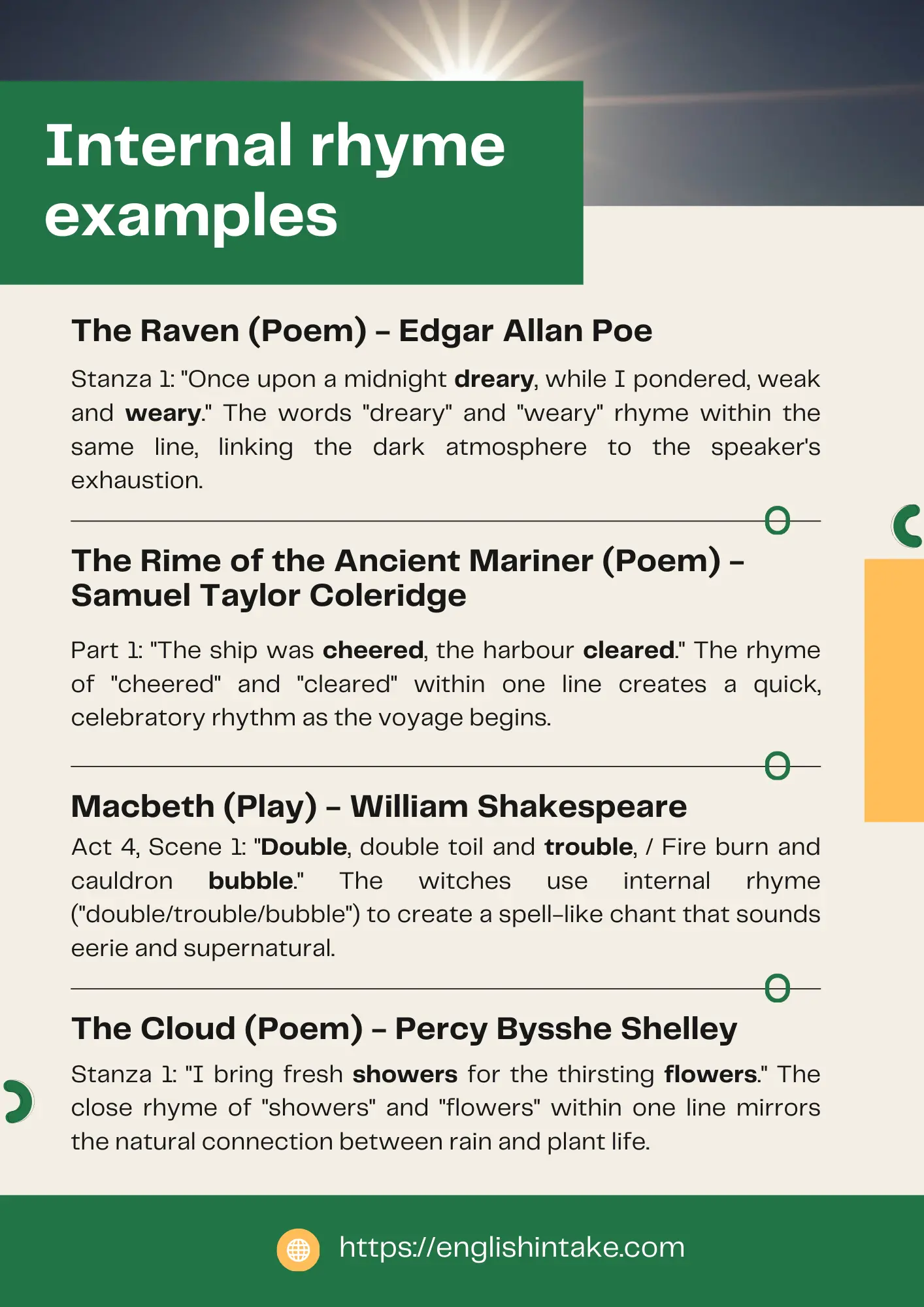
Classic poets often used internal rhyme to enhance mood, emphasise meaning, and create memorable lines. Below are some of the finest internal rhyme examples from literary history.
4.1 Edgar Allan Poe: "The Raven"
Poe is perhaps the undisputed master of internal rhyme. In "The Raven," he uses the technique relentlessly to build an atmosphere of dread and obsession. The opening line alone demonstrates his skill: "Once upon a midnight dreary, while I pondered, weak and weary."
Later in the poem, Poe writes: "Ah, distinctly I remember it was in the bleak December." Here, "remember" and "December" create a haunting echo that reinforces the speaker's painful recollections. The internal rhymes throughout the poem draw attention to key emotional words whilst maintaining a hypnotic rhythm.
4.2 Samuel Taylor Coleridge: "The Rime of the Ancient Mariner"
Coleridge filled this narrative poem with internal rhymes that give it a song-like quality. Consider: "The ship was cheered, the harbour cleared." The rhyme of "cheered" and "cleared" makes this line feel celebratory and swift.
Another striking example: "We were the first that ever burst / Into that silent sea." The internal rhyme of "first" and "burst" emphasises the sailors' groundbreaking voyage into unknown waters.
4.3 Percy Bysshe Shelley: "The Cloud"
Shelley opens his poem with a memorable internal rhyme: "I bring fresh showers for the thirsting flowers." The close rhyme of "showers" and "flowers" immediately establishes a natural, flowing rhythm that matches the cloud's gentle movement.
4.4 William Shakespeare: Macbeth
The witches' famous chant relies heavily on internal rhyme to create an eerie, incantatory effect: "Double, double toil and trouble, / Fire burn and cauldron bubble." The rhymes "double/trouble/bubble" work both internally and at line ends, producing a spell-like rhythm that has captivated audiences for centuries.
5. Internal rhyme examples in songs and rap
Internal rhyme is not confined to poetry; it flourishes in music. Song lyrics and rap verses rely on internal rhyme to create memorable hooks and showcase lyrical dexterity.
5.1 Classic rock and pop
Journey's "Don't Stop Believin'" contains a famous internal rhyme: "Some will win, some will lose, some were born to sing the blues." The words "win" and "sing" create an internal connection that makes this line particularly satisfying to sing along to.
Cole Porter's swing-era classic "Don't Fence Me In" demonstrates the technique beautifully: "Just turn me loose, let me straddle my old saddle, / Underneath the western skies." The playful rhyme of "loose" paired with the assonance throughout creates a sense of freedom and movement.
5.2 Hip-hop and rap
Rap music has elevated internal rhyme to an art form. The Sugarhill Gang's 1979 track "Rapper's Delight" features: "I'm six-foot-one and I'm tons of fun / And I dress to a T." Here, "one" and "fun" rhyme internally, setting the tone for hip-hop's emphasis on complex rhyme patterns.
Rakim, widely considered one of the greatest lyricists in hip-hop, showcased dense internal rhymes in "My Melody": "My unusual style will confuse you a while." Contemporary artists like Eminem have built their reputations on intricate internal rhyme schemes that challenge listeners to keep up.
6. Simple internal rhyme examples for beginners
If you are learning English or just starting to explore poetry, here are some straightforward internal rhyme examples to practise with. These sentences demonstrate the technique in clear, accessible language.
"I had a cat who wore a hat."
"The bee flew free across the sea."
"I took the car and drove so far."
"At my school, there is a golden rule."
"I lost my dog in the midst of fog."
Notice how the rhyming words in each sentence share the same vowel and final consonant sounds. This is what creates the satisfying echo that makes internal rhyme so effective.
7. Why poets and songwriters use internal rhyme
Writers choose internal rhyme for several important reasons. Understanding these purposes will deepen your appreciation of the technique when you encounter it.
To create musicality: Internal rhyme adds a melodic quality that makes writing more pleasant to hear. The echoing sounds create rhythm without relying on a strict metre, allowing for natural speech patterns whilst maintaining a musical feel.
To emphasise connections: When two words rhyme, readers instinctively connect their meanings. Poets use this to link images, emotions, or ideas. In Poe's "dreary/weary," the rhyme reinforces that the speaker's exhaustion is tied to the bleak atmosphere.
To aid memory: Rhyme makes text easier to remember. This is why advertising jingles, nursery rhymes, and folk songs frequently employ internal rhyme. The echoing sounds lodge in our memory more readily than plain prose.
To create subtlety: Unlike end rhyme, which announces itself loudly, internal rhyme works beneath the surface. Modern poets who want rhythm without obvious rhyme schemes often prefer this technique. It provides musicality without feeling old-fashioned or predictable.
8. Identification
Spotting internal rhyme requires careful reading and, ideally, reading aloud. Here is a practical method to find internal rhymes in any text.
Step one: Read the line or verse slowly, paying attention to the sounds of each word. Listen for words that share similar ending sounds, particularly vowel and consonant combinations.
Step two: Check the position of the rhyming words. If they both appear within a single line, or if they appear in the middle portions of different lines (not at the very end), you have found an internal rhyme.
Step three: Consider whether the rhyme is exact (perfect rhyme) or approximate (slant rhyme). Perfect internal rhymes share identical sounds, like "bright" and "light." Slant rhymes share similar but not identical sounds, like "bridge" and "grudge."
9. Line breaks
The distinction between internal rhyme and end rhyme often comes down to where poets place their line breaks. The same rhyming words can function as either type depending on the formatting.
Consider this as a single line: "I went to town to buy a gown and then came back around." Here, "town" and "gown" form an internal rhyme because they sit within one continuous line.
Now consider the same words split differently:
"I went to town
To buy a gown
And then came back around."
With line breaks after each rhyming word, "town" and "gown" become end rhymes instead. Poets make deliberate choices about line breaks to control whether rhymes feel obvious or subtle.
10. Practice exercise
Now that you understand internal rhyme, try identifying it in this excerpt from "Annabel Lee" by Edgar Allan Poe. Read the lines aloud and note which words create internal rhymes:
"For the moon never beams without bringing me dreams
Of the beautiful Annabel Lee;
And the stars never rise but I feel the bright eyes
Of the beautiful Annabel Lee."
In the first line, "beams" and "dreams" create an internal rhyme within the same line. In the third line, "rise" and "eyes" do the same. These internal echoes give the verse its dreamlike, haunting quality.