
1. Introduction
Is Duolingo good? This is one of the most common questions people ask when starting their language learning journey. With over 500 million registered users worldwide, Duolingo has become the most popular language learning app on the planet. But popularity does not always equal effectiveness.
In this comprehensive review, I will examine Duolingo from every angle and give my honest review. I will describe its learning method, features, pricing, user reviews, and scientific research. Whether you want to learn Spanish for travel, French for romance, or Japanese for fun, you deserve to know if Duolingo can actually help you reach your goals.
By the end of this article, you will have a clear answer to the question: is Duolingo good for your specific situation? I have researched official sources, independent studies, and user reviews to give you the complete picture.
2. What is Duolingo?
Duolingo is a free language learning platform founded in 2011 by Luis von Ahn and Severin Hacker. The company's mission is to develop the best education in the world and make it universally available.
The platform uses a gamified approach to language learning. You earn points (XP), maintain streaks, compete on leaderboards, and unlock new content as you progress. This game-like structure is designed to keep you motivated and coming back for daily practice.
Duolingo currently offers over 40 language courses for English speakers. The lessons are bite-sized, typically taking 5 to 15 minutes to complete. The app is available on iOS, Android, and web browsers, making it accessible to almost anyone with a smartphone or computer.
3. Learning method
Understanding how Duolingo teaches is essential to answering the question: is Duolingo good for language learning? Let me break down each aspect of their methodology.
3.1 Lesson style
Duolingo lessons follow a structured path where you progress through units covering different topics. Each lesson focuses on a real-life goal, such as ordering at a restaurant or introducing yourself.
Lessons typically include translation exercises (both directions), matching words to images, fill-in-the-blank sentences, listening comprehension, and speaking practice. The variety helps reinforce material through different modalities.
Duolingo uses what they call "implicit learning," where you discover patterns on your own rather than memorizing rules. This approach mimics how children learn their first language. However, some adult learners find this frustrating without explicit grammar explanations.
3.2 Speaking practice
Duolingo includes speaking exercises where you repeat phrases and sentences aloud. The app uses speech recognition to evaluate your pronunciation. According to user reviews, the speech recognition works reasonably well for major languages like Spanish and French.
For premium subscribers (Duolingo Max), AI-powered conversation practice called "Roleplay" is available for Spanish and French. This feature lets you practice realistic conversations with AI characters. However, this advanced feature is currently limited to iOS users in selected countries.
3.3 Grammar explanations
One common criticism of Duolingo is its limited grammar instruction. The platform relies primarily on learning through context rather than explicit explanations. However, Duolingo does provide "Tips" sections for many units that explain grammar concepts.
According to reviews on Trustpilot, users like the fact that Duolingo shows how grammar works through examples rather than lengthy explanations. However, some learners—especially those studying languages with complex grammar like German or Russian—wish for more detailed instruction.
3.4 Real-life dialogues
Duolingo includes a "Stories" feature for major languages. These are short interactive narratives with native speaker audio. You answer comprehension questions as you read and listen. Stories help build connections between written and spoken language.
The main lesson content covers practical topics like travel, shopping, family, and work. However, some users on Sitejabber have criticized Duolingo for including unusual or impractical sentences. One reviewer mentioned learning phrases about hippos and penguins that seemed unlikely to be useful in real conversations.
3.5 Review system and spaced repetition
Duolingo uses a proprietary spaced repetition algorithm called "Half-Life Regression" (HLR). This system predicts when you are about to forget words and schedules reviews accordingly.
The algorithm adapts to your performance. Words you struggle with appear more frequently, while words you know well are reviewed less often. This personalized approach helps commit vocabulary to long-term memory efficiently.
4. Features
Beyond the core lessons, Duolingo offers several features that enhance the learning experience. Here is what you can expect.
4.1 Offline mode
Both free and premium users can access some lessons offline. The app automatically downloads upcoming lessons when you are connected to Wi-Fi. However, there are significant limitations.
Duolingo removed the ability to download entire courses for offline use in 2021. Now, only your current lesson path is cached. Stories, Practice Hub, and timed challenges are only available online. This represents a downgrade from what was previously a premium feature.
4.2 Placement test
If you already know some of a language, Duolingo offers a placement test to skip beginner content. The test evaluates your current level and places you at an appropriate point in the course.
Some users report that the placement test can be inconsistent. On Trustpilot, one reviewer mentioned being placed at A2 level despite considering themselves B1 or B2. The test may not always accurately reflect your abilities.
4.3 Progress tracking
Duolingo provides detailed progress tracking. You can see your daily XP, streak length, league standing, and course completion percentage. The app syncs across devices, so your progress follows you between phone and computer.
The platform uses CEFR (Common European Framework of Reference) alignment for major courses. Completing the Spanish or French course can bring you to approximately B1-B2 level in reading and listening.
4.4 Streaks and reminders
The streak system is central to Duolingo's motivation strategy. You maintain a streak by practicing at least once per day. This gamification helps many users build consistent study habits.
Duolingo sends push notifications to remind you to practice. According to Trustpilot reviews, some users find these notifications helpful while others describe them as "pushy" and annoying. Premium users can access "Streak Repair" to restore a broken streak.
4.5 Pronunciation feedback
Duolingo includes speech recognition for pronunciation practice. When you speak a phrase, the app evaluates your pronunciation and provides feedback. For major languages, this feature works reasonably well.
According to user reviews, the speech recognition is not always accurate. Some users report that the app accepts incorrect pronunciation, while others say it rejects correct speech. The quality varies by language and device.
5. Languages supported
One of Duolingo's strengths is its extensive language catalog. Duolingo currently offers 40+ languages for English speakers.
The most popular courses include Spanish (the most studied language globally), French, German, Japanese, Korean, Italian, Chinese, and Portuguese. These major language courses receive the most updates and have the most comprehensive content.
Duolingo also offers unique languages that are hard to find elsewhere: High Valyrian (from Game of Thrones), Klingon (from Star Trek), Esperanto, Latin, Welsh, Irish, Scottish Gaelic, Hawaiian, Navajo, and Zulu. However, these smaller courses have less content and fewer features than major languages.
6. Pricing and plans
When asking is Duolingo good, you may also wonder if it is worth the price. Here is the current pricing structure.
| Plan | Cost | Key features |
|---|---|---|
| Free | $0 | Full access to all courses, ads included, limited hearts (mistakes) |
| Super Duolingo (monthly) | $12.99/month | No ads, unlimited hearts, progress quizzes, limited offline access |
| Super Duolingo (annual) | $84/year (~$7/month) | Same as monthly, 46% savings |
| Super Family (annual) | $119.99/year | Up to 6 users, all Super features |
| Duolingo Max (annual) | $168/year (~$14/month) | AI conversation practice, explain my answer feature (Spanish/French only, iOS only) |
Duolingo frequently offers promotional pricing. The annual Super plan sometimes drops to $59.99 during sales events. The Super Family plan offers the best per-person value at approximately $1.67/month when split among 6 users.
7. Plans and policies
7.1 Free version
Unlike most language learning apps, Duolingo's free version provides access to all course content. You can complete an entire language course without paying anything. However, the free experience includes advertisements and a "hearts" system that limits mistakes.
Duolingo has introduced an "energy" system in some regions that further restricts free usage. Users report running out of energy after just a few minutes, making progress difficult without subscribing. This change has generated significant criticism.
7.2 Refund policy
Duolingo offers a 14-day free trial for Super Duolingo. You can cancel before the trial ends to avoid charges. However, refund policies for paid subscriptions vary depending on how you subscribed.
Subscriptions purchased through the App Store or Google Play are subject to Apple's or Google's refund policies. Direct purchases from Duolingo's website may have different terms. Users on Trustpilot have reported difficulties obtaining refunds after auto-renewal.
7.3 Cancellation steps
To cancel Super Duolingo, you must cancel through the platform where you originally subscribed. If you subscribed through iOS, cancel via Apple Settings. For Android, cancel through Google Play. For web subscriptions, cancel through Duolingo's website.
The cancellation process can be confusing. Several users report being charged after believing they had canceled. I recommend setting a calendar reminder before any trial ends.
7.4 Family plan
The Super Family plan allows up to 6 users to share a subscription. Each user gets their own profile with separate progress tracking and personalized lessons. At $119.99/year, this works out to approximately $20 per person annually.
The Family plan is only available as an annual subscription. There is no monthly Family option. All members receive the full Super Duolingo experience, including ad-free learning and unlimited hearts.
8. Device and access
| Platform | Availability | Notes |
|---|---|---|
| iOS | Yes | Full features including Duolingo Max |
| Android | Yes | Most features, Duolingo Max not yet available |
| Web browser | Yes | Full desktop experience at duolingo.com |
| Windows app | Yes | Available through Microsoft Store |
| Multiple devices | Yes | Progress syncs across all devices |
| Account sharing | Not recommended | Progress tracking is personalized; Family plan available for multiple users |
Duolingo's cross-platform availability is a significant advantage. You can start a lesson on your phone during lunch and continue on your computer at home. Progress syncs automatically when you are connected to the internet.
9. What does research say?
To truly answer is Duolingo good, we need to examine what scientific research shows about its effectiveness.
According to a study published in the journal Foreign Language Annals, researchers compared Duolingo users with university language students. The findings showed that Duolingo learners who completed the beginning-level Spanish or French course achieved reading and listening proficiency comparable to students who completed four semesters of university instruction.
A separate study by Rachels and Rockinson-Szapkiw (2018) compared Duolingo with traditional classroom instruction for elementary school students learning Spanish. The researchers found no significant difference between the two groups, concluding that Duolingo was as effective as face-to-face classes for teaching Spanish vocabulary and grammar.
About 97% of language teachers surveyed in North America thought Duolingo was effective, and 96% said they would recommend it to learners. However, these findings come from Duolingo's own research team, so independent verification is valuable.
Research from ResearchGate confirms that Duolingo helps develop vocabulary and grammar, particularly for beginner learners. However, studies also note that productive skills like speaking and writing are less developed through app use alone. Most researchers recommend using Duolingo as a supplement to other learning methods rather than a sole resource.
10. Ratings and reviews
User reviews provide real-world insight into the Duolingo experience.
| Platform | Rating | Number of reviews |
|---|---|---|
| Apple App Store | 4.7/5 stars | 2+ million |
| Google Play Store | 4.6/5 stars | 15+ million |
| Trustpilot | 2.4/5 stars | 7,000+ |
| Sitejabber | 2.5/5 stars | 83 |
| Product Hunt | Positive (qualitative) | Various |
There is a significant gap between app store ratings (very positive) and independent review platform ratings (poor to average). This discrepancy is worth exploring.
Common positive themes from reviews include: the gamification makes learning fun, the streak system builds habits, the free version is genuinely useful, and the app is convenient for busy schedules.
Common negative themes include: the recent "energy" or "battery" system limits free usage too much, auto-renewal charges are difficult to avoid, customer support is unresponsive, push notifications are excessive, and the app alone cannot make you fluent.
11. Support and trust
Customer support
According to multiple Trustpilot reviews, Duolingo's customer support is limited. There is no phone support. Users must submit requests through the app or website and wait for email responses.
Many reviewers report slow response times or no response at all, particularly for billing issues. This is a significant concern given the number of complaints about unwanted subscription charges.
Privacy and data handling
Duolingo collects usage data to personalize learning and improve their algorithms. According to their privacy policy, data may be shared with third parties for analytics and advertising purposes.
The company is based in Pittsburgh, Pennsylvania, USA, and is publicly traded on NASDAQ. As a publicly traded company, Duolingo is subject to financial reporting requirements and regulatory oversight.
12. Pros and cons
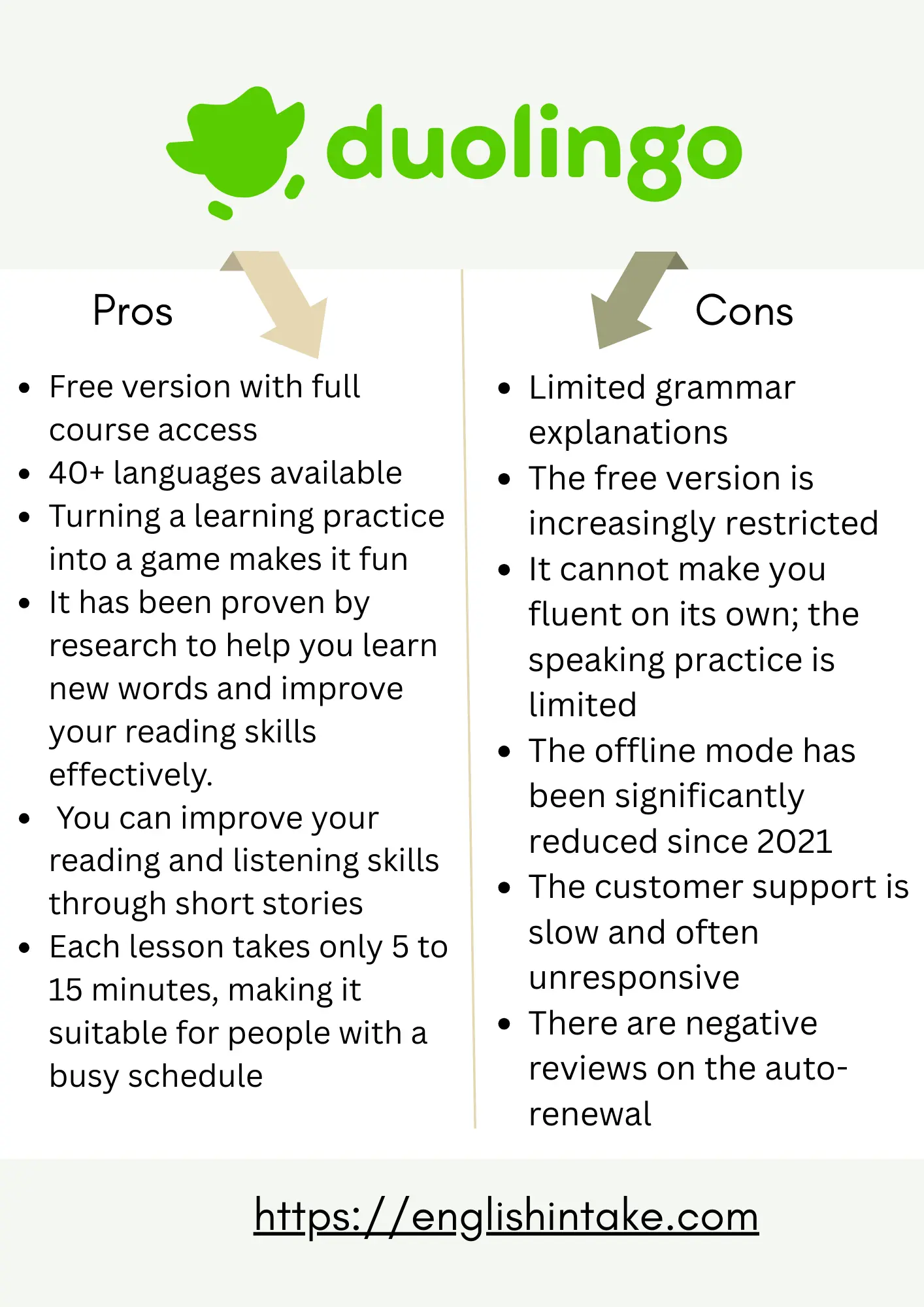
- Completely free version with full course access
- 40+ languages available, including rare and fictional languages
- A game-like approach makes daily practice more fun and motivating.
- It has been proven by research to help you learn new words and improve your reading skills effectively.
- It is available on all major platforms with progress sync
- Each lesson takes only 5 to 15 minutes, making it suitable for people with a busy schedule
- It adapts to how fast you learn things and shows you things again when you need a reminder.
- You can improve your reading and listening skills through short stories.
- Limited grammar explanations
- The free version is increasingly restricted
- It cannot make you fluent on its own; the speaking practice is limited
- The offline mode has been significantly reduced since 2021
- The course quality varies widely between languages
- The push notifications can be excessive and annoying
- The customer support is slow and often unresponsive
- There are negative reviews on the auto-renewal process
- Some sentences feel impractical or odd
13. Who is Duolingo good for?
- Are a complete beginner starting from zero
- Want a free way to start learning a language
- Need short, flexible lessons that fit a busy schedule
- Are motivated by gamification, streaks, and leaderboards
- Want to build vocabulary and reading comprehension
- Are learning one of the major languages with full course content
- Prefer learning through context rather than explicit grammar rules
- Want to maintain or refresh a language you previously studied
14. Who should consider alternatives?
- Need to develop strong speaking and conversation skills
- Want detailed grammar explanations in your native language
- Are an intermediate or advanced learner seeking challenging content
- Need reliable offline access for travel or limited internet
- Are learning a less popular language with limited Duolingo content
- Dislike gamification and prefer traditional learning methods
- Need to pass a specific language exam or certification
- Want one-on-one tutoring or conversation practice with humans
15. Use-case scenarios
Scenario 1: Travel in 30 days
Verdict: Moderately good
Duolingo can teach you essential travel vocabulary and phrases quickly. The gamification helps with daily practice. However, for real travel conversations, you will want to supplement with speaking practice. The phrasebook-style content in major languages can be helpful for tourists.
Scenario 2: Build a daily habit
Verdict: Excellent
This is where Duolingo truly excels. The streak system, notifications, and leaderboards create powerful habit-forming incentives. Many users maintain streaks of hundreds or even thousands of days. If your goal is consistent daily practice, Duolingo delivers.
Scenario 3: Become conversationally fluent
Verdict: Insufficient alone
Research shows Duolingo builds reading and listening skills effectively. However, speaking fluency requires human conversation practice that the app cannot fully provide. Use Duolingo as a foundation, but add tutoring, language exchanges, or immersion for fluency.
Scenario 4: Pass a language exam
Verdict: Helpful but not sufficient
Duolingo's CEFR-aligned courses can help you reach A2-B2 level in major languages. However, exam preparation typically requires targeted practice with exam-format questions. Duolingo is better as a supplement to dedicated exam prep materials.
16. Final scorecard
| Criteria | Weight | Score | Notes |
|---|---|---|---|
| Value for money | 25% | 9/10 | Free version offers genuine value; premium is affordable |
| Speaking/pronunciation | 20% | 5/10 | Basic speech recognition; limited conversation practice |
| Ease of use | 20% | 9/10 | Intuitive interface; excellent gamification |
| Content quality | 20% | 7/10 | Good for major languages; variable for smaller courses |
| Customer support | 15% | 3/10 | Slow responses; billing complaints common |
| Weighted total | 100% | 6.85/10 |
17. Conclusion
So, is Duolingo good? The answer depends on your goals and expectations.
For building vocabulary, developing reading comprehension, and creating a daily learning habit, Duolingo is genuinely effective. Scientific research supports its usefulness, particularly for beginners. The free version offers real value, making language learning accessible to anyone with a smartphone.
However, Duolingo has significant limitations. It will not make you fluent on its own. Speaking skills require practice that the app cannot fully provide. The recent restrictions on free usage have frustrated many users. And customer support issues remain a persistent concern.
I recommend Duolingo as a starting point or supplement for language learning (not as a complete solution). Use it to build vocabulary and maintain daily practice. Combine it with other resources: conversation practice with native speakers, grammar textbooks, podcasts, and immersion experiences.
If you have not tried Duolingo yet, the free version costs nothing to explore. Start with your target language and see if the approach works for you. For most learners, especially beginners, Duolingo provides a valuable and enjoyable entry point into language learning. Also check my honest review on Babbel vs Rosetta Stone.