
If you've been searching for a good language learning app, you've likely come across italki. With millions of users worldwide and tutors teaching more than 150 languages, it has become one of the most popular online language learning platforms. But is italki good enough to help you achieve fluency? In this comprehensive review, I'll examine everything you need to know before subscribing. I'll talk about features and pricing, as well as real my own experience to help you decide if it is the right choice for you.
1. What is italki?
italki is an online language learning platform founded in 2007 in Shanghai that connects language learners with tutors from around the world for personalised one-on-one lessons via video calls. Unlike traditional language learning apps that rely on pre-recorded content or gamification like Duolingo, italki focuses on live human interaction with native speakers and qualified teachers.
The platform operates as a marketplace where tutors set their own rates and schedules. This gives you the flexibility to choose instructors that match your budget, learning style, and availability. The lessons take place through italki's built-in classroom or via external platforms like Zoom and Skype.
1.1 Types of teachers on italki
italki offers two categories of instructors:
Professional teachers: These are certified language instructors with teaching qualifications, degrees, or formal training. They typically provide structured lessons with homework and progress tracking. They're ideal if you need grammar instruction or exam preparation. Professional teachers generally charge between £12 and £40+ per hour.
Community tutors: They are native speakers without formal teaching credentials. They offer conversation practice and cultural immersion. They're perfect if you're looking to improve your speaking fluency at a more affordable rate, typically between £6 and £20 per hour.
2. Is italki good? important things you need to know
Understanding what italki offers is essential to determining whether the platform suits your needs or not. In this section, I'm going through the features that make it a compelling choice for language learners.
2.1 Extensive language selection
It has a remarkable language diversity. The platform offers lessons in over 150 languages, from widely spoken ones like Spanish, French, German, and Mandarin to rare and endangered languages such as Tibetan, Azerbaijani, and even fictional languages like Dothraki and Klingon. This makes it particularly valuable if you want to study less common languages where finding qualified tutors locally would be nearly impossible.
2.2 Flexible scheduling and pricing
italki operates on a pay-as-you-go model with no subscription fees or long-term commitments. You only pay for the lessons you book, which provides exceptional flexibility. The lessons are available in various durations (30, 45, 60, or 90 minutes).
| Lesson type | Duration | Typical trice range |
|---|---|---|
| Trial lesson | 30 minutes | £3 - £8 |
| Community tutor | 60 minutes | £6 - £20 |
| Professional teacher | 60 minutes | £12 - £40+ |
| Group class | Varies | £4 - £12 |
2.3 Trial lessons
Most tutors offer discounted trial lessons, typically 30 minutes long. This allows you to test their teaching style before you commit to regular sessions. This feature is great for finding the right tutor match before any financial commitment. The platform also offers a satisfaction guarantee on your first three trial lessons.
2.4 Classroom
The platform features a built-in video classroom with interactive tools including video calling, chat functionality, shared notes, and an interactive whiteboard. You can also use external platforms if you like. All lessons can be recorded for later review.
2.5 Community features
Beyond a one-on-one tutoring, italki offers several free community resources:
Notebook: Write in your target language and receive corrections from native speakers.
Questions & answers: Post language-related questions and get answers from the community.
Language exchange: Connect with language partners for free practice sessions.
Group classes: Join small group lessons on specific topics at reduced rates.
3. Is italki good for beginners?
This is one of the most common questions potential users ask, and the answer is nuanced. italki can be beneficial for beginners, but with some important considerations.
For beginners: italki works best when combined with structured self-study materials. Many successful learners use apps like Duolingo or textbooks to build foundational vocabulary and grammar, then use italki for conversation practice and clarification. Complete beginners may find it challenging to maximise lesson value without some basic knowledge.
The platform allows you to filter tutors who specialise in teaching beginners, and many instructors are adept at working with absolute novices. However, without a structured curriculum built into the platform, beginners need to be proactive about their learning goals or find a professional teacher who provides a comprehensive syllabus.
4. Pros and cons
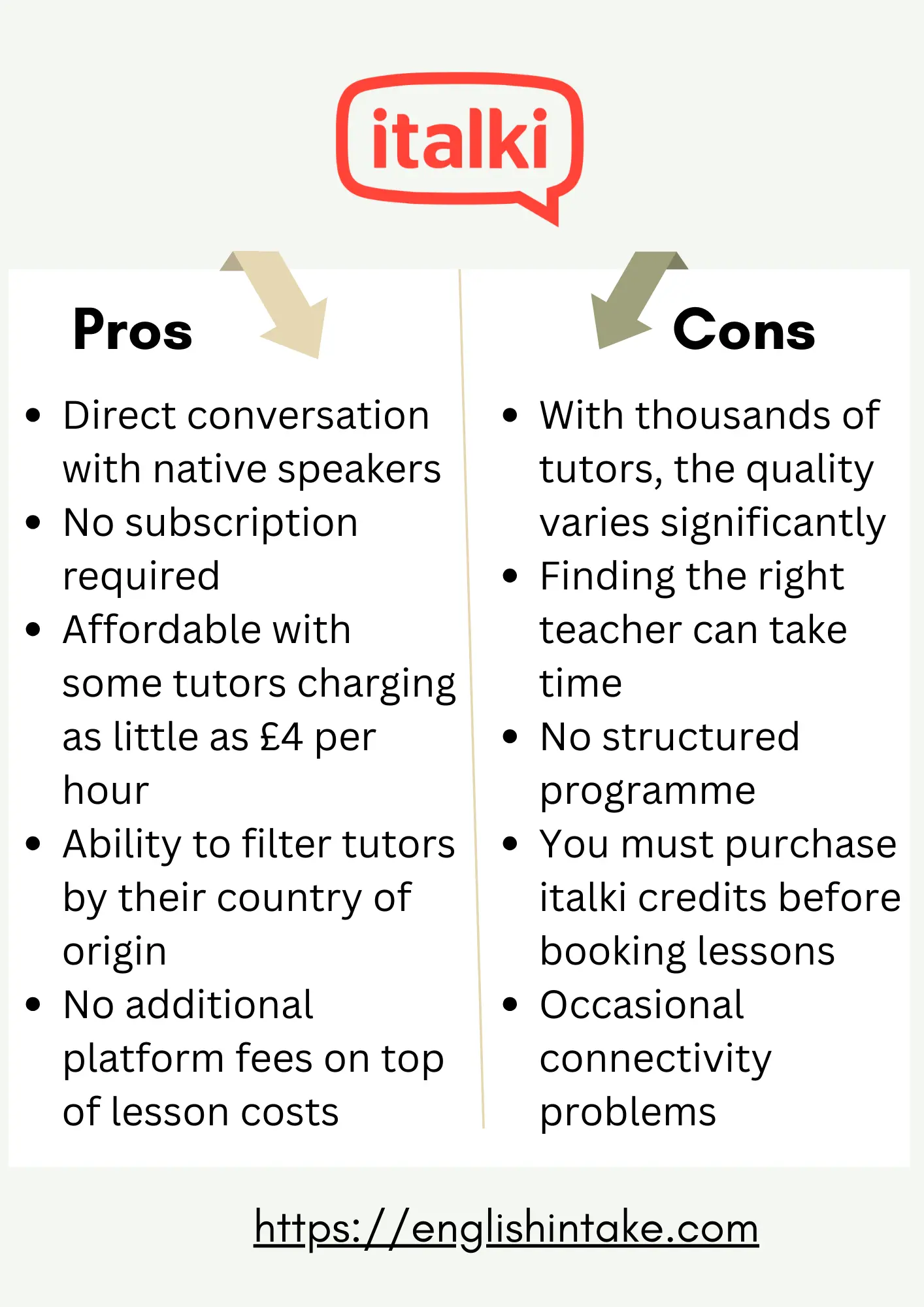
To help you assess whether italki is good for your specific needs, here's a balanced overview of the platform's strengths and weaknesses.
4.1 Advantages
Native speaker access: Direct conversation with native speakers accelerates pronunciation improvement and cultural understanding far beyond what apps or textbooks can offer.
Unmatched flexibility: No subscription required, complete control over scheduling, and the ability to try multiple tutors before committing.
Affordability: Compared to traditional language schools or private tutoring, italki offers competitive rates, with some tutors charging as little as £4 per hour.
Regional variety: If you're learning a specific dialect or accent, you can filter tutors by their country of origin. This is great if you want, for example, learn Brazilian Portuguese instead of European Portuguese, or Mexican Spanish versus Castilian Spanish.
No platform fees: Unlike competitors like Preply, italki doesn't charge additional platform fees on top of lesson costs.
4.2 Disadvantages
Quality inconsistency: With thousands of tutors, the quality varies significantly. Finding the right teacher may require several trial lessons.
No structured curriculum: Unlike language schools, italki doesn't provide a learning path. You must self-direct yourself or you must find professional teachers (from their plaform) who offer you structured programmes. I will tallk about this later.
Credit system: You must purchase italki credits before booking lessons, and unused credits aren't refundable for cash—only as platform credit.
Technical issues: Some users report occasional connectivity problems with the italki Classroom, though using external platforms like Zoom can mitigate this.
5. What people say about italki
Understanding real user experiences is crucial when evaluating any platform. I've gathered feedback from various sources including Reddit, Trustpilot, and app store reviews to provide an authentic picture.
5.1 Positive experiences
On Trustpilot, italki maintains a rating of approximately 4.4 out of 5 stars from over 14,000 reviews, with 82% rating it 5 stars. Many users praise the platform's accessibility and tutor quality.
Reddit user feedback: One user on r/languagelearning shared: "I went through 4 trial lessons before finding my current teacher. Six months later, I'm conversational in Spanish. Don't settle for the first teacher."
App Store reviewers frequently highlight the immersive experience, with one user stating they've "learned more, and more quickly, than ever before" and that for the first time, "being fluent in another language feels possible."
Users particularly appreciate the ability to find tutors for niche languages and dialects that are difficult to access elsewhere, such as Egyptian Arabic or regional Spanish variants.
5.2 Negative experiences
Not all experiences are positive. Among the complaints are:
Customer service: Some users report long wait times when contacting support, particularly regarding refunds or technical issues.
Tutor reliability: A small number of reviews mention tutors who didn't show up for scheduled lessons or whose quality declined over time.
Platform changes: Recent interface updates have frustrated some long-term users who found the previous version more intuitive.
From a reddit thread: "My German teacher was great for two months, then started showing up unprepared. No warning, just sudden quality drop." This highlights the importance of maintaining open communication with tutors about expectations.
5.3 Teacher perspectives
It's worth noting that some negative Trustpilot reviews come from teachers rather than students. Teachers have raised concerns about recent commission increases (reportedly up to 40% on some lesson types) and inconsistent platform policies. While this doesn't directly affect learners, it could potentially impact tutor availability and pricing in the long term.
6. Final verdict: Is italki Good for language learning?
In my opinion, yes, italki is good but there are things you need to consider.
italki excels for:
1. Intermediate learners seeking conversation practice and fluency development
2. Learners studying rare or regional language variants
3. Self-directed students who can supplement lessons with independent study
4. Budget-conscious learners wanting affordable access to native speakers
5. Those with irregular schedules requiring flexible booking
italki may not be ideal for:
6. Complete beginners who need extensive structure and hand-holding
7. Learners who prefer a pre-designed curriculum without self-direction
8. Those uncomfortable navigating varied tutor quality
7. My practical recommendations
After testing italki myself, I have gathered some practical advice that can significantly improve your learning outcomes.
7.1 Should you choose professional teachers or community tutors?
When you subscribe to the platform, you may be wondering whether you should book lessons with professional teachers or community tutors. From my personal experience, I can tell you that the answer depends entirely on your current level, goals, and learning style. Neither option is universally better; what matters is matching the right instructor type to your specific needs.
Professional teachers have formal teaching qualifications (such as TEFL, CELTA, or university degrees in education) that italki has verified. They typically offer structured lesson plans, homework assignments, grammar explanations, and progress tracking. You should choose a professional teacher if
- you are a complete beginner who needs guidance on where to start,
- you are preparing for a language exam like DELE or JLPT,
- or you struggle to understand why sentences are structured a certain way
Professional teachers are worth the higher price. They know how to explain grammar rules clearly and if you are an absolute beginner, they put you on the right track from the very start.
Community tutors are native speakers without formal teaching credentials; however, this does not mean they lack value. I found them particularly useful for intermediate to advanced learners who already understand the basics and need conversation practice, pronunciation refinement, or cultural immersion. What I have noticed is that community tutors who have completed hundreds of lessons and maintain high student-to-lesson ratios are usually as effective as professional teachers.
7.2 How to find the best tutors on italki
Finding the right tutor requires more effort than simply picking the first person you see or choosing based on price alone.
First, always watch the introduction video before booking anything. The video tells you more than any written profile can; you hear the tutor's accent, observe their communication style, and get a sense of their personality. Ask yourself: can you understand them clearly? Do they speak at a pace that matches your level? Do they seem warm and approachable, or formal and reserved?.
Second, look beyond the star rating. Almost every tutor on italki has a rating between 4.8 and 5.0, which makes star ratings nearly useless for comparison. Instead, look at the lessons-to-students ratio; this is the total number of lessons taught divided by the number of students. A ratio of 4 or higher suggests that students return repeatedly, which is a much stronger indicator of quality than reviews alone. A tutor with 5,000 lessons and 1,200 students (ratio of about 4) demonstrates better retention than one with 5,000 lessons and 3,000 students (ratio of less than 2). Some highly regarded tutors maintain ratios of 10, 15, or even 20 to 1.
Third, read the reviews carefully for specific details rather than generic praise. Reviews that mention concrete improvements ("my pronunciation has improved dramatically" or "she helped me understand subjunctive mood finally") are more informative than vague compliments ("great teacher, highly recommend"). Also pay attention to negative patterns; if multiple reviews mention that a tutor shows up unprepared, talks too much, or has frequent technical issues, take those warnings seriously.
Fourth, consider the tutor's country and dialect. If you are learning Spanish for a trip to Mexico, a tutor from Spain may teach vocabulary and expressions that differ from what you will hear. italki lets you filter tutors by country of origin; use this feature strategically. Regional accents, slang, and cultural context all vary significantly within the same language.
Finally, check schedule compatibility before falling in love with a profile. Time zone differences mean some tutors simply will not be available when you can take lessons. There is no point investing time researching a perfect tutor if their available hours are at 3am your time.
7.3 How to maximise your italki lessons
I suggest you message your tutor before your first lesson. Do not wait until the lesson starts to explain your goals, current level, and what you want to work on. Sending this information in advance (even a day before) allows your tutor to prepare materials tailored to your needs. This also avoids spending half the lesson asking diagnostic questions.
Use italki's three trial lessons wisely. You only get three trial lessons in total (one per tutor, with up to three different tutors), so do not waste them. Before booking trials, research thoroughly using the criteria above. After each trial, ask yourself the questioons: did you enjoy the session? Did the tutor listen to your goals? Did you feel comfortable making mistakes? The tutor's personality and teaching style matter more than you might initially think; you will spend many hours with this person, so compatibility is crucial.
Prepare before every lesson. Review vocabulary and grammar from your last session. Write down questions you want to ask. If you are doing conversation practice, think about the topics you want to discuss and look up relevant vocabulary beforehand.
Be honest with your tutor about what is and is not working. If the lessons feel repetitive, say so. If you want more grammar explanations or less, communicate that as well. If you prefer being corrected immediately versus at the end of sentences, let them know.
Finally, book lessons consistently. Language learning requires regular practice, and sporadic lessons lead to forgetting what you have learned previously. I recommend at least two to three lessons per week if you are serious about progress. Set a recurring time in your calendar and treat it like any other important appointment.
The key to success on the platform is finding the right tutor and maintaining consistent practice. With over 20,000 teachers across 150+ languages, the right instructor for your goals, learning style, and budget is almost certainly available. The question isn't so much whether italki is good, but whether you're prepared to invest the initial effort to find your ideal language learning partner.
I hope you like my reviews, see also my comparison between Babbel and Rosetta stone in another article.