The verb to be shows a state, condition, or gives information about the subject. It is used as both a main verb and an auxiliary verb. In this lesson, we will learn the use of the verb to be in the affirmative, negative, and interrogative forms with example sentences.
As a main verb:
- I am a teacher.
- You are my best friend.
- She is an artist.
- We are on the same team.
- They are students at the local university.
As an auxiliary verb:
An auxiliary verb (also called a helping verb) is a verb used together with a main verb to help form tenses, voices, questions, or negatives.
- I am playing the guitar.
- You are reading a book.
- He is swimming in the pool.
- We are watching a movie.
- They were eating breakfast when I came in.
1. Be verb in different forms
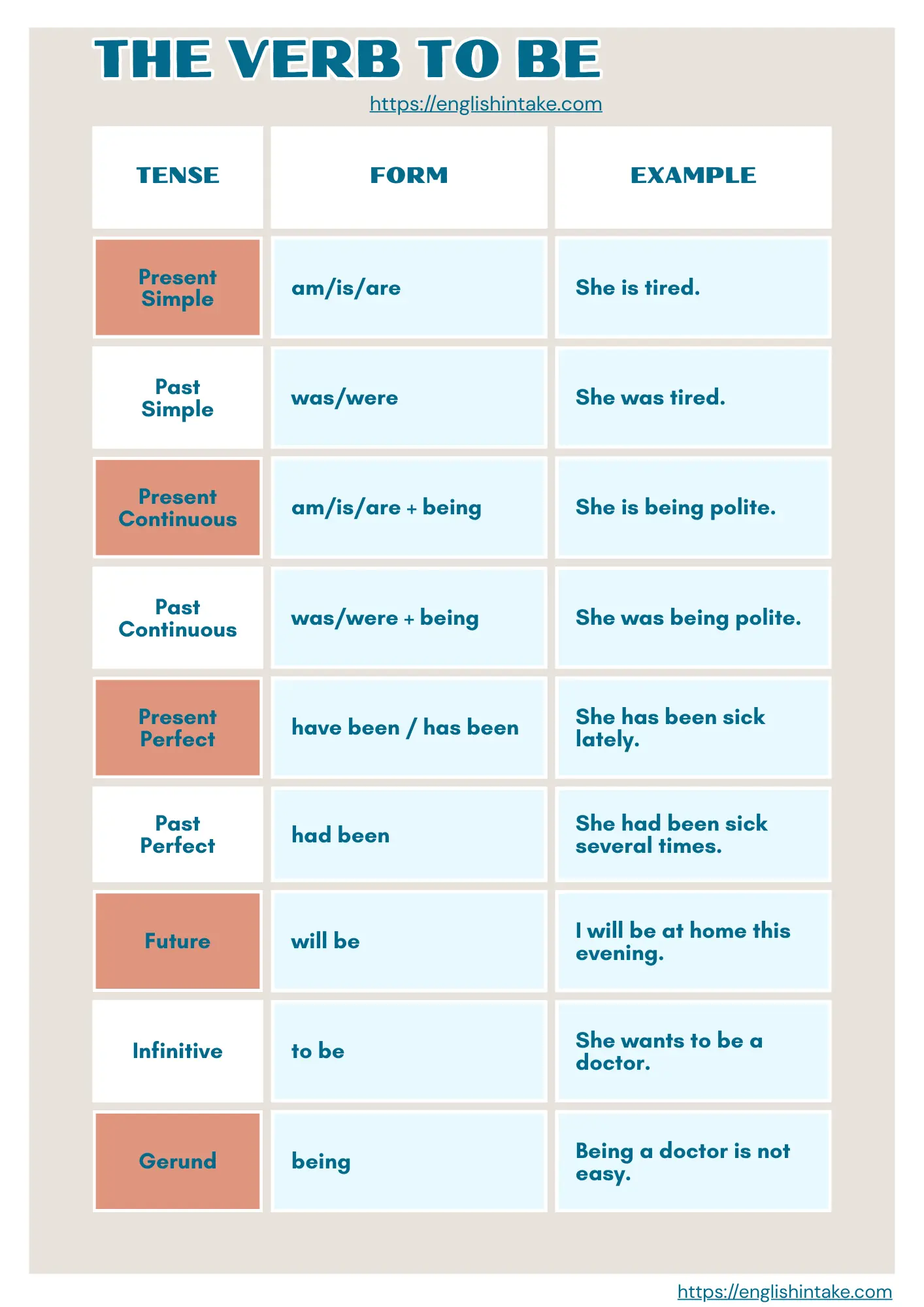

1. The verb be
The verb be is irregular. This means that its form changes depending on the subject and the tense.
In English, be is used to talk about identity, age, feelings, jobs, places, descriptions, and temporary behaviour.
1.1 Present simple: am / is / are
We use the present simple of be to talk about facts, identity, feelings, descriptions, jobs, ages, and places.
| Subject | Positive | Short form | Negative | Negative short form | Question |
|---|---|---|---|---|---|
| I | I am | I’m | I am not | I’m not | Am I? |
| you | you are | you’re | you are not | you aren’t / you’re not | Are you? |
| he | he is | he’s | he is not | he isn’t / he’s not | Is he? |
| she | she is | she’s | she is not | she isn’t / she’s not | Is she? |
| it | it is | it’s | it is not | it isn’t / it’s not | Is it? |
| we | we are | we’re | we are not | we aren’t / we’re not | Are we? |
| they | they are | they’re | they are not | they aren’t / they’re not | Are they? |
In questions, we put am, is, or are before the subject.
- You are ready. → Are you ready?
- She is tired. → Is she tired?
Negative questions in the present
Negative questions are often used when we expect agreement, confirmation, or surprise.
| Full form | Short form |
|---|---|
| Am I not? | — |
| Are you not? | Aren’t you? |
| Is he not? | Isn’t he? |
| Is she not? | Isn’t she? |
| Is it not? | Isn’t it? |
| Are we not? | Aren’t we? |
| Are they not? | Aren’t they? |
Example: Aren’t you cold? means “I think you may be cold.”
1.2 Past simple: was / were
We use was and were to talk about past states, past feelings, past places, and past situations.
| Subject | Positive | Negative | Negative short form | Question |
|---|---|---|---|---|
| I | I was | I was not | I wasn’t | Was I? |
| you | you were | you were not | you weren’t | Were you? |
| he / she / it | he was | he was not | he wasn’t | Was he? |
| we | we were | we were not | we weren’t | Were we? |
| they | they were | they were not | they weren’t | Were they? |
- I was at home yesterday.
- They were not ready.
- Were you tired after work?
1.3 Future simple: will be
We use will be to talk about a future state, situation, feeling, place, or description.
| Form | Structure | Example |
|---|---|---|
| Positive | subject + will be | I will be ready. |
| Short form | subject + ’ll be | I’ll be ready. |
| Negative | subject + will not be | I will not be late. |
| Negative short form | subject + won’t be | I won’t be late. |
| Question | will + subject + be? | Will you be there? |
| Negative question | won’t + subject + be? | Won’t you be there? |
The form is the same for all subjects: I will be, you will be, he will be, we will be, they will be.
1.4 Present continuous: am / is / are being
We use am / is / are being when someone is behaving in a certain way at the moment. It usually describes temporary behaviour, not a permanent personality.
| Form | Structure | Example |
|---|---|---|
| Positive | subject + am / is / are + being | He is being very quiet today. |
| Negative | subject + am not / isn’t / aren’t + being | She isn’t being rude. |
| Question | am / is / are + subject + being? | Are you being serious? |
Be being is grammatically possible, but it is not common in everyday English. It is mainly used to describe temporary behaviour.
- He is kind. = This is his personality.
- He is being kind. = He is acting kindly at this moment.
1.5 Past continuous: was / were being
We use was / were being to describe temporary behaviour in the past.
| Form | Structure | Example |
|---|---|---|
| Positive | subject + was / were + being | He was being difficult. |
| Negative | subject + wasn’t / weren’t + being | They weren’t being honest. |
| Question | was / were + subject + being? | Was she being serious? |
1.6 Present perfect: have / has been
We use have / has been when a past situation is connected to the present.
| Form | Structure | Example |
|---|---|---|
| Positive | I / you / we / they + have been | They have been busy. |
| Positive | he / she / it + has been | She has been ill. |
| Short form | ’ve been / ’s been | I’ve been tired. / He’s been busy. |
| Negative | haven’t been / hasn’t been | We haven’t been ready. |
| Question | have / has + subject + been? | Have you been here before? |
1.7 Past perfect: had been
We use had been to talk about a state or situation that happened before another moment in the past.
| Form | Structure | Example |
|---|---|---|
| Positive | subject + had been | I had been tired before the meeting started. |
| Short form | subject + ’d been | She’d been nervous before the exam. |
| Negative | subject + hadn’t been | They hadn’t been ready. |
| Question | had + subject + been? | Had you been there before? |
1.8 Future perfect: will have been
We use will have been to say that a state or situation will be complete before a future time.
| Form | Structure | Example |
|---|---|---|
| Positive | subject + will have been | By Monday, I will have been here for a week. |
| Short form | subject + ’ll have been | By Monday, I’ll have been here for a week. |
| Negative | subject + won’t have been | He won’t have been ready for long. |
| Question | will + subject + have been? | Will they have been here long? |
1.9 Quick summary
| Tense | Main form | Example |
|---|---|---|
| Present simple | am / is / are | She is happy. |
| Past simple | was / were | They were late. |
| Future simple | will be | I will be ready. |
| Present continuous | am / is / are being | He is being quiet. |
| Past continuous | was / were being | She was being careful. |
| Present perfect | have / has been | We have been busy. |
| Past perfect | had been | I had been ill. |
| Future perfect | will have been | They will have been ready. |
2. Use of the verb to be
The verb to be has many uses. It is used to say who someone is or what they do. It can also show where someone or something is. In addition, we use to be to talk about feelings or emotions. It helps describe what a person or thing is like. We also use to be when we talk about time and dates.
2.1 Describing identity or occupation
1. He is an engineer.
2. She is a student.
3. They are firefighters.
4. We are musicians.
5. He is a chef.
6. I am a pilot.
7. She is a lawyer.
8. He is a police officer.
9. They are athletes.
10. Are you a graphic designer?
2.2 Indicating location
1. The computer is on the table.
2. The cat is under the bed.
3. The park is near our house.
4. The keys are in the drawer.
5. She is in the kitchen.
6. The shoes are by the door.
7. They are at the cinema.
8. The phone is on the desk.
9. The children are in the playground.
10. He is in the office.
11. The library is across the street.
2.3 Describing feelings or emotions
1. I am bored.
2. She is angry.
3. She is excited about the trip.
4. They are sad because of the news.
5. I am nervous about the presentation.
6. He is surprised by the gift.
7. She is disappointed with the results.
8. They are proud of their achievements.
9. I am scared of the dark.
10. He is afraid of snakes.
2.4 Describing characteristics
1. The house is big.
2. The dog is friendly.
3. The cake is delicious.
4. He is tall.
5. She is kind.
6. The weather is cold.
7. He is intelligent.
8. The flowers are colourful.
9. The dress is elegant.
10. This book is very informative.
2.5 Talking about time and dates
1. What time is it?
2. It’s noon.
3. Tomorrow is Tuesday.
4. It is 7 o’clock in the morning.
5. The meeting is on Wednesday.
6. Her birthday is on October 21st.
7. It is 1:45 p.m.
8. The concert is on Friday night.
9. The deadline is September 15th.
10. It is 12:30 in the afternoon.
11. Today is the first day of summer.
12. The party is on Saturday evening.
13. The appointment is at 10 a.m. sharp.
14. Today is the 5th of May.
15. It is 6:15 in the evening.
3. Common expressions using 'be'
Many idioms and expressions use the verb to be. For example, when someone says they are on cloud nine, they are extremely happy.
The expressions below are commonly used in English.
To be on cloud nineTo be extremely happy or ecstatic
Ever since he got the promotion, he's been on cloud nine.
To be in hot waterTo be in trouble
If you don't finish your project on time, you'll be in hot water with the boss.
To be in the same boatTo be in the same situation as someone else
Don't worry, I haven't finished my essay either. We're in the same boat.
To be a piece of cakeTo be very easy
Don't stress about the test, it's a piece of cake.
To be over the moonTo be very happy
She was over the moon when she found out she got the job.
To be on the ballTo be alert and knowledgeable
You always have to be on the ball in business negotiations.
To be under the weatherTo feel sick or unwell
I think I'm catching a cold. I've been feeling under the weather all day.
To be up in the airFor something to be uncertain or unresolved
Our vacation plans are still up in the air. We haven't decided where to go yet.
To be all earsTo listen carefully and attentively
Tell me about your day, I'm all ears.
To be on the fenceTo be undecided about something
I'm on the fence about buying the new phone or keeping my old one.
To be out of the loopTo not have current knowledge or information
I didn't know they were getting married. I guess I'm out of the loop.
To be on pins and needlesTo be anxiously awaiting something
I've been on pins and needles waiting for the test results.
To be in stitchesTo be laughing uncontrollably
The comedian was so funny, the whole audience was in stitches.
To be in over one's headTo be involved in a situation too difficult to manage
I thought I could handle the situation, but now I feel I'm in over my head.
Try to use these expressions in your daily conversation. Talk to yourself, practice with a friend, or join an English conversation group. The more you use them, the more natural they will feel.