If you’re trying to find the best books to learn English, I know it can feel overwhelming to choose which one is right for your level. Some books focus only on grammar, others on vocabulary, and many try to cover everything at once.
In this post, I have listed some of the best books to learn English for all levels and ages.
- Books to learn English for adult beginners (A1–A2)
- Books to learn English for kids
- Best grammar books by level
- Vocabulary
- Best-selling books for English pronunciation
- ELT graded reader series
- Exam preparation and business English
- Building a study plan
List of books to improve your English
1. Books to learn English for adult beginners (A1–A2)
If you are starting from zero or almost zero, you need clear visuals, simple explanations, and a lot of practice. Good beginner books also include audio and cover all skills, not only grammar. If you are an adult beginner, here are some of the most practical choices.
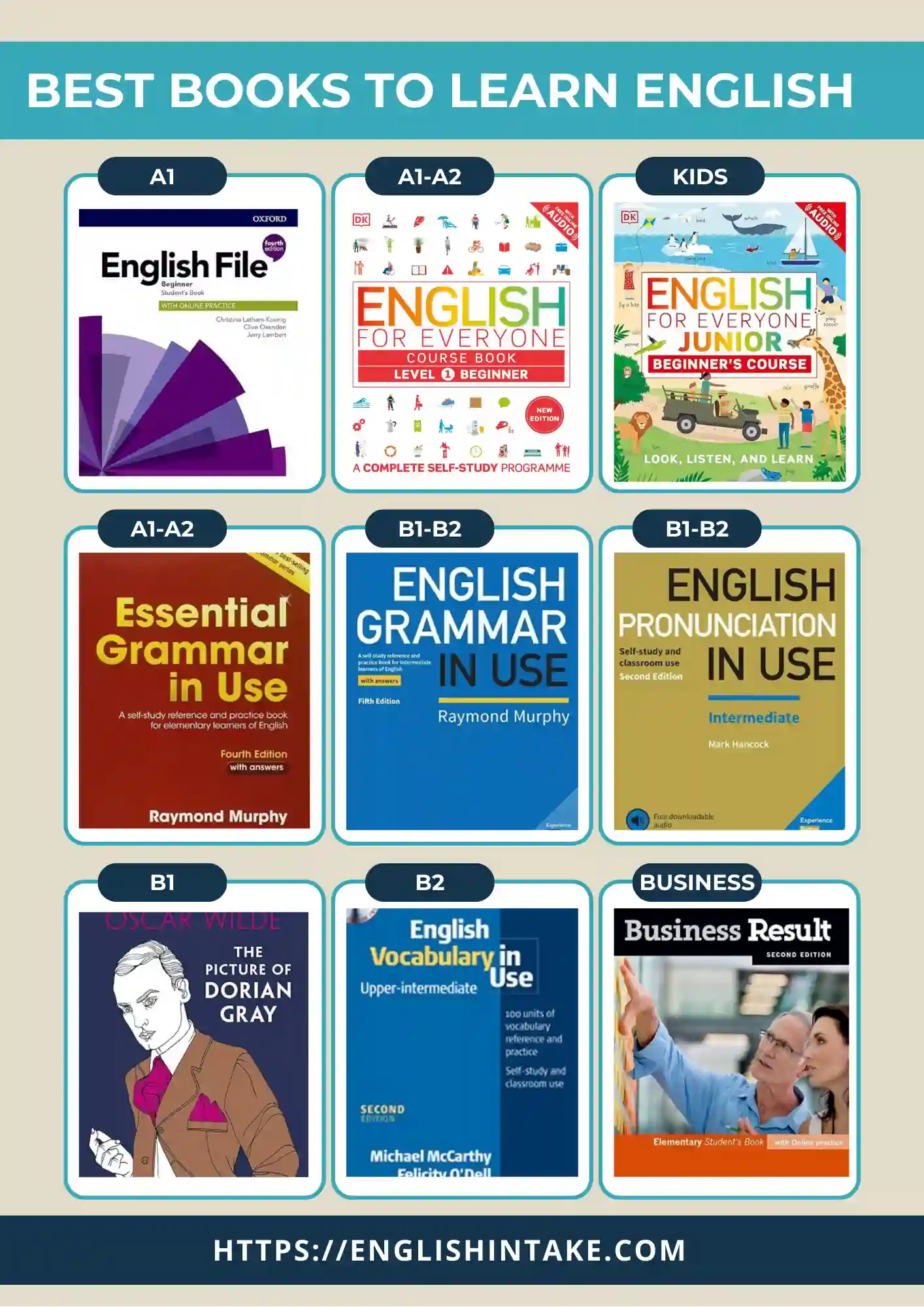
1.1. English for Everyone Course Book Level 1 Beginner (DK)
This book is for complete beginners (A1). It is built as a full self-study programme with over 1,000 vocabulary and grammar exercises, plus free audio that you can access online. The Units are short, visual, and cover everyday topics like greetings, numbers, jobs, daily routines, travel, and shopping.
It mixes pictures, dialogues, and grammar boxes. The layout is consistent across the book, so once you understand one unit, you can easily move through the rest of the course.
Why is it good? You can work completely alone because the explanations are simple. It has answer keys at the back. It’s better if you use it with the accompanying practice book.
Check English for Everyone Course Book Level 1 Beginner on Amazon at amazon.
1.2. English File Beginner (Oxford)
Level: Beginner (A1). English File Beginner is a popular course used in many language schools and is also suitable for self-study with the digital pack. Each unit combines grammar, vocabulary, speaking tasks, and listening activities that reflect real-life situations such as meeting people, ordering in cafés, and talking about your family or free time. The digital resources provide audio, video, and online practice that mirror the content of the printed student’s book.
Strength: This course puts a strong focus on speaking and listening, which many self-study books tend to overlook. The grammar syllabus is clear and well-structured. Each unit includes guided tasks that help you practise what you have learned in short, realistic conversations.
View English File Beginner Student’s Book on Amazon
1.3. Learn English Fast for Adult Beginners – ESL Certified Workbook
Level: Adult beginners who want a short, intensive course. This workbook is organised as a 30-day programme with 15-minute daily lessons that focus on essential grammar, vocabulary, and simple conversation patterns. The book combines explanations, short drills, and mini dialogues, and often includes stories or role-plays so you can see how language works in real situations. It targets practical American English for daily life, including work, travel, and everyday interactions.
Why it is good: The 30-day structure is motivating if you like clear goals and routines. Lessons are short enough to fit into a busy schedule, and the focus on practical phrases means you can start speaking early, even with a limited vocabulary. It pairs well with a more detailed grammar or vocabulary book if you want deeper study later.
View Learn English Fast for Adult Beginners on Amazon
2. Books to learn English for kids
Children need colour, stories, and characters more than long grammar explanations. The best books to learn English for kids use pictures, games, and audio, and are organised by themes like school, family, animals, and hobbies.
2.1. English for Everyone Junior: Beginner’s Course
Age: About 6 to 9 years old, complete beginners. This book is a first English course for children and introduces more than 500 core words through 22 teaching units and 4 review units. Six recurring child characters present new language in short scenes, and each unit combines vocabulary, simple grammar, and listening activities, with audio available for all units. Topics include family, school, food, hobbies, and everyday actions, all presented with colourful illustrations and clear icons that guide the child through the tasks.
Why it is good: The course is structured but feels playful, so children can progress without feeling they are doing “serious” study. Review units help recycle vocabulary and grammar, which is vital at this age, and there is a matching practice book with hundreds of extra exercises for consolidation. Parents with little English can still use it, because the layout is intuitive and examples are visual.
View English for Everyone Junior: Beginner’s Course on Amazon
2.2. English for Everyone Junior: 5 Words a Day
Age: About 6 to 9 years old. This vocabulary book teaches 1,000 English words through a simple routine of five words per day. Words are grouped by themes such as animals, home, school, transport, and food, and each page uses pictures and quick tasks to reinforce meaning and spelling. It fits naturally beside the Junior course book or any other children’s course.
Why it is good: The “5 words a day” format gives children a clear, achievable micro-goal. Repetition is built into the design, which helps young learners remember vocabulary without long, tiring sessions. It is also easy for parents to open the book for ten minutes each evening and turn learning into a habit.
View English for Everyone Junior: 5 Words a Day on Amazon
2.3. The Oxford Picture Dictionary for Kids
Age: Primary-age children, especially visual learners. This picture dictionary presents around 60 everyday topics on large double-page scenes, for example the classroom, the park, the supermarket, home, and special days. Each scene shows children and families in action with labelled objects and phrases, and there is an appendix with the alphabet, numbers, and extra language. The dictionary is part of a larger programme with stories, audio, and worksheets that reuse the same vocabulary in different formats.
Why it is good: Kids learn language in context, not from word lists, and the big scenes are perfect for pointing, describing, and playing “find and say” games. Because the topics are so visual, this book also works in mixed-language families where parents may not share the child’s first language. Teachers like it because the same dictionary supports storytelling, writing, and speaking activities.
View The Oxford Picture Dictionary for Kids on Amazon
4. Best grammar books by level
When people search for “books to learn English”, grammar books often appear first. The following titles are classics, used worldwide by millions of learners and teachers.
4.1. Essential Grammar in Use (Raymond Murphy)
Level: Elementary (A1–A2). This book is a self-study grammar reference and practice book with 115 two-page units, each covering one grammar point such as present simple, past simple, present perfect, countable and uncountable nouns, or prepositions. Explanations and examples are on the left-hand page, with exercises on the right, and there is an answer key at the back. The units are independent, so you can jump directly to the grammar you need instead of following a strict order.
Why it is good: The language is extremely clear, and the examples feel natural, which makes it ideal for self-study without a teacher. Many adult learners use it as a long-term reference, going back whenever they forget a structure. Teachers also use single units as homework to support lessons from other course books.
View Essential Grammar in Use on Amazon
4.2. English Grammar in Use (Raymond Murphy)
Level: Intermediate learners (roughly B1–B2). This is the “big brother” of Essential Grammar in Use and contains 145 double-page units, each focused on one intermediate grammar point. Typical units cover areas such as present perfect vs past simple, conditionals, passive forms, reported speech, articles, prepositions, and phrasal verbs. The structure is the same as the elementary book: clear explanations on the left, varied exercises on the right, plus a study guide and answer key at the back.
Why it is good: The progression of units follows the most common problems intermediate learners face, so you can use the contents as a roadmap for your grammar study. The exercises are practical and often contrast similar structures, which helps you notice small but important differences. The latest editions also include an interactive e-book version if you prefer to study on a tablet.
View English Grammar in Use on Amazon
4.3. Practical English Usage, 4th edition (Michael Swan)
Level: Upper-intermediate to advanced learners, teachers, and serious students. Practical English Usage is not a traditional “course” but a reference book that explains more than 250 common grammar and vocabulary problems. Entries are organised like a dictionary and cover areas such as tense choice, word order, article use, prepositions, phrasal verbs, idioms, pronunciation, and differences between British and American English. The explanations are informed by large corpora of real English, which means examples reflect actual usage, not invented textbook sentences.
Why it is good: This is the book you open when you have a very specific question such as “Can I use ‘suggest’ with ‘to’ plus infinitive?” or “What is the difference between ‘say’ and ‘tell’ here”. Many advanced learners keep it on their desk next to a dictionary and grammar, because it focuses on real mistakes made by learners. It is also excellent for exam preparation and for teachers who need quick, reliable explanations.
View Practical English Usage on Amazon
5. Vocabulary
Grammar tells you how to build sentences. Vocabulary books help you say something interesting inside those sentences. Here are some of the most useful vocabulary books to learn English at different levels.
5.1. Oxford Word Skills Basic
Level: Elementary and pre-intermediate. Oxford Word Skills Basic contains 80 units of vocabulary presentation and practice. Units are one to three pages long and organised by everyday topics such as clothes, food, weather, daily routines, feelings, and telephone language, as well as functions like giving opinions or apologising. Each unit introduces new words with pictures or short texts, followed by exercises that train recognition, use in phrases, and sometimes pronunciation.
Why it is good: The focus is on high-frequency vocabulary that you will actually use in conversation. Because units are short, you can learn a small, coherent set of words in one sitting, then revisit them later. The book is especially useful if you already know some grammar but feel you “have no words” when you want to speak.
View Oxford Word Skills Basic on Amazon
5.2. English Vocabulary in Use series (Cambridge)
Level: Elementary to advanced (different books). The English Vocabulary in Use series is divided by level, from elementary up to advanced, and each book contains around 100 two-page units. Units usually present vocabulary on the left page, with explanations, example sentences, and sometimes pictures, and then provide exercises on the right page. Topics range from everyday life and work to abstract nouns, collocations, idioms, phrasal verbs, and specialised vocabulary such as academic language or technology.
Why it is good: You can pick the level that matches your current English and move up through the series as you progress. The books are flexible enough to use for self-study, exam preparation, or as extra practice alongside a course book. The advanced book in particular pays attention to connotation, register, and how words combine in collocations and fixed phrases, which is what you need for more natural, fluent English.
View English Vocabulary in Use Upper-Intermediate on Amazon
5.3. English Short Stories for Beginners and Intermediate Learners (Language Guru)
Level: High beginner to intermediate. This book collects short stories written especially for learners and provides controlled language, glossaries, and questions. Each story is followed by vocabulary lists and sometimes comprehension or reflection questions, so you can check your understanding and recycle new words. The aim is to practise reading while improving vocabulary and grammar in a more natural context than single sentences.
Why it is good: Stories are short enough to finish in one sitting, which is satisfying and encourages regular reading. Because the stories are written for learners, they stay within a realistic vocabulary range without feeling childish. This makes the book a good bridge between graded readers and authentic novels.
View English Short Stories for Beginners and Intermediate Learners on Amazon
6. Books to improve English pronunciation
If you want people to understand you easily, pronunciation practice is essential. Good pronunciation books give you clear explanations, audio for different accents, and exercises for stress, rhythm, and intonation.
6.1. English Pronunciation in Use Intermediate (Mark Hancock)
Level: B1–B2, but motivated A2 learners can also benefit. This book has 60 easy-to-use two-page units that cover individual sounds, word stress, sentence stress, connected speech, and intonation. The left page explains a single pronunciation feature with diagrams, examples, and minimal pairs, while the right page offers practice exercises. Audio is available as downloadable files or as CDs, and it includes a range of accents, which helps you understand different speakers.
Why it is good: You can dip in and out of individual units depending on your problems, for example, “th” sounds or sentence stress. Activities are practical and often ask you to listen and repeat, mark stress, or notice differences between similar sentences. It is one of the most widely recommended pronunciation books for self-study and classroom use.
View English Pronunciation in Use Intermediate on Amazon
7. ELT graded reader series
Reading is one of the most powerful ways to grow vocabulary and grammar intuitively. Graded readers are books written or adapted especially for learners at specific levels, so you can enjoy real stories without looking up every word.
7.1. Penguin Readers Level 3: The Picture of Dorian Gray
Level: B1 (intermediate) learners. This adapted version of Oscar Wilde’s classic novel is part of the Penguin Readers graded reader series. The language has been carefully rewritten to match a specific level and includes language-learning exercises, new illustrations, and online support material. There are many other titles at each level, both classic and modern, so once you finish one book, you can move to another at the same difficulty.
Why it is good: Reading famous stories in a simplified version boosts your confidence and cultural knowledge at the same time. The tasks in the book encourage you to check vocabulary and think about the story, not only to decode the words. Because the series covers a wide range of genres, you can choose topics you genuinely enjoy.
View Penguin Readers Level 3: The Picture of Dorian Gray on Amazon
7.2. Oxford Bookworms Library Stage 2: Dracula
Level: A2–B1 (700 headwords).
Oxford Bookworms is another famous graded reader series, with seven levels from A1 to C1. The Stage 2 edition of “Dracula” retells Bram Stoker’s classic horror story using a controlled vocabulary of about 700 headwords and includes illustrations and activities. The series is written for secondary and adult students, so the stories feel mature while still being accessible.
Why it is good: Language is graded very carefully, so you can read fluently without constant dictionary use. Different genres, from crime and romance to biography and non-fiction, mean you can find something that fits your interests. Many programmes and teachers build whole reading courses around Bookworm titles.
View Oxford Bookworms Stage 2: Dracula on Amazon
8. Exam preparation and business English
If your goal is to pass an exam or use English at work, you should add at least one specialised book to your library. Here are two solid options many learners use.
8.1. The Official Cambridge Guide to IELTS
Level: Upper-intermediate and advanced learners preparing for IELTS Academic or General Training. This is a comprehensive guide that explains every part of the IELTS test and offers strategies, skills practice, and exam tasks. It includes eight official practice tests, detailed advice on how examiners assess answers, and exercises that build listening, reading, writing, and speaking skills. The book comes with a DVD-ROM or online audio and video material, including model interviews.
Why it is good: Because it is produced by Cambridge, the organisation behind IELTS, the tasks match the real exam format very closely. The first part of the book focuses on skills and strategies, which is useful even if your exam date is still far away. Many learners use it together with a general course book to make sure they cover both language and exam technique.
View The Official Cambridge Guide to IELTS on Amazon
8.2. Business Result Elementary: Student’s Book with Online Practice
Level: Elementary learners who need English for work.
Business Result Elementary is a course that introduces essential business English at a simple level. The student’s book covers typical business situations such as introducing yourself, making phone calls, arranging meetings, giving basic presentations, and small talk with colleagues. Each unit links language to real workplace tasks and includes video and online practice through the companion platform.
Why it is good: If you work in an international environment and do not have much time, this course lets you focus on the English you actually need at the office. You practise short, realistic dialogues and learn the kind of polite phrases that are common in emails and meetings. As you move up through the Business Result levels later, the structure stays familiar.
View Business Result Elementary on Amazon
9. Building a study plan
It is easy to buy many books to learn English and then feel lost. A simple weekly plan will help you actually use them and see progress.
- For complete beginners (adults): Choose one main course (for example, English for Everyone Level 1 or English File Beginner), add Essential Grammar in Use for extra grammar support once or twice a week, and read one short story at the weekend.
- For kids: Use English for Everyone Junior or another kids’ course three times a week, add 5 Words a Day for quick daily vocabulary, and play games with the Oxford Picture Dictionary on family evenings.
- For intermediate learners: Work through English Grammar in Use, study one or two units of English Vocabulary in Use or Oxford Word Skills each week, and read a graded reader such as Penguin Readers or Oxford Bookworms every month.
- For pronunciation and fluency: Add two units of English Pronunciation in Use per week and record yourself reading dialogues from your course books or readers.
- For exams or business: Keep your general study routine, then reserve two sessions per week for The Official Cambridge Guide to IELTS or Business Result, depending on your goal.
Whichever books you choose, try to mix grammar, vocabulary, pronunciation, and real reading or listening. Small, regular steps will always beat one huge study session at the weekend. If you keep going, these books to learn English can take you from a complete beginner to a confident communicator.