
1. Phone conversation in English
Talking on the phone in foreing language can be intimidating. When you can’t see the other person’s face or body language, you need to rely on words to understand what they are talking about. Things get harder when there is background noise, poor connections, or when the other person speaks fast. However, there are things you can do on your side to make the conversation smoother. In this lesson, I’ll teach you formal and informal phrases people use when making a call. I have included many examples of typical phone conversation in English for your reference.
2. Basic telephone vocabulary
Before we look at conversations, let’s learn some useful words that you might hear and use during phone calls.
A traditional phone connected by a wire, usually in a home or office.
We still have a landline at home for emergencies.
A portable phone you carry with you. It is also called a cell phone in American English.
I forgot my mobile phone at the beach.
To enter a phone number.
Please dial the number again; it didn’t go through.
When the phone makes a sound because someone is calling.
I felt embarassed when my phone was ringing during the mass.
To respond to a call by lifting the phone or pressing a button.
I was driving so I couldn’t answer your call. I’m sorry about that.
To end a phone call.
You know what? I phoned my ex-girlfriend today. She hung me up as soon as she realised that it was me calling her.
A recorded message you leave when someone doesn’t answer your phone call.
I phoned Jack today, but he didn’t pick up his phone. I think he might have been in a meeting when I called, but I left him a voicemail.
To phone someone who called you earlier.
Sorry, I’m in a meeting right now. I’ll call you back in five minutes.
To ask a caller to wait while you do something else.
Somebody is knocking at my door. I have to put you on hold for a second, okay?
A beeping sound that tells you the other person is already on another call.
I tried to call several times, but I kept getting a busy signal.
To connect a caller to another person or department.
Let me transfer your call to our customer service.
A specific number within a company that connects to a particular person or department.
Please dial extension 204 to reach the HR office.
3. Informal phone conversations
You can use the phrases below when you call your friends, family, or colleagues that you know well. You don’t need to introduce yourself formally because the other person knows who you are. The conversation can move quickly from greetings to the reason for the call.
3.1 Answering an informal call
When you answer a call from someone you know, keep it simple.
- Hello?
- Hey!
- Hi, what’s up?
If you don’t recognise the number, you might say:
- Hello? Who’s this?
- Sorry, who’s calling?
3.2 Starting an informal call
When you’re the one calling a friend, you can use the informal greetings below.
- Hey, it’s me!
- Hi, it’s Sarah.
- Hey! How’s it going?
- What’s up?
3.3 Asking to speak to someone
If someone else answers and you want to talk to another person, you can ask for the other person as follow:
- Hey, is Tom there?
- Can I talk to Emma?
- Is your mum around?
3.4 Sample informal phone conversation
Here’s what an informal call between friends might sound like:
Alex: Hello?
Ben: Hey Alex, it’s Ben. How’s it going?
Alex: Pretty good, thanks. What’s up?
Ben: Not much. I was just wondering if you’re free this Saturday. We’re going to that new pizza place.
Alex: Sounds great! What time?
Ben: Around 7. I’ll text you the address.
Alex: Cool. See you then!
Ben: Catch you later!
What have you noticed? Well, the conversation is short and direct, isn’t it? There’s no formal introduction, and both speakers use contractions like it’s, I’ll, and you’re.
3.5 Ending informal calls
To end an informal phone conversation, use friendly phrases like:
- Alright, I’ve got to go. Talk to you soon!
- Okay, catch you later!
- See you!
- Bye for now!
- Take care!
4. Formal phone conversations
Formal phone calls require more polite language and a clearer structure. You’ll use these when calling businesses, speaking with clients, contacting government offices, or talking to people you don’t know well. You introduce yourself clearly, you use modal verbs like could, may, and would, and you avoid using slang words.
4.1 Answering a formal call
If you’re answering calls at work, state the company name and your name. Then offer help.
- Good morning, Anderson Associates. This is Claire speaking. How can I help you?
- Thank you for calling Smith & Partners. How may I direct your call?
- Hello, customer service. My name is David. How can I assist you today?
"How may I direct your call?" is a polite, professional question used by receptionists or call agents to understand where to transfer the caller. It is equivalent to:
- Who would you like to speak to?
- Which department or person should I connect you with?
4.2 Introducing yourself on a formal call
When you’re the caller, introduce yourself clearly and explain why you’re calling.
- Hello, this is James Miller from ABC Company.
- Good afternoon. My name is Sophie Brown. I’m calling about the job vacancy you recently advertised.
- Hello, I’m calling regarding my booking.
Use phrases like I’m calling about or I’m calling regarding to state the purpose of your call. You can learn more about for additional phrases.
4.3 Asking to speak to someone
In formal situations, use polite requests with modal verbs.
- May I speak with Mr Johnson, please?
- Could I speak to someone in the accounts department?
- I’d like to speak with the manager, please.
- Could you put me through to extension 234?
4.4 Putting someone on hold
If you need to transfer a call or check something, ask the caller to wait politely.
- One moment, please. I’ll transfer you now.
- Could you hold the line for a moment?
- Please hold while I put you through.
- Would you mind holding for a minute?
4.5 When the person is not available
Sometimes the person you want to speak with isn’t available. Here’s how to handle that situation.
- I’m afraid she’s in a meeting at the moment.
- I’m sorry, but Mr Williams is not available right now.
- He’s out of the office today. Would you like to leave a message?
- She’s on another call. Can I ask her to call you back?
4.6 Taking and leaving messages
If you need to take a message for someone:
- May I take a message?
- Would you like to leave a message?
- I’ll make sure she gets your message.
If you want to leave a message:
- Yes, please. Could you ask him to call me back?
- Could you tell her that Michael called?
- Please let him know I called regarding the contract.
4.7 Sample formal phone conversation
Here’s an example of a formal business call:
Receptionist: Good morning, Greenfield Solutions. This is Helen speaking. How can I help you?
Caller: Hello, this is Robert Chen from Bright Marketing. May I speak with Ms Patterson, please?
Receptionist: Certainly. May I ask what this is about?
Caller: I’m calling about the proposal she sent last week.
Receptionist: One moment, please. I’ll see if she’s available.
Receptionist: I’m afraid Ms Patterson is in a meeting right now. Would you like to leave a message?
Caller: Yes, please. Could you ask her to call me back when she’s free? My number is 020 7946 0958.
Receptionist: Of course. I’ll pass on the message. Is there anything else I can help you with?
Caller: No, that’s all. Thank you for your help.
Receptionist: You’re welcome. Have a nice day.
Caller: You too. Goodbye.
4.8 Ending formal calls
Conclude formal calls politely with phrases like:
- Thank you for your time.
- Thank you for your help.
- I appreciate your assistance.
- I look forward to hearing from you.
- Have a good day. Goodbye.
5. Dealing with problems during phone calls
Phone connections aren’t always perfect. You might struggle to hear the other person, or they might speak too fast. Here are phrases to help you manage these situations.
5.1 Asking someone to repeat something
Don’t just say What? Instead, use polite phrases.
- Sorry, I didn’t catch that. Could you repeat it?
- I’m sorry, could you say that again?
- Pardon? I didn’t quite hear you.
- Would you mind repeating that?
5.2 Asking someone to slow down
- Could you speak a bit slower, please?
- Sorry, my English isn’t perfect. Could you slow down a little?
5.3 Asking someone to speak louder
- I’m having trouble hearing you. Could you speak up?
- Sorry, I barely hear anything. Can you speak a bit louder?
5.4 What to say when there’s a bad connection?
- I think we have a bad connection.
- You’re breaking up. Can you hear me?
- The line is very bad. Let me call you back.
- Sorry, there’s a lot of background noise. I can barely hear you.
5.5 Confirming information
When you need to check details like names, numbers, or addresses, confirm them to avoid mistakes. You can ask for clarification if you’re not sure.
- Let me read that back to you.
- So that’s 020 7946 0958. Is that correct?
- Just to confirm, you said Thursday at 2 pm?
5.6 Spelling words over the phone
Some letters sound similar, like B and D, or M and N. To avoid confusion, use phrases like:
- That’s B for Bravo, A, R, D for Delta.
- My name is Smith. That’s S for Sierra, M for Mike, I, T, H.
6. Leaving a voicemail message
When no one answers, you might need to leave a voicemail. Keep it short and clear. Include your name, phone number, the reason for your call, and a good time to reach you.
6.1 Formal voicemail
Message: Hello, this is Sarah Thompson from Henderson Law Firm. I’m calling for Mr Peters regarding the documents he requested. Could you please call me back at 020 7123 4567? I’m available until 5 pm today. Thank you.
6.2 Informal voicemail
Message: Hey Tom, it’s Jack. Just calling to see if you want to play football on Sunday. Give me a ring when you get this. Cheers!
7. Phone etiquette tips
Good phone manners make a positive impression. Here are some tips to keep in mind.
- Answer promptly Try to answer within three rings.
- Speak clearly Don’t mumble or speak too fast.
- Be polite Always say please and thank you.
- Listen carefully Don’t interrupt the other person.
- Take notes Write down important information during the call.
- Smile It sounds strange, but smiling actually affects your tone of voice.
- Avoid distractions Don’t eat, type loudly, or have conversations with others while on the phone.
- End the conversation politely Thank the person for their time before hanging up.
8. Quick reference
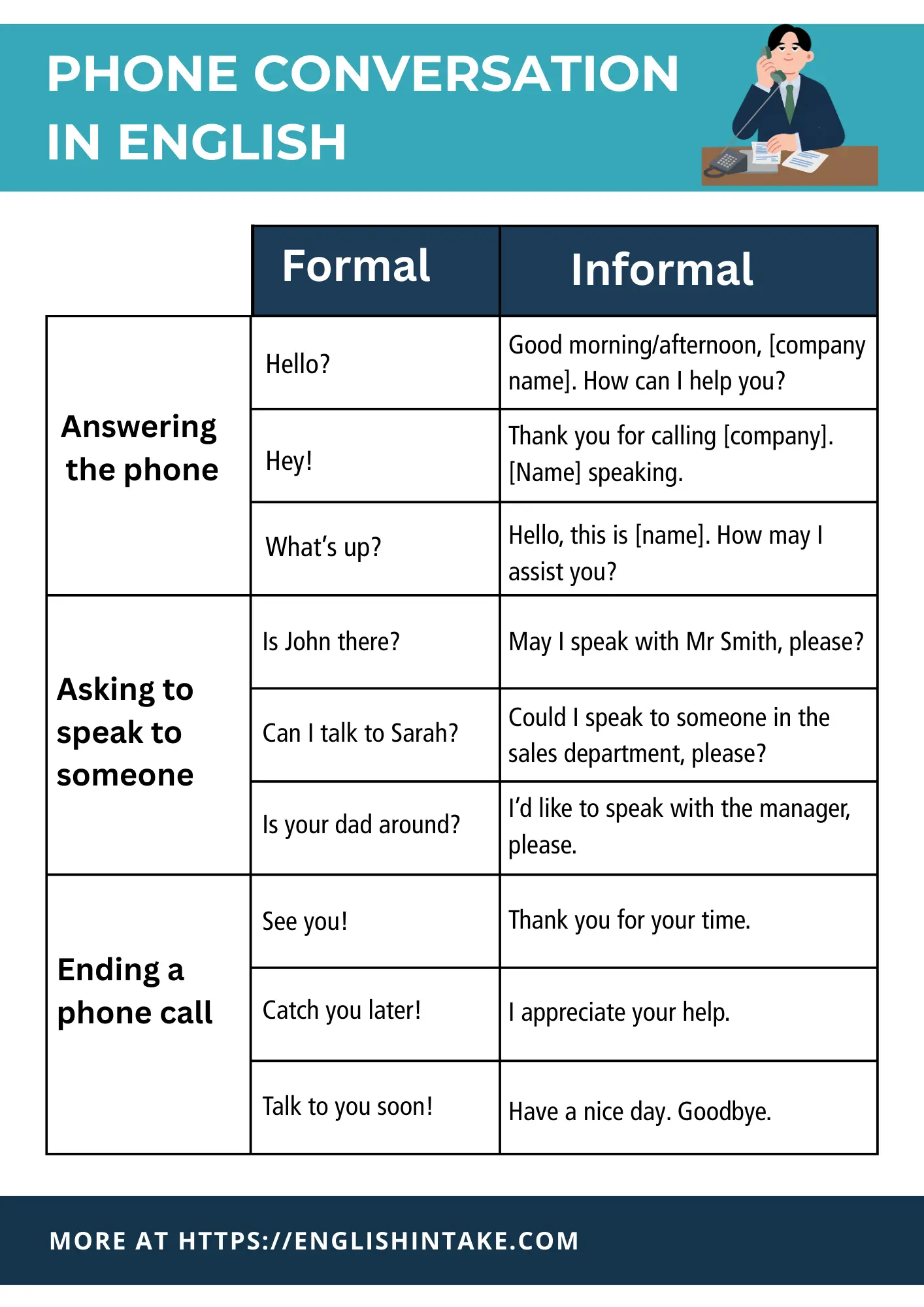
Here’s a summary of useful phrases organised by situation.
| Informal | Formal |
|---|---|
| Answering the phone | |
| Hello? | Good morning/afternoon, [company name]. How can I help you? |
| Hey! | Thank you for calling [company]. [Name] speaking. |
| What’s up? | Hello, this is [name]. How may I assist you? |
| Asking to speak to someone | |
| Is John there? | May I speak with Mr Smith, please? |
| Can I talk to Sarah? | Could I speak to someone in the sales department, please? |
| Is your dad around? | I’d like to speak with the manager, please. |
| Ending a call | |
| See you! | Thank you for your time. |
| Catch you later! | I appreciate your help. |
| Talk to you soon! | Have a nice day. Goodbye. |
The best way to improve your phone conversation skills is to practise regularly. Start with simple calls, like ordering food or making appointments. Record yourself while leaving voicemail messages and listen back. The more you do it, the more natural it becomes.
If you’re nervous about making calls in English, write down key phrases before you dial. Having notes in front of you can boost your confidence. It’s perfectly fine to ask the other person to speak slowly or repeat something. Most people are happy to help you.