
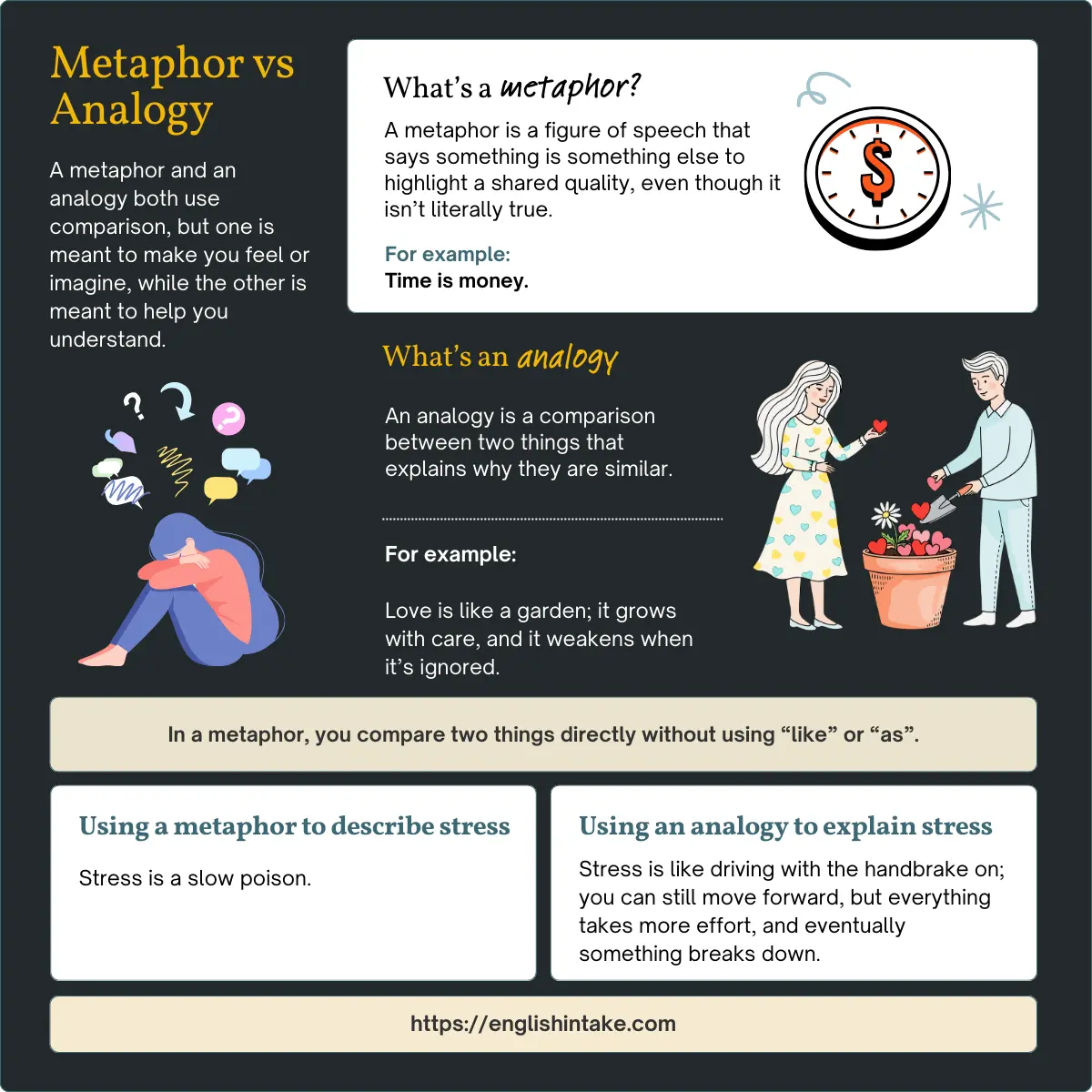
To understand the metaphor vs analogy difference, let's look at the two examples below.
- Time is money.
- Learning a language is like building a house. Vocabulary is the bricks, and grammar is the structure.
The first example is a metaphor because it makes a direct comparison to evoke imagery. The second sentence is an analogy, which spells out the reasoning behind the comparison to help you understand a concept more clearly.
1. Examples of metaphors
Here are some common metaphors you might encounter in everyday English:
- Time is money. (Time is compared directly to money, suggesting it has value and should not be wasted.)
- He has a heart of stone. (The person is not literally made of stone; rather, they are emotionally cold.)
- The world is a stage. (From Shakespeare's As You Like It, comparing life to a theatrical performance.)
- She's drowning in paperwork. (The person isn't actually underwater; they simply have too much work.)
- That exam was murder. (The exam was extremely difficult, not an actual crime.)
Notice how none of these statements are literally true. A heart cannot be made of stone, and an exam cannot commit murder. The power of metaphor lies in this imaginative leap, which helps readers understand abstract ideas through concrete, vivid imagery.
2. Examples of analogies
Here are some well-known analogies:
- "Life is like a box of chocolates; you never know what you're going to get." (From Forrest Gump; the comparison is explained by noting that both life and a box of chocolates contain surprises.)
- "Explaining a joke is like dissecting a frog. You understand it better, but the frog dies in the process." (E.B. White's famous analogy shows why analysing humour often destroys it.)
- "A computer's processor is like the human brain; both are responsible for computing and processing information." (This analogy helps beginners understand technology by connecting it to biology.)
- "Writing a book is like hacking away at a freezer with a screwdriver." (Actress Amy Poehler used this analogy to convey the frustration and slow progress of writing.)
Notice how each of these analogies does more than state a comparison. They explain the reasoning behind it to help the reader understand a concept more deeply.
3. The purpose of analogies
Writers and speakers use analogies primarily for three reasons:
- To explain complex ideas: Scientific concepts often become clearer when compared to everyday objects. For instance, comparing electricity to water flowing through pipes helps students visualise how current works.
- To make arguments more persuasive: Analogies can strengthen a point by showing that a similar situation led to a particular outcome.
- To help readers connect with unfamiliar topics: By linking new information to something the reader already knows, analogies create a bridge between the familiar and the unknown.
4. Main differences between metaphor and analogy
Although both metaphors and analogies involve comparisons, they serve different purposes and work in different ways. Try to understand these distinctions to help you use them effectively in your writing.
| Feature | Metaphor | Analogy |
|---|---|---|
| Primary purpose | To create a vivid image or emotional response | To explain, clarify, or argue a point logically |
| Length | Usually short (a phrase or sentence) | Often longer (includes explanation) |
| Structure | States that one thing is another | Often uses "like" or "as," then explains the similarity |
| Function | Figure of speech (literary device) | Type of reasoning or argument |
| Effect on reader | Invites the reader to feel | Encourages the reader to think |
| Explicit explanation | No explanation provided | Explanation is usually included |
Here is a simple way to remember the difference: a metaphor says something is something else, whilst an analogy explains how one thing is like another and why that matters.
5. Side-by-side example
Consider how the same comparison might work as either a metaphor or an analogy:
- Metaphor: "Love is a battlefield."
- Analogy: "Love is like a battlefield; both involve struggle, strategy, and the risk of getting hurt, and sometimes you wonder why you entered the fight in the first place."
The metaphor creates an immediate, powerful image. The analogy takes that same comparison and unpacks it, helping the reader understand exactly what the speaker means.
6. Metaphors vs analogies vs similes
A common source of confusion is the simile, which is related to both metaphors and analogies. A simile compares two things using the words "like" or "as," such as "Her smile was like sunshine."
Here is how these three devices relate to one another:
- A simile is a type of metaphor that uses "like" or "as" to signal the comparison explicitly.
- A metaphor makes the comparison directly, without "like" or "as."
- An analogy can use either metaphors or similes, but it always includes an explanation of the comparison.
Think of it this way: all similes are metaphors (in the broad sense of figurative comparisons), but not all metaphors are similes. And whilst analogies may contain similes or metaphors, they go further by explaining the logic behind the comparison.
4.1 Quick comparison
| Device | Example | Uses "like" or "as"? | Includes explanation? |
|---|---|---|---|
| Simile | "He ran like the wind." | Yes | No |
| Metaphor | "He is the wind." | No | No |
| Analogy | "He moves like the wind; just as the wind travels without obstacles, he navigates problems effortlessly." | Usually yes | Yes |
5. When to use metaphors vs analogies
The metaphor vs analogy choice depends on your purpose as a writer. Each has its strengths, and skilled writers know when to use one over the other.
5.1 Use a metaphor when:
- You want to create a vivid image quickly.
- You wish to evoke emotion rather than explain something logically.
- You are writing poetry, fiction, or creative prose where imagery matters.
- You want to make your language more engaging and memorable.
For example, if you are writing a short poem about loneliness, a metaphor like "I am an island" communicates isolation instantly and emotionally.
5.2 Use an analogy when:
- You need to explain a complex concept clearly.
- You are writing academic, technical, or persuasive texts.
- You want to build an argument by showing how two situations are similar.
- Your reader may be unfamiliar with the topic and needs a bridge to understanding.
For instance, if you are explaining how a computer's memory works to a beginner, an analogy like "Computer memory is like a filing cabinet; it stores information in specific locations so you can retrieve it later" makes the concept accessible.
6. Exercise
For each sentence, decide whether it contains a metaphor, a simile, or an analogy:
1. "Her voice was music to my ears."
2. "Learning a language is like climbing a mountain; the higher you go, the clearer the view becomes."
3. "The news hit me like a ton of bricks."
4. "My brother is a walking encyclopaedia."
5. "Teaching without enthusiasm is like trying to drive a car without fuel; you simply won't get anywhere."