
In this guide, you will find many oxymoron examples that can help you understand this literary device and use it to add elegance to your writing.
1. What is an oxymoron?
An oxymoron is a figure of speech that places two contradictory or opposite words together to create a new meaning. The word itself comes from ancient Greek; "oxys" means sharp, whilst "moros" means dull or foolish. So the term "oxymoron" is, rather cleverly, an oxymoron itself.
When you hear phrases like "deafening silence" or "bittersweet," you are encountering oxymorons. These word combinations may seem nonsensical at first glance, but they actually express complex ideas that single words cannot capture.
1.1 Importance
Understanding oxymorons helps you grasp how native speakers use contradiction to add depth to their language. You will encounter them in everyday conversation, literature, advertising, and news media. Recognising them improves both your comprehension and your ability to express nuanced thoughts.
More importantly, oxymorons reveal something fascinating about how English handles complexity. Rather than avoiding contradictions, the language embraces them to capture emotions and situations that are inherently paradoxical.
2. Common oxymoron examples in everyday English
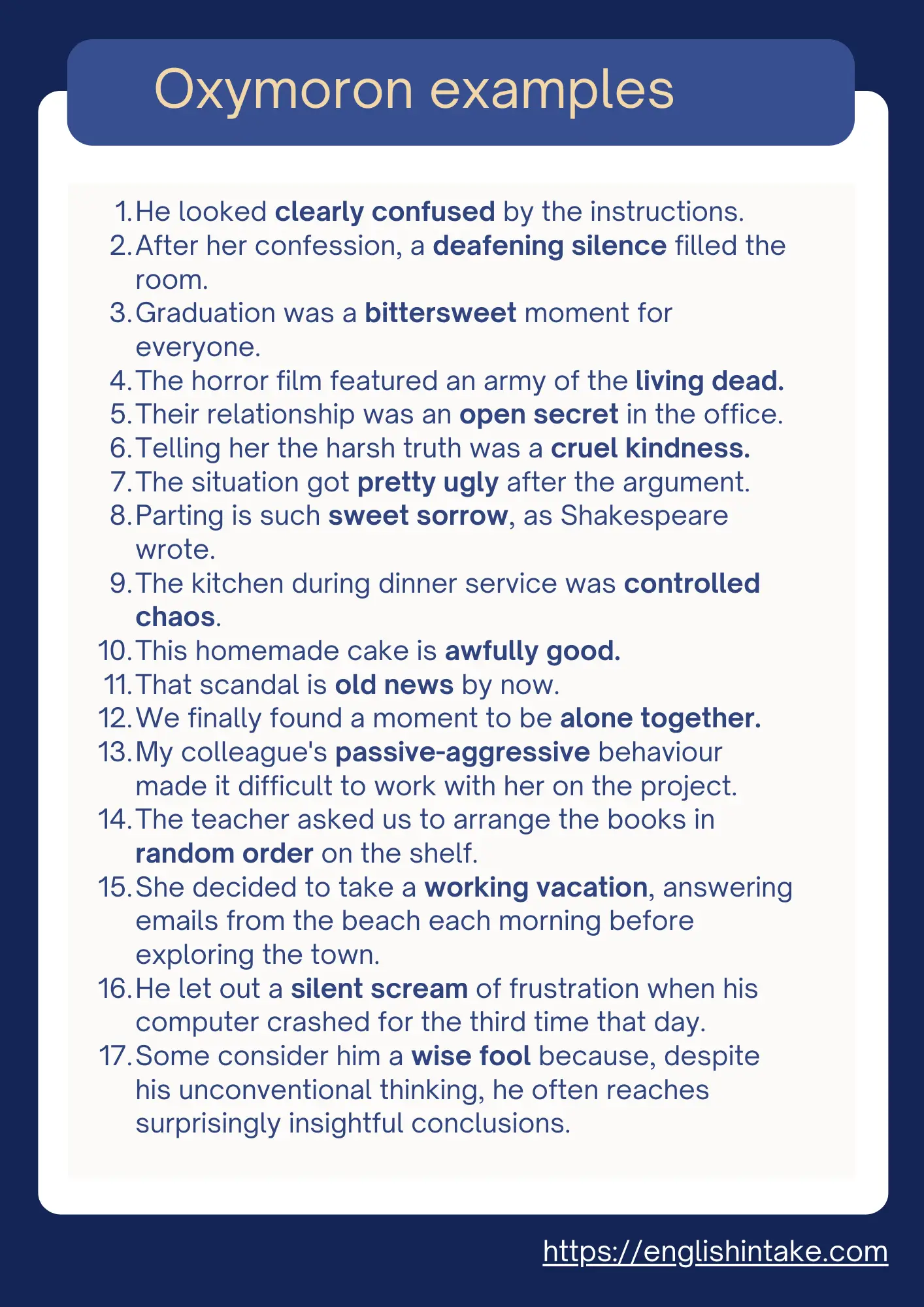
You probably use oxymorons more often than you realise. Many have become so embedded in daily speech that we no longer notice their contradictory nature. Here are some of the most frequently used examples, organised by category.
2.1 Describing size and quantity
"Jumbo shrimp" remains one of the most cited oxymoron examples. "Jumbo" means large, whilst "shrimp" suggests something small. Together, they simply describe larger-than-average prawns, but the contradiction makes the phrase memorable.
Other examples in this category include "small crowd," "only choice," and "alone together." Each pairs opposing concepts of size or quantity to express something more specific than either word alone could convey.
2.2 Expressing emotions
"Bittersweet" perfectly captures experiences that bring both joy and sadness simultaneously. Think of a graduation ceremony or saying goodbye to a beloved home; the feeling is neither purely happy nor entirely sad.
Similarly, "love-hate relationship" describes those complex connections where strong positive and negative feelings coexist. You might also hear "terribly pleased" or "awfully good," where negative intensifiers strengthen positive meanings.
2.3 Business and media
The business world has adopted several oxymorons. "Virtual reality" combines the non-physical (virtual) with the physical (reality). "Working holiday" pairs labour with leisure. "Negative growth" softens the blow of declining profits.
News media frequently uses "old news" (information that is no longer new but still called news) and "clearly confused" (where confusion, by nature, lacks clarity).
3. Oxymoron examples from literature
Writers have long recognised the power of oxymorons to convey complex emotions and situations. Literature provides some of the finest and most memorable examples of this device in action.
3.1 Shakespeare oxymoron examples in Romeo and Juliet
William Shakespeare used oxymorons extensively, particularly in Romeo and Juliet. The play explores forbidden love between members of feuding families, making contradiction central to its themes.
In Act 1, Romeo describes his feelings with a cascade of oxymorons: "O brawling love, O loving hate... feather of lead, bright smoke, cold fire, sick health." These phrases capture the paradoxical nature of intense emotion; love that feels like fighting, lightness that weighs heavily, brightness that obscures.
Juliet uses equally powerful oxymorons when she learns Romeo killed her cousin Tybalt. She calls him a "beautiful tyrant" and "fiend angelical," expressing her internal conflict between love and betrayal.
The play's most famous oxymoron appears when Juliet says, "Parting is such sweet sorrow." This phrase has become so iconic that many English speakers use it without realising its Shakespearean origin. The sweetness of their love makes separation painful, yet that very pain confirms the depth of their connection.
3.2 Oxymorons in poetry
Poets frequently employ oxymorons to compress complex ideas into memorable phrases. W.B. Yeats wrote of a "terrible beauty" being born in his poem about the 1916 Easter Rising in Ireland. The phrase captures how something devastating can simultaneously create something magnificent.
The Petrarchan sonnet tradition, which influenced poets for centuries, often described love through oxymorons. Francesco Petrarch, who created this form, wrote of "sweet anger" and "sweet bitterness" to express how love mingles pleasure with pain.
Claude McKay, the Jamaican-American poet, used the oxymoron "cultured hell" in his sonnet "America" to describe his complicated feelings about a country that offered opportunity whilst perpetuating racism. The phrase captures a nation's contradictions in just two words.
4. The difference between oxymoron and paradox
Many English learners confuse oxymorons with paradoxes. Whilst both involve contradictions, they function differently and understanding this distinction will sharpen your grasp of figurative language.
An oxymoron typically consists of just two words placed together that contradict each other. A paradox, by contrast, is a complete statement or idea that seems self-contradictory but reveals a deeper truth upon reflection.
Consider the oxymoron "alone together." These two words contradict each other directly. Now compare that to the paradox "the only constant is change." This full statement appears contradictory (how can something constant be about change?) but expresses a genuine insight about life.
The phrase "deafening silence" is an oxymoron; two opposing words creating immediate impact. The statement "I know that I know nothing," attributed to Socrates, is a paradox; a full idea that seems contradictory but contains wisdom.
Another way to remember: oxymorons hit you quickly with their contradiction, whilst paradoxes require contemplation to unpack their meaning. Both are valuable rhetorical tools, but they achieve their effects through different mechanisms.
5. How to identify oxymorons
Spotting oxymorons becomes easier once you know what to look for. Here is a practical approach to recognising them in speech and writing.
5.1 Structure
Most oxymorons follow one of these patterns. The most common is an adjective followed by a noun, such as "cruel kindness" or "living death." Another pattern pairs an adverb with an adjective, as in "clearly confused" or "seriously funny."
You will also find compound words that function as oxymorons, like "bittersweet" or "frenemy" (friend plus enemy). Some oxymorons appear as short phrases, such as "act naturally" or "same difference."
5.2 Identification
Not every unusual word combination qualifies as an oxymoron. To confirm you have found one, ask yourself: do these words have genuinely opposite meanings? If the words merely seem odd together without true contradiction, the phrase is probably not an oxymoron.
Also consider whether the combination creates a new, meaningful concept. True oxymorons produce insight or emphasis through their contradiction. Random contradictory words thrown together (like "hot snow" without context) lack the purposeful impact of genuine oxymorons.
6. Oxymoron examples organised by category
For easy reference, here are oxymoron examples grouped by how you might encounter them. These lists will help you recognise and use oxymorons appropriately.
6.1 In conversation
Everyday speech contains numerous oxymorons that have become so familiar we rarely notice them. These include "pretty ugly," "same difference," "act naturally," "definite maybe," "original copy," and "clearly misunderstood."
You might also hear "good grief," "exact estimate," "open secret," "passive aggressive," "living dead," and "random order." Each of these combines opposing ideas into accepted expressions.
6.2 In titles and advertising
Creative industries love oxymorons because they capture attention. Films like "True Lies" and "Eyes Wide Shut" use contradictory titles to intrigue audiences. The band Simon and Garfunkel famously sang about "The Sound of Silence."
Advertisers use phrases like "new and improved" (if something is new, why does it need improvement?) or "free gift" (gifts are, by definition, free). These oxymorons have become marketing clichés precisely because they work.
6.3 Humorous and satirical oxymorons
Some oxymorons are created deliberately for comic effect or social commentary. People joke about "military intelligence," "government organisation," "airline food," and "business ethics."
Whilst these examples often rely on cynical stereotypes rather than true contradiction, they demonstrate how oxymorons can serve humour and criticism. The format itself signals that the speaker finds irony in the combination.
7. Using oxymorons in your own writing
Now that you understand oxymorons, you can begin incorporating them into your own English expression. Used well, they add sophistication and memorability to your communication.
Oxymorons work particularly well when you need to express complex or mixed emotions. If you want to describe a bittersweet experience, a situation with both positive and negative aspects, or a feeling that seems contradictory, an oxymoron might be your best tool.
They also add emphasis. Describing a silence as "deafening" makes it more powerful than simply calling it "very quiet." The contradiction forces readers to pause and consider the intensity you are conveying.
Like any rhetorical device, oxymorons lose impact through overuse. If every sentence contains a contradiction, readers become numb to the effect. Use them sparingly and purposefully.
Be aware that many oxymorons have become clichés through overuse. Phrases like "deafening silence" and "bittersweet" are effective but familiar. For maximum impact in creative writing, consider crafting fresh oxymorons that fit your specific context rather than relying solely on established examples.