
Have you ever heard someone say "the wind whispered through the trees" or "my alarm clock screamed at me this morning"? These sentences use a technique called personification.
1. What is personification?
Personification is when you give human qualities, actions, or emotions to something that is not human. This includes objects, animals, ideas, and forces of nature. When you personify something, you describe it as if it were a person.
The word comes from the Latin "persona" (meaning "person") and "facere" (meaning "to make"). So personification literally means "to make into a person."
Think of it this way. If something cannot actually do what a human does, but you describe it as doing that thing, you are using personification. For example, the sun cannot smile, but if you write "the sun smiled down on us," you have personified the sun.
This technique helps readers connect emotionally with non-human things. When we give objects or ideas human traits, they become easier to understand and relate to.
2. How to identify personification
Here is a simple three-step method to check if a sentence contains personification. First, find the subject of the sentence (what or who is doing the action). Second, ask yourself: is this subject human or non-human? Third, look at the verb or description: is this action or quality something only humans can truly do or have?
If the subject is non-human but the action or quality is human, you have found personification. For example, in "the flowers danced in the breeze," the subject (flowers) is non-human, but dancing is a human action.
3. Personification examples
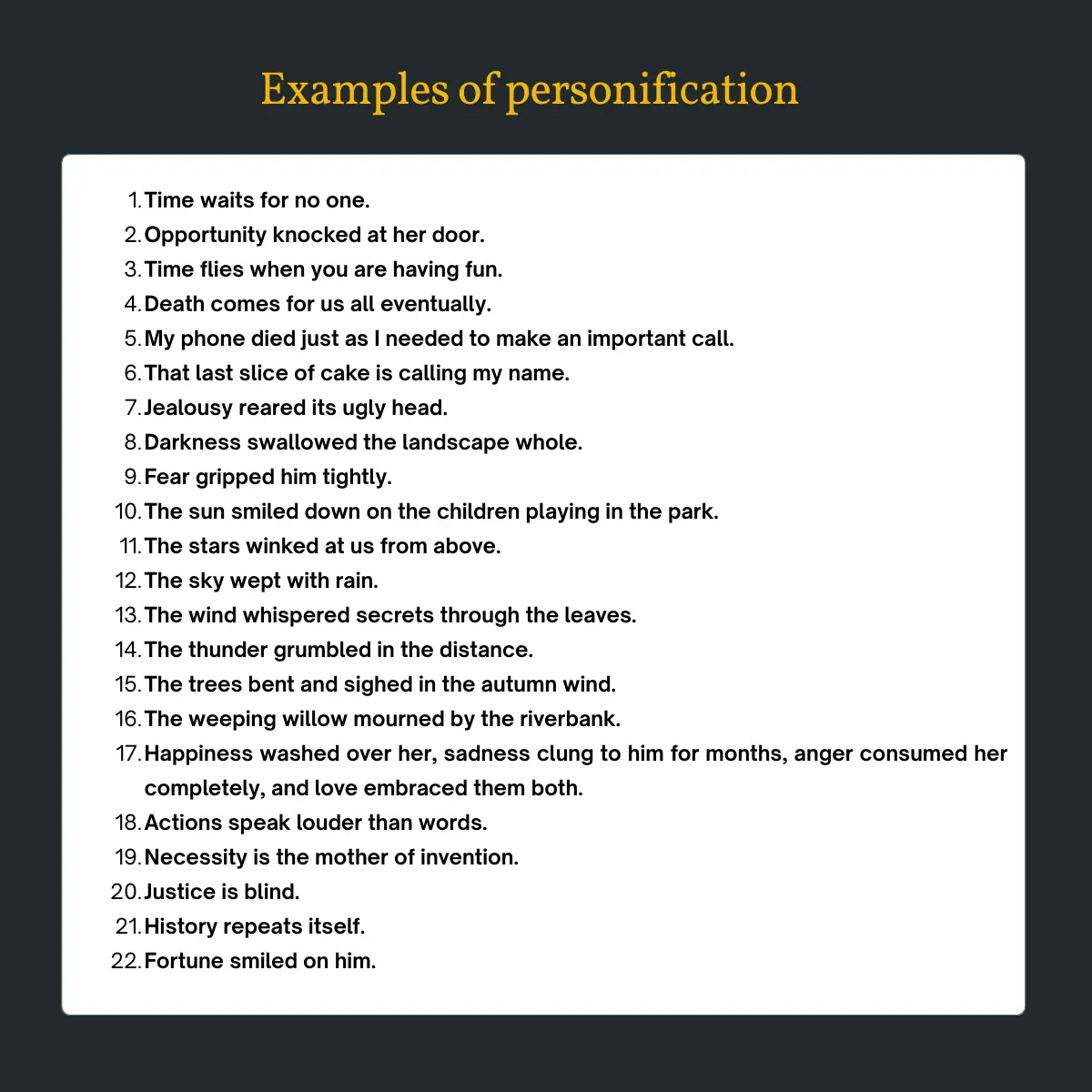
Here are many personification examples that show how the writing feel more vivid, emotional, and easy to imagine.
1. The sun smiled down on the children playing in the park.
2. The clouds lazily drifted across the afternoon sky.
3. The sun peeked through the curtains.
4. The moon watched over the sleeping village.
5. The stars winked at us from above.
6. The sky wept with rain.
7. The wind whispered secrets through the leaves.
8. The storm raged across the coastline, destroying everything in its path.
9. The breeze caressed her cheek.
10. The thunder grumbled in the distance.
11. The hurricane punished the city.
12. The fog crept silently through the streets.
13. The flowers were begging for water.
14. The trees bent and sighed in the autumn wind.
15. The grass reached towards the sunlight.
16. The weeping willow mourned by the riverbank.
17. The vines embraced the old stone wall.
18. The roses nodded their heads in greeting.
19. My computer refuses to cooperate today.
20. My phone died just as I needed to make an important call.
21. The printer stubbornly jammed again.
22. The internet has been temperamental all week.
23. My car coughed and wheezed before finally starting.
24. The old laptop groaned under the weight of too many programmes.
25. My alarm clock screamed at me to wake up.
26. The kettle sang cheerfully as the water boiled.
27. The stairs groaned under his weight.
28. The front door protested with a loud creak.
29. The old chair embraced me with its soft cushions.
30. That last slice of cake is calling my name.
31. The aroma of fresh coffee greeted me as I entered the kitchen.
32. The chocolate cake was tempting me from across the room.
33. Time waits for no one.
34. Opportunity knocked at her door.
35. Life has a way of surprising us.
36. Time flies when you are having fun.
37. The years crept by slowly.
38. Fate smiled upon them that day.
39. Fear gripped him tightly.
40. Jealousy reared its ugly head.
41. Happiness washed over her, sadness clung to him for months, anger consumed her completely, and love embraced them both.
42. Death comes for us all eventually.
43. Darkness swallowed the landscape whole.
4. Literature and poetry
Many famous writers have used personification to create memorable imagery. Studying these examples from literature can help you understand how professional authors employ this technique effectively.
4.1 Classic poetry
In William Wordsworth's famous poem "I Wandered Lonely as a Cloud," he describes daffodils as "fluttering and dancing in the breeze." Flowers cannot dance; this is a human activity. Wordsworth uses personification to convey the lively, joyful movement of the flowers.
Emily Dickinson frequently personified abstract concepts. In her poem "Because I could not stop for Death," she writes that Death "kindly stopped for me." Death becomes a gentleman caller with a carriage, transforming something frightening into something almost courteous.
John Donne's "Death, be not proud" directly addresses Death as if it were a person, commanding it not to feel proud. William Blake similarly personified nature in his poetry, writing "O Rose, thou art sick" as though the rose could fall ill like a human.
4.2 Prose and novels
In "The Great Gatsby," F. Scott Fitzgerald describes the eyes on a billboard as watching over a valley. These painted eyes become almost god-like observers, personified to suggest judgement and surveillance over the characters below.
Ernest Hemingway personified the sea throughout "The Old Man and the Sea," referring to the ocean as "she" and describing her as giving or withholding favours. This personification reflects the old fisherman's deep relationship with the sea.
Shirley Jackson's "The Haunting of Hill House" personifies the house itself, describing it as insane, watching, and waiting. The house becomes almost a character in its own right, creating an intensely creepy atmosphere.
4.3 Children's literature
Children's books frequently use personification to make stories more engaging for young readers. In "The Giving Tree" by Shel Silverstein, a tree experiences human emotions like happiness, love, and sadness. The tree gives everything it has to a boy throughout his life.
The nursery rhyme "Hey Diddle Diddle" contains several examples: the dish ran away with the spoon, and the little dog laughed. These impossible scenarios capture children's imaginations precisely because everyday objects behave like people.
5. Personification vs anthropomorphism
Many learners confuse personification with anthropomorphism. While both involve giving human qualities to non-human things, there is an important difference between them.
5.1 The key difference
Personification is figurative language. When you say "the wind whispered," you do not literally mean the wind has a mouth and speaks. It is a comparison, a way of describing something non-human using human terms.
Anthropomorphism, on the other hand, is literal. When animals or objects are portrayed as actually having human characteristics (talking, wearing clothes, having complex thoughts), that is anthropomorphism.
5.2 Comparing examples
Consider these two examples. Personification: "My dog cried mournfully as I left, begging me not to leave him alone." The dog displays human-like behaviour metaphorically, but does not literally speak or beg with words.
Anthropomorphism: In Disney's "Beauty and the Beast," household objects like a candlestick and a clock actually talk, have personalities, and behave exactly like humans. They are literally portrayed as people in object form.
Mickey Mouse, Winnie the Pooh, and the animals in "Animal Farm" are all examples of anthropomorphism. The animals talk, make decisions, and behave as humans genuinely would; this is not figurative language but literal character design.
6. Why writers use personification
Understanding why writers choose this technique will help you use it more effectively in your own writing. Personification serves several important purposes.
6.1 Creating vivid imagery
Personification helps readers visualise descriptions more clearly. Compare "the sun rose" with "the sun stretched its golden arms across the horizon and smiled down at the waking world." The second version creates a much richer mental picture.
By connecting non-human things to human actions we all recognise, writers make their descriptions more immediate and engaging. Readers can easily imagine these scenes because they relate to human experience.
6.2 Building emotional connection
When writers personify objects or nature, readers can connect emotionally with these elements. A "weeping sky" evokes sadness; a "smiling sun" creates happiness. The human qualities transfer their emotional associations.
This technique is particularly useful when describing settings. A "welcoming cottage" or a "hostile mountain" immediately tells readers how to feel about these places without lengthy descriptions.
6.3 Explaining abstract ideas
Abstract concepts like justice, time, or death are difficult to describe. By personifying them (Justice is blind, Time marches on, Death knocked at his door), writers make these ideas concrete and easier to grasp.
This is why personification appears so frequently in proverbs and sayings. Phrases like "opportunity knocks" or "money talks" communicate complex ideas simply and memorably.
7. How to write your own personification
Now that you understand what personification is and why writers use it, here is how to create your own. Follow these practical steps to add this technique to your writing.
7.1 A simple formula
The basic formula for personification is: non-human subject + human verb or adjective. Choose something non-human (an object, animal, or idea), then describe it using a word that typically applies only to humans.
Start with the object: a car. Think of human actions: complain, protest, sigh, refuse. Combine them: "The old car complained loudly every morning before starting." You have created personification.
7.2 Choosing effective verbs
Strong verbs create better personification. Instead of generic human verbs like "did" or "was," choose specific, expressive verbs. Compare "the house was old" with "the house groaned with age."
Consider these verb categories for inspiration: speaking verbs (whisper, shout, murmur), emotional verbs (mourn, rejoice, sulk), physical action verbs (dance, embrace, creep), and mental verbs (remember, forget, dream).
7.3 Matching mood to meaning
Your personification should match the tone you want to create. For a happy scene, use positive human qualities: the sun smiled, the birds sang cheerfully, the flowers nodded welcomingly. For a dark scene, use negative ones: the shadows lurked, the wind howled, the house frowned.
Ask yourself what emotion you want readers to feel, then choose human characteristics that evoke that emotion. A "friendly" river feels different from an "angry" one, though both are personified water.
8. Incorrect usage of personification
As you practise writing personification, watch out for these common errors that can weaken your writing or confuse your readers.
7.1 Overusing the technique
Like any literary device, personification loses its impact when overused. If every sentence personifies something, the technique becomes tiresome rather than effective. Use it selectively for maximum impact.
Choose the most important elements in your scene to personify. Not every tree needs to dance, and not every cloud needs to weep. Save personification for moments when you truly want readers to pay attention.
8.2 Being inconsistent
If you personify something in a particular way, maintain consistency. Do not describe the sun as a gentle friend in one paragraph and then as an angry enemy in the next (unless showing a deliberate change).
The human qualities you assign should make sense together. A "shy" flower that later "shouts" would confuse readers unless you explain the transformation.
8.3 Forcing unnatural comparisons
Good personification feels natural, even though it describes impossible things. The human quality should somehow fit the non-human subject. Rain "falling sadly" makes sense; rain "laughing loudly" feels strange unless there is a specific reason.
Consider what qualities the non-human subject naturally has that could connect to human traits. Wind moves, so verbs like "rushing" or "creeping" work well. Rocks are still and solid, so "patient" or "stubborn" fit better than "dancing."
9. Practice exercises
The best way to master personification is through practice. Try these exercises to develop your skills.
8.1 Exercise one: identify the personification
Read each sentence and identify what is being personified and what human quality it receives. The lonely house watched visitors pass by without stopping. (Answer: the house is personified with the ability to watch and feel lonely.)
More sentences to analyse: Time heals all wounds. The book transported her to another world. Fear wrapped its cold fingers around his heart. The city never sleeps.
8.2 Exercise two: create your own
Choose five objects from your home and write a sentence personifying each one. For example: my coffee mug, my bed, my front door, my bookshelf, and my mirror. Remember to use human verbs or emotions.
Challenge yourself further by writing a short paragraph where you personify the weather to match a particular mood (joy, fear, sadness, or excitement). Notice how different human qualities change the atmosphere of your writing.