
Of the three main points of view in English, second person stands apart as the rarest perspective in fiction. Writers and readers alike find this "you" narration challenging, yet when used effectively, it creates an immediacy no other perspective can match.
1. What is second person point of view?
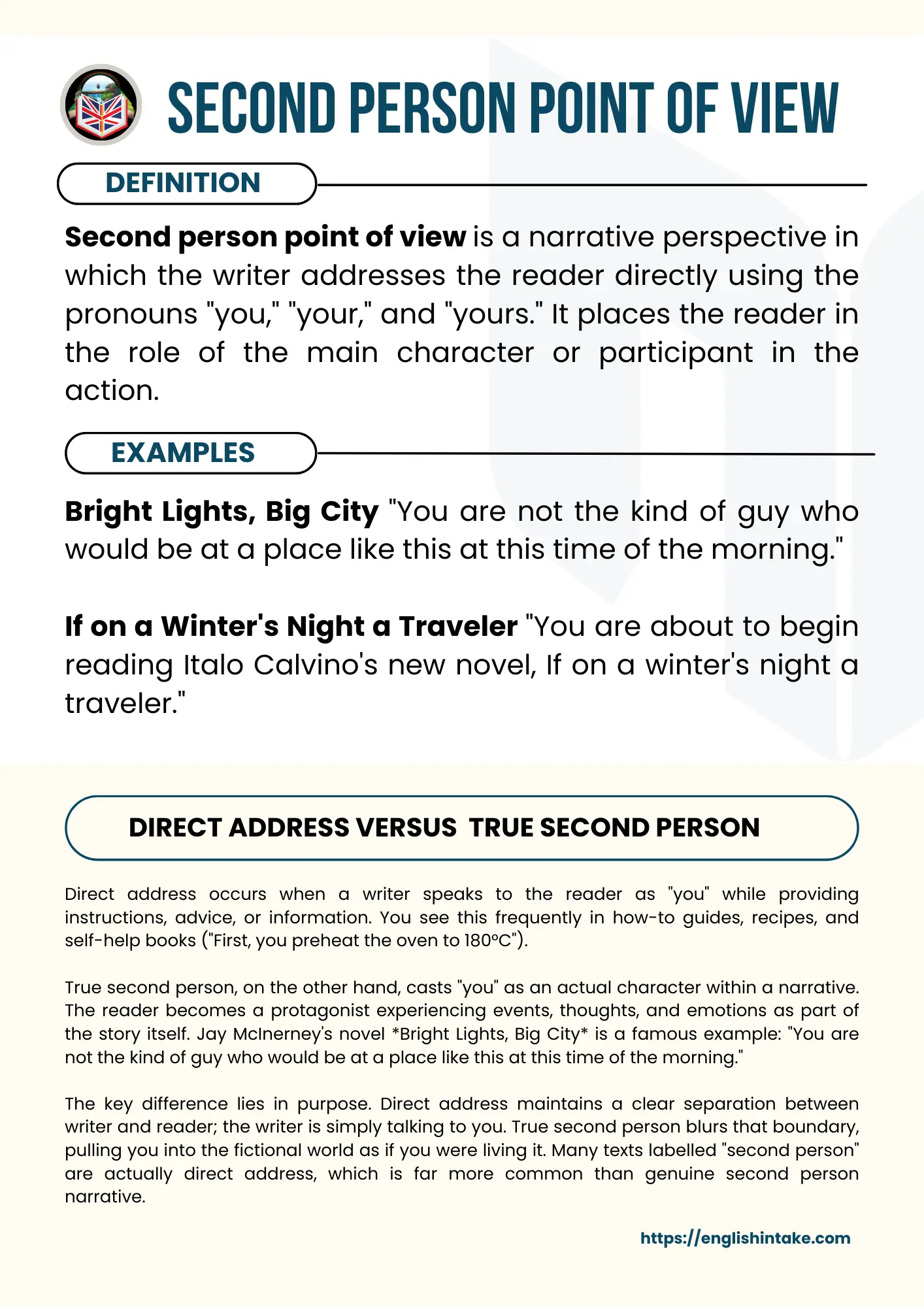
Second person point of view is a narrative perspective that addresses the reader directly using the pronoun "you." Unlike first person point of view, where the narrator speaks about themselves, second person places you, the reader, at the centre of the action. You become the character experiencing the events.
This perspective is the rarest of the three main points of view in literature, yet it appears frequently in everyday communication. When someone gives you directions, offers advice, or writes instructions, they are using second person. The difference in creative writing is that second person asks you to inhabit a character's experience rather than simply receive information.
1.1 The pronouns of second person
Identifying second person is straightforward once you know which pronouns to look for. Unlike first and third person, second person has fewer pronoun variations because "you" serves as both the subject and object form.
| Type | Singular | Plural |
|---|---|---|
| Subject pronoun | you | you |
| Object pronoun | you | you |
| Possessive determiner | your | your |
| Possessive pronoun | yours | yours |
| Reflexive pronoun | yourself | yourselves |
Notice that "you," "your," and "yours" remain the same whether addressing one person or many. Only the reflexive pronouns distinguish between singular ("yourself") and plural ("yourselves"). This simplicity makes second person easy to identify but also creates ambiguity about whether the "you" refers to one reader or a general audience.
2. How second person differs from other points of view
Understanding second person becomes clearer when you compare it directly with the other perspectives. Each point of view creates a distinct relationship between the narrator, the characters, and the reader.
In first person, the narrator says "I walked into the room." In second person, the narrator says "You walk into the room." In third person, the narrator says "She walked into the room." The shift from "I" to "you" to "she" fundamentally changes how readers experience the story.
2.1 The direct address factor
What makes second person unique is its direct address. The narrative speaks to you as though you are present, participating, and responsible for the actions described. This creates an unusual intimacy; or, for some readers, an uncomfortable intrusion.
The second person places the reader "on the playing field" by putting them in the position of the protagonist. You are not watching events unfold from outside; you are meant to experience them as your own.
3. Why second person is rare in fiction
Walk into any bookshop and examine the novels on display. The vast majority will be written in first or third person. Second person remains conspicuously rare in long-form fiction, and there are good reasons for this scarcity.
Sustaining second person narration over hundreds of pages is technically demanding. The constant repetition of "you" can become wearying, and the perspective limits what the narrator can describe. When you cannot see yourself, describing your own appearance becomes awkward. When the narrative tells you what you think and feel, some readers resist: "But I wouldn't do that!"
3.1 The immersion problem
Second person works by asking readers to surrender their own identity and become the character addressed. Not all readers are willing to make this leap. If the narrative describes actions or emotions that feel foreign, the illusion shatters.
Imagine reading: "You slap your friend across the face." If you would never do such a thing, the narrative loses credibility. You are pulled out of the story by the narrative device meant to draw you in. This tension between immersion and resistance makes second person a high-risk narrative choice.
3.2 When distance becomes closeness
Paradoxically, second person can also create emotional distance. Some writers use "you" as a way for narrators to dissociate from their own experiences. Rather than saying "I made terrible mistakes," a narrator might say "You made terrible mistakes," as though observing themselves from outside.
This technique appears in confessional writing where the narrator struggles to confront painful memories directly. The "you" becomes a shield, allowing examination of difficult experiences whilst maintaining psychological distance from them.
4. Where second person thrives
Despite its challenges in fiction, second person dominates several other forms of writing. Recognising these contexts helps you understand when this perspective works effectively and why.
4.1 Instructional and how-to writing
Recipes, manuals, tutorials, and guides rely heavily on second person. "Preheat your oven to 180 degrees. Mix your dry ingredients in a large bowl." This direct address feels natural because the reader genuinely is the person performing the actions.
The second person works well for giving advice or explaining how to do something, making process analysis papers a good choice for this perspective.
4.2 Advertising and persuasive writing
Marketing copy uses second person to create connection and urgency. "You deserve a holiday. Your family will thank you. Treat yourself today." By addressing potential customers directly, advertisers forge an immediate relationship and make their pitch personal.
This technique extends to self-help books, motivational speeches, and any writing that aims to persuade or inspire action. The direct address implies understanding: the writer knows you, sees your struggles, and offers solutions tailored to your needs.
4.3 Interactive fiction and gaming
Second person found its natural home in interactive storytelling. Choose Your Own Adventure books, which sold over 250 million copies between the late 1970s and 1990s, used "you" throughout: "If you decide to enter the cave, turn to page 47. If you decide to climb the mountain, turn to page 63."
Video games and text adventures adopted this convention because players genuinely control the protagonist's actions. When a game tells you "You enter the dungeon" or "You have collected a sword," the second person accurately describes the player's role. The perspective transforms from literary device to functional description.
5. Famous examples in literature
While rare, several acclaimed works have successfully employed second person narration. Studying these examples reveals how skilled writers overcome the perspective's challenges.
5.1 Bright Lights, Big City
Jay McInerney's 1984 debut novel remains the most famous example of sustained second person narration in literary fiction. The novel opens: "You are not the kind of guy who would be at a place like this at this time of the morning."
McInerney uses second person to immerse readers in the disorienting nightlife of 1980s New York. The protagonist's confusion, self-deception, and substance abuse feel more immediate when filtered through "you." Readers cannot maintain comfortable distance from a character who is grammatically themselves.
5.2 If on a Winter's Night a Traveler
Italo Calvino's experimental 1979 novel uses second person to address the reader as a character within the story. "You are about to begin reading Italo Calvino's new novel, If on a winter's night a traveler." The book becomes a meditation on reading itself, with "you" representing the reader's experience of encountering texts.
Calvino's approach differs from McInerney's because "you" and the reader are meant to be genuinely identical. The novel comments on its own nature as a book being read by someone who exists outside its pages.
5.3 The Fifth Season
N.K. Jemisin's Hugo Award-winning fantasy novel uses second person for one of its narrative threads. The technique serves a specific purpose: the protagonist has experienced trauma so severe that she cannot speak of herself directly. The "you" reflects her psychological fragmentation.
Jemisin demonstrates how second person can serve characterisation rather than mere stylistic novelty. The perspective choice reveals something essential about who the character is and what she has endured.
6. Second person in short fiction
Second person appears more frequently in short stories than novels. The compressed form allows experimentation without exhausting readers over hundreds of pages.
6.1 Lorrie Moore's Self-Help
Lorrie Moore's 1985 story collection Self-Help uses second person throughout, mimicking the tone of advice columns and how-to guides. Stories like "How to Be an Other Woman" offer darkly comic instructions for situations no one should need guidance navigating.
Moore's titles signal the device immediately: "How to Talk to Your Mother (Notes)," "How to Become a Writer." The second person creates ironic distance even as it draws readers into painful emotional territory.
6.2 When short form succeeds
Short stories can sustain second person because readers encounter the perspective briefly. The novelty engages rather than exhausts. Writers can exploit the technique's immediacy without testing its limits over extended reading sessions.
Many creative writing workshops encourage experimenting with second person in flash fiction or short stories before attempting longer works. The form allows writers to understand the perspective's effects without committing to its challenges at novel length.
7. The implied "you" in instructions
Sometimes second person operates without the pronoun appearing at all. Imperative sentences, which give commands or instructions, have an understood "you" as their subject even when unstated.
"Open the door. Walk inside. Sit down." Each of these commands addresses "you" without stating it explicitly. The full versions would read: "(You) open the door. (You) walk inside. (You) sit down." This implied second person is so common in instructional writing that we rarely notice it.
7.1 Recipes and directions
Cookbooks overwhelmingly use imperative constructions: "Dice the onions. Sauté until translucent. Add garlic and cook for one minute." The understood "you" keeps instructions concise whilst maintaining the direct address that makes them actionable.
Similarly, navigation directions use imperatives: "Turn left at the roundabout. Continue for two miles. Take the third exit." The implicit "you" guides someone through physical space using second person without stating the pronoun.
8. Direct address versus true second person
Not every use of "you" constitutes second person point of view. This distinction confuses many learners, so understanding the difference is essential.
8.1 When "you" appears in first person
A first person narrator might address someone directly: "I was walking to meet you when I slipped in a puddle." This sentence uses "you," but the narrative remains first person because "I" is telling the story. The "you" refers to a character within the narrative, not to the reader experiencing it.
This technique, called direct address, appears in letters, speeches, and dialogue. A character saying "You wouldn't believe what happened" is not shifting the entire narrative into second person; they are simply speaking to someone.
8.2 The crucial distinction
True second person point of view makes "you" the protagonist whose actions and experiences drive the narrative. "You wake up. You do not recognise the room. You reach for your phone but find only empty sheets." Here, "you" is not a character being addressed; "you" is the character living the story.
The difference lies in whether "you" receives the story or inhabits it. Direct address speaks to someone; second person point of view speaks as someone.
9. Second person in academic writing
Academic conventions generally discourage second person, though this rule has nuances worth understanding.
9.1 Why academics avoid "you"
Formal academic writing typically uses third person to create objectivity and professional distance. "You" can seem too casual and may alienate readers who do not identify with the statements being made.
Consider: "You can see from the data that pollution levels have increased." This assumes all readers will interpret the data identically. The Scribbr style guide notes that second person should be avoided in academic writing because it presumes too much about the reader's perspective.
9.2 When "you" might be acceptable
Some contexts permit second person even in academic settings. Instructions within an assignment ("You will write a 2,000-word essay") appropriately use direct address. Reflective writing that asks students to consider their own experiences may invite second person responses.
Always check specific guidelines for your institution, discipline, or publication. The rules vary, and what one instructor prohibits, another may encourage.
10. Advantages of second person
Despite its challenges, second person offers unique effects that no other perspective can achieve. Understanding these advantages helps you recognise when the perspective serves a text well.
10.1 Maximum immediacy
Second person creates the most immediate reading experience possible. Events happen to "you" in the present moment. There is no intermediary narrator, no temporal distance, no escape into observing someone else's story.
Combined with present tense, second person can produce almost visceral intensity: "You hear footsteps behind you. Your heart accelerates. You walk faster." The reader's nervous system may respond as though the threat were real.
10.2 Forced complicity
When a narrator describes morally questionable actions in second person, readers cannot easily distance themselves. "You lie to your mother. You take the money. You walk away without looking back." The grammar implicates the reader in the character's choices.
This complicity can serve powerful thematic purposes. Writers exploring guilt, responsibility, or ethical compromise may choose second person precisely to prevent readers from judging characters from a comfortable distance.
10.3 Distinctive voice
Because second person is rare, choosing it immediately distinguishes a work. Readers notice the perspective and engage differently than they would with conventional first or third person narration.
For writers seeking to stand out or create a memorable reading experience, second person offers novelty value. The very unusualness of the form draws attention and invites closer reading.
11. Challenges and limitations
Second person presents genuine difficulties that writers must navigate carefully. Being aware of these challenges helps you evaluate whether the perspective suits your purposes.
11.1 Reader resistance
Some readers simply dislike being told what they are doing, thinking, or feeling. The constant "you" can feel presumptuous or intrusive. These readers may abandon a second person text regardless of its other qualities.
Writers choosing second person accept this risk. The perspective will not work for everyone, and some potential readers will be lost before giving the content a fair chance.
11.2 Sustained difficulty
Maintaining second person over long works tests both writer and reader. The pronoun repetition that feels fresh in a short story can become monotonous across chapters. Writers must work harder to vary sentence structures and maintain engagement.
This is why most successful second person narratives are either short or broken up with other perspectives. Pure second person at novel length remains exceptionally challenging.
11.3 Limited information
Second person restricts what the narrative can convey. You cannot easily describe what "you" look like or provide backstory about "your" life without awkward constructions. The perspective works best for immediate, present-moment experiences rather than expansive storytelling.
12. Practical tips for writing in second person
If you decide to experiment with second person, these guidelines will help you use the perspective effectively.
12.1 Consider present tense
Second person pairs naturally with present tense. "You walk down the street" feels more immediate than "You walked down the street." The combination maximises the sense that events are happening now, to the reader, in real time.
While past tense is possible, it introduces slight distance that may undermine second person's primary strength. Consider which tense best serves your purpose before committing.
12.2 Know who "you" is
Before writing, decide whether "you" represents the reader directly, a specific character the reader is meant to inhabit, or a narrator addressing themselves. Each approach has different implications for tone, reliability, and reader engagement.
Clarity about this choice prevents the narrative from becoming confused about its own perspective. Readers should understand the relationship between themselves and the "you" on the page.
12.3 Vary your sentences
The biggest stylistic danger in second person is beginning every sentence with "you." Consciously vary your constructions. Describe the environment. Use dialogue. Begin sentences with time markers, sensory details, or subordinate clauses.
Strong second person writing maintains the perspective without letting "you" dominate every sentence opening.
13. Things to avoid
Writers new to second person often make predictable errors. Awareness of these pitfalls helps you avoid them.
13.1 Slipping into other perspectives
Because second person feels unfamiliar, writers sometimes unconsciously shift into first or third person mid-narrative. Careful proofreading catches these slips. Read your work aloud to hear perspective inconsistencies.
13.2 Overusing the perspective
Not every story benefits from second person. Choose this perspective when it serves a specific purpose, not merely to be different. If you cannot articulate why second person improves your particular narrative, another perspective may work better.
13.3 Ignoring reader boundaries
Be thoughtful about what you ask readers to experience as "you." Describing traumatic, violent, or deeply personal experiences in second person can feel exploitative rather than immersive. Consider whether the perspective adds meaning or merely discomfort.
14. Conclusion
Second person point of view occupies a unique position in English writing. It dominates instructional contexts where direct address feels natural, yet remains rare in literary fiction where sustaining it presents significant challenges. The perspective's power lies in its directness: nothing comes between "you" and the experience described.
For learners of English, understanding second person completes your knowledge of the three main points of view. You can now identify when writers address readers directly, when they speak about themselves, and when they describe others. This awareness enriches both your reading comprehension and your writing choices.
Whether you encounter second person in a recipe, an advertisement, an experimental novel, or an interactive game, you will recognise the technique and understand its effects. The pronoun "you" does more than indicate address; it shapes relationship, creates intimacy, and invites participation. How you respond to that invitation remains, as always, entirely up to you.