
1. What is verbal irony?
Verbal irony occurs when someone says something that means the opposite of what they actually intend. It is a deliberate choice of words where the speaker's intended meaning differs from the literal meaning of their statement. For example, if you step outside into a thunderstorm and say, "What lovely weather we're having," you are using verbal irony.
This figure of speech relies heavily on context and tone. The speaker expects the listener to recognise the gap between the words spoken and the reality of the situation.
Verbal irony must be intentional. If someone accidentally says something that turns out to mean the opposite of what they intended, that is not verbal irony; it is simply a mistake or a misunderstanding.
2. Origin of the word "irony"
The word "irony" has its roots in Ancient Greece. It comes from the Greek word "eironeia," which meant "feigned ignorance" or "dissimulation." This term referred to a stock character in Greek comedies called the "eiron."
The eiron was a clever character who pretended to be less intelligent than he truly was. By hiding his abilities, he could outwit his opponent, the "alazon" (a boastful braggart who believed himself to be magnificent). The eiron's strategy was to appear weak on the surface while actually holding all the power.
When you use verbal irony, you are, in a sense, playing the role of the eiron; you say one thing whilst meaning another, and you trust your audience to catch on.
3. Types
| Term | Definition | Example |
|---|---|---|
| Verbal irony | Saying something that means the opposite of what you intend | "What lovely weather!" (during a storm) |
| Sarcasm | Verbal irony with a mocking, critical tone | "Oh, brilliant idea." (said dismissively) |
| Understatement | Deliberately downplaying something significant | "It's just a scratch." (after a major car crash) |
| Overstatement | Exaggerating something to an absurd degree | "I'm so hungry I could eat a horse." |
| Socratic irony | Pretending ignorance to expose flaws in another's reasoning | "I'm confused; didn't you say you were too busy?" |
3.1 Sarcasm
Sarcasm involves saying the opposite of what you mean, but with a mocking or critical tone. The key difference is that sarcasm is usually directed at a specific person and carries a negative, often hurtful intention.
For example, if a colleague arrives late to an important meeting and you say, "Nice of you to join us," you are being sarcastic. Your words sound polite, but your tone and the context make your true feelings clear: you are annoyed.
3.2 Understatement
Understatement occurs when the speaker deliberately downplays the significance of something. This technique can create humour or emphasise the severity of a situation through restraint.
Imagine someone finishes running a marathon and says, "I'm a bit tired." This is an understatement; running 42 kilometres is exhausting, not just tiring. The gap between the mild description and the intense reality is what makes it ironic.
3.3 Overstatement (hyperbole)
Overstatement, also known as hyperbole, works in the opposite direction. Here, the speaker exaggerates something to an absurd degree. The exaggeration signals that the statement should not be taken literally.
For instance, saying "I've told you a million times to tidy your room" is an overstatement. You have not literally said it a million times, but the exaggeration emphasises your frustration.
3.4 Socratic irony
Socratic irony involves pretending to be ignorant in order to expose the ignorance or flaws in someone else's argument. This technique is named after the Greek philosopher Socrates, who famously used this method to guide his students towards deeper understanding.
In everyday life, you might use Socratic irony when you say something like, "I'm a bit confused; didn't you say you were too busy to help?" By feigning confusion, you highlight the inconsistency in the other person's behaviour without directly accusing them.
4. Verbal irony vs sarcasm
Whilst all sarcasm is a form of verbal irony, not all verbal irony is sarcasm. The distinction lies in tone and intent.
| Feature | Verbal irony | Sarcasm |
|---|---|---|
| Definition | Saying the opposite of what you mean | Saying the opposite of what you mean with a mocking tone |
| Tone | Can be playful, neutral, or humorous | Usually biting, cutting, or mocking |
| Intent | To highlight a contrast or add humour | To ridicule, criticise, or hurt |
| Target | Often directed at situations | Usually directed at a person |
| Emotional charge | Neutral or light | Negative |
Think of it this way: verbal irony is the broader category, and sarcasm sits inside it as a more aggressive subset. A mother who says, "I quite enjoy muddy paw prints on my new white carpet," is using verbal irony to express frustration with gentle humour. However, if a colleague sneers, "Oh, brilliant idea; that will definitely work," after you make a suggestion, that cutting tone makes it sarcasm.
5. Verbal irony vs lying
At first glance, verbal irony might seem similar to lying because both involve saying something untrue. The difference is the intention.
When you lie, you want the other person to believe your words. You are trying to deceive them. When you use verbal irony, you want the listener to understand that you do not mean what you are saying. The whole point is for the audience to recognise the gap between your words and the truth.
Consider this example: if someone asks whether you took the last biscuit and you say "No" whilst hiding crumbs behind your back, you are lying. But if you say "No" with a wink and an exaggerated display of innocence, you are using verbal irony. Your body language and tone signal that you did take it, and you expect the other person to catch on.
6. Identification
Here are some clues that can help you identify when someone is being ironic.
Context: Does the statement contradict the situation? If someone is standing in the rain and says, "Perfect weather for a picnic," the context tells you they cannot possibly mean it literally.
Tone of voice: In spoken English, ironic statements often come with a particular tone. The speaker might draw out certain words, use a flat or exaggerated voice, or add a pause before delivering the ironic line.
Body language: Rolling eyes, smirks, or exaggerated facial expressions can signal that the speaker's words are not meant to be taken at face value.
Knowledge of the speaker: If you know the person well, you can often tell when their words do not match their usual opinions or reactions. Familiarity with someone's personality helps you detect irony faster.
7. Examples of verbal irony in everyday life
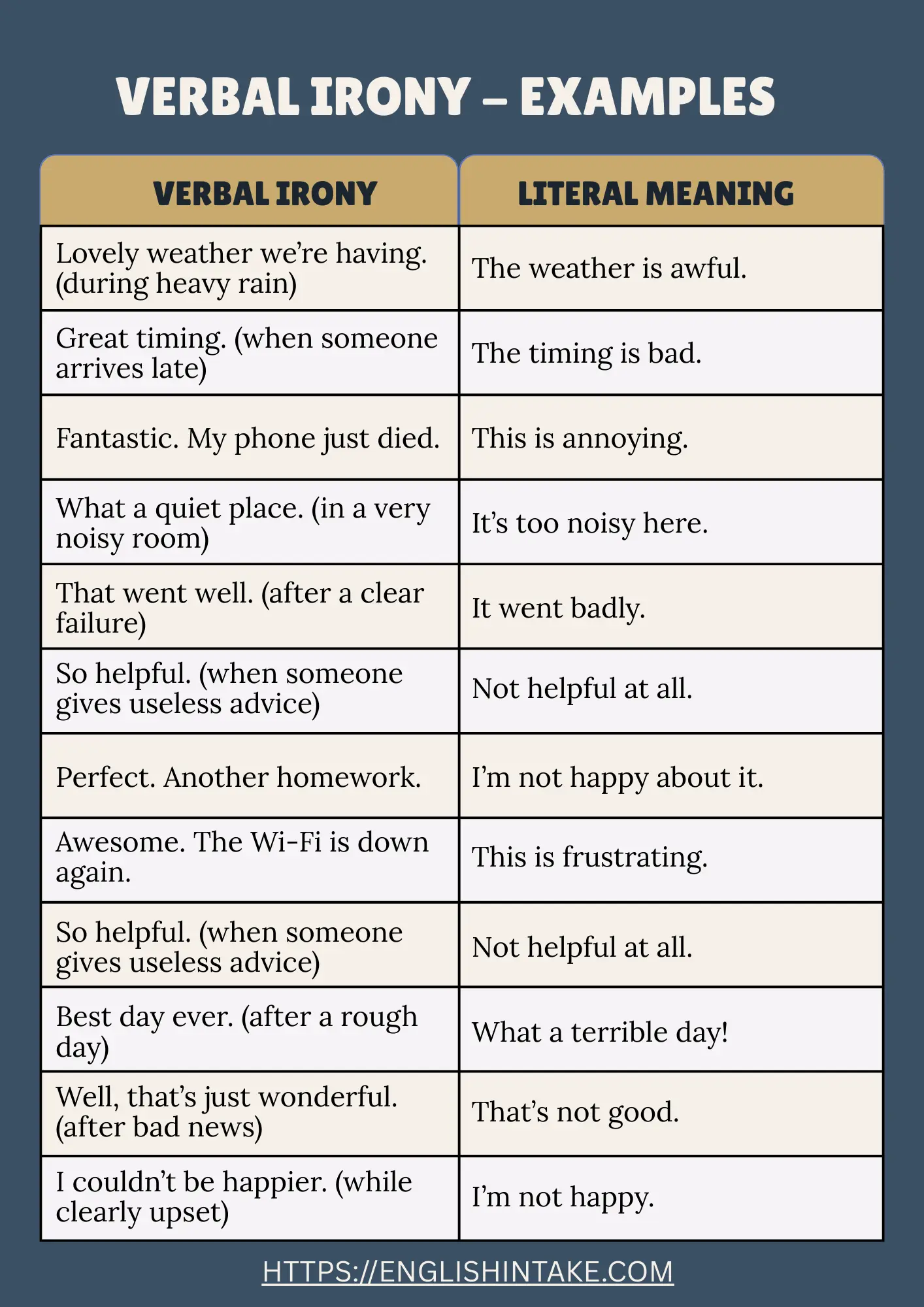
Weather complaints: "What a beautiful day!" (said during a terrible storm)
Failed plans: "Well, that went well." (said after something goes horribly wrong)
Being late: "Oh, take your time; it's not like we have anywhere to be." (said when someone is making you late)
Difficult tasks: "This will be a piece of cake." (said before tackling something extremely challenging)
Expressing frustration: "Just what I needed today." (you can say it when something unwanted happens)
Responding to obvious statements: "No, really? I had no idea." (said when someone tells you something you already know)
8. Examples of verbal irony in literature
Writers have used verbal irony for centuries to develop characters, create humour, and make social commentary. Here are some famous examples.
8.1 Julius Caesar by William Shakespeare
In Mark Antony's famous funeral speech, he repeatedly calls Brutus "an honourable man." The audience knows that Antony believes the opposite; he is subtly turning the crowd against Brutus by using verbal irony. Each repetition of "honourable" drips with sarcasm, even though the words themselves sound like praise.
8.2 Pride and Prejudice by Jane Austen
Mr Bennet is a master of verbal irony. When his wife complains about her nerves, he replies, "I have a high respect for your nerves. They are my old friends. I have heard you mention them with consideration these last twenty years at least." His words sound sympathetic, but they are actually gently mocking his wife's constant complaints.
8.3 A modest proposal by Jonathan Swift
Swift's entire essay is built on verbal irony. He proposes solving poverty in Ireland by selling poor children as food for wealthy families. The suggestion is so outrageous that readers understand Swift does not mean it literally. Instead, he is criticising the callous attitudes of those who ignored the suffering of the poor.
8.4 The cask of Amontillado by Edgar Allan Poe
In this short story, Montresor appears to show concern for Fortunato's health whilst leading him deeper into the catacombs to murder him. His expressions of care ("Your health is precious") are chillingly ironic because the reader knows his true, murderous intentions.
9. Film and television
The Devil Wears Prada: Miranda Priestly says, "By all means, move at a glacial pace. You know how that thrills me." Her words suggest patience, but her tone makes clear she is frustrated by her assistant's slowness.
Monsters, Inc.: The character Roz says to Mike, "I'm sure you filed your paperwork correctly. For once." The addition of "for once" reveals that she means the exact opposite of what her opening words suggest.
Beauty and the Beast: Belle tells Gaston, "I just don't deserve you." The audience understands that Belle actually thinks she is far better than the arrogant Gaston; her apparent humility is verbal irony.
10. Useful tips
Using verbal irony yourself can feel risky, especially in a second language. Here are some guidelines to help you use it effectively.
Know your audience: Verbal irony works best when your listener is likely to catch on. Close friends and people who share your cultural background will usually understand your ironic intent. Strangers or colleagues might take your words literally.
Use tone carefully: Your voice is crucial in signalling irony. A slight change in pitch, a pause, or a drawn-out word can tell your listener that you do not mean your words literally. Without these cues, your irony might fall flat.
Start simple: Begin with common ironic phrases that native speakers use frequently, such as "Just my luck," "Oh, great," or "Well, that's just perfect." These are low-risk ways to practise.
Be careful in writing: Irony is harder to convey in text because the reader cannot hear your tone. If you must be ironic in writing, you might need to add context clues or, in casual settings, use an emoji or exclamation mark to signal your intent.
English learners sometimes struggle with verbal irony. Here are some pitfalls to watch out for.
Confusing irony with coincidence: If you and your friend turn up to a party wearing the same outfit, that is a coincidence, not irony. Irony requires a contrast between expectation and reality, often with an element of meaning or significance.
Using irony when sincerity is needed: In serious or emotional situations, irony can come across as dismissive or insensitive. If a friend shares bad news, responding with verbal irony (even if meant kindly) might hurt them.
Overdoing it: Using irony too often can make you seem insincere or difficult to trust. Balance is key; save your ironic comments for moments when they will land well.
Forgetting cultural differences: Irony varies across cultures. What is considered witty in Britain might be seen as rude elsewhere. Pay attention to how irony is used in the specific English-speaking community you are engaging with.