
For beginners, family members vocabulary is among the first topics you learn in classes. In this lesson, I will teach you how relatives are named in English. After reading this lesson, you will know how to talk about your parents, your brothers and sisters, and other members of your relatives.
What you will learn
1. Immediate family members (nuclear family)
Your immediate family is also called your nuclear family. These are the people who are closest to you. They usually live with you in the same house.
fatherYour male parent.
My father works in a hospital.
motherYour female parent.
my mother makes delicious food.
brotherA male child of the same parents as you.
I have one older brother.
sisterA female child of the same parents as you.
My sister is three years younger than me.
sonA male child.
I have two sons.
daughterA female child.
My sister has two daughters.
The word sibling means a brother or sister. If someone asks you Do you have any siblings?, they want to know if you have any brothers or sisters.
A married man.
Her husband is a teacher.
wifeA married woman.
His wife is a doctor.
The word spouse means your husband or wife. This word can be used for both men and women. The word parents means your mother and father together.
2. Extended family
Your extended family includes all the relatives beyond your immediate family. These are people like your grandparents, aunts, uncles, and cousins. They may or may not live with you.
Grandparents and grandchildren
Your parents have parents too. These are your grandparents. And when you have children, they will be your grandparents' grandchildren. If you do not understand what I mean, look at the table below.
| Family members | Meaning | Example sentences |
|---|---|---|
| grandfather | The father of your mother or father | My grandfather is 80 years old. |
| grandmother | The mother of your mother or father | My grandmother makes great cookies. |
| grandparents | Your grandfather and grandmother together | I visit my grandparents every summer. |
| grandson | The son of your child (male grandchild) | Their grandson just started school. |
| granddaughter | The daughter of your child (female grandchild) | Her granddaughter is learning to read. |
| grandchildren | All the children of your children | They have five grandchildren. |
Your grandparents also have parents. These are your great-grandparents. A great-grandfather is the father of your grandparent. A great-grandmother is the mother of your grandparent.
Aunts, Uncles, and cousinsYour parents have brothers and sisters too. These relatives are your aunts and uncles.
uncleThe brother of your mother or father. Also, the husband of your aunt.
My uncle lives in London.
auntThe sister of your mother or father. Also, the wife of your uncle.
My aunt always brings me gifts.
cousinThe child of your aunt or uncle. You share grandparents with your cousins.
I have many cousins.
nephewThe son of your brother or sister.
My nephew is learning to walk.
nieceThe daughter of your brother or sister.
My niece loves to dance.
The word cousin is the same for both males and females. You can say my male cousin or my female cousin if you need to be specific.
3. In-Laws (relatives by marriage)
When you get married, your spouse's family becomes your family too. These relatives are called in-laws. The term in-law means you are related through marriage, not by blood.
| Word | Meaning | Example |
|---|---|---|
| father-in-law | The father of your husband or wife | My father-in-law is very kind. |
| mother-in-law | The mother of your husband or wife | My mother-in-law cooks well. |
| brother-in-law | The brother of your spouse, or your sibling's husband | My brother-in-law is a pilot. |
| sister-in-law | The sister of your spouse, or your sibling's wife | My sister-in-law is coming to visit. |
| son-in-law | The husband of your daughter | Their son-in-law works in finance. |
| daughter-in-law | The wife of your son | Our daughter-in-law is a lawyer. |
When you talk about more than one in-law, add -s to the first word. For example: brothers-in-law (not brother-in-laws), sisters-in-law, mothers-in-law.
When you want to talk about all of your spouse's family together, you can say my in-laws. For example: I am having dinner with my in-laws tonight.
4. Blended family (stepfamily)
A blended family is also called a stepfamily. This type of family is created when parents remarry. The new family may include children from previous marriages.
step-relativesThe word step- means you are related because your parent married someone new. These are not your blood relatives.
stepfatherYour mother's new husband. He is not your biological father.
My stepfather taught me to drive.
stepmotherYour father's new wife. She is not your biological mother.
My stepmother is very caring.
stepbrotherThe son of your stepmother or stepfather. You do not share any parents.
My stepbrother and I play games together.
stepsisterThe daughter of your stepmother or stepfather. You do not share any parents.
My stepsister lives in another city.
stepsonYour spouse's son from a previous marriage. Not your biological son.
Her stepson is in high school.
stepdaughterYour spouse's daughter from a previous marriage. Not your biological daughter.
His stepdaughter loves reading.
half-siblingsA half-sibling shares ONE parent with you. This is different from a step-sibling who shares NO parents with you.
half-brotherA brother who has the same mother OR the same father as you, but not both.
My half-brother has a different dad.
half-sisterA sister who has the same mother OR the same father as you, but not both.
My half-sister visits us every weekend.
- Stepbrother/stepsister: You share NO biological parents. Your parent married their parent.
- Half-brother/half-sister: You share ONE biological parent. You are related by blood.
5. Informal names
In everyday conversations, most of the time we use informal or casual names for family members. These names are more friendly and personal. Here are the most common ones.
| Formal word | Informal names | Notes |
|---|---|---|
| father | dad, daddy, papa, pa, pop | Dad is the most common form |
| mother | mom (US), mum (UK), mommy, mummy, mama, ma | Mom is American, Mum is British |
| grandfather | grandpa, granddad, gramps, papa, pop | Grandpa is most common |
| grandmother | grandma, granny, gran, nana, nanny | Grandma is most common |
| brother | bro | Very casual, used by young people |
| sister | sis | Very casual, used by young people |
| aunt | auntie, aunty | Common in british English |
Many families have special or unique names for grandparents. Some children call their grandparents by names from other languages, like Oma and Opa (German), Nonna and Nonno (Italian), or Abuela and Abuelo (Spanish).
6. Tree diagram
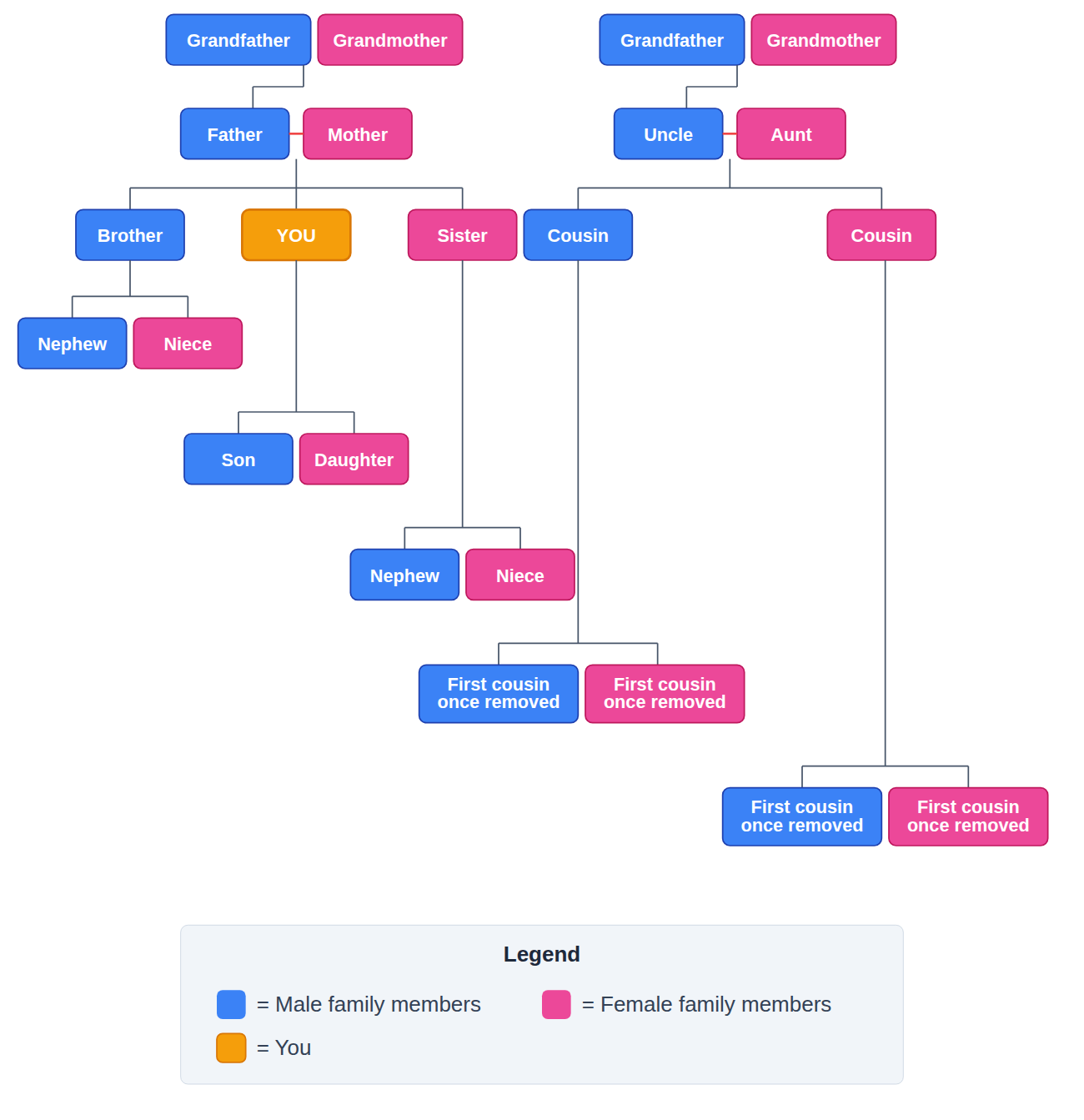
A family tree is a diagram that shows how family members are connected. Looking at a family tree can help you understand family relationships better. Here is a simple family tree to help you learn.
Simple family tree
7. Other common terms
Here are some more family words that are useful to know.
relativesAll the people in your family. Another word for family members.
I have many relatives in my country.
ancestorsPeople in your family who lived long ago, before your grandparents.
My ancestors came from Europe.
descendantsPeople who are born from you, like your children, grandchildren, and beyond.
His descendants still live in this town.
generationAll the people in a family who are about the same age. Your parents are one generation, you are another.
Three generations live in this house.
twinsTwo children born at the same time to the same mother.
My cousins are twins.
only childA person who has no brothers or sisters.
I am an only child.
adopted childA child who is legally taken into a family and raised as their own.
They have one adopted child.
foster childA child who is cared for by a family that is not their biological family, usually temporarily.
They are caring for two foster children.
Marital status
These words describe if someone is married or not.
- Single: not married
- Married: having a husband or wife
- Engaged: planning to get married (a fiancé is a man who is engaged, a fiancée is a woman who is engaged)
- Divorced: was married but the marriage has legally ended
- Widowed: uour spouse has died (a widow is a woman, a widower is a man)
- Ex-husband/Ex-wife: a former spouse after divorce
8. Vocabulary exercise
Try to answer the following questions to practice what you have learned.
1. Your mother's sister is your .
2. Your father's father is your .
3. Your sister's son is your .
4. Your wife's mother is your .
5. Your mother's new husband (not your biological father) is your .
6. Your aunt's daughter is your .
7. A brother who shares only one parent with you is your .
8. Your brother and sister together are your .
9. Larning tips
You can follow the following tips to memorise the names of family members in English.
- Draw your own family tree and label each person in English.
- Practice talking about your family with a friend or language partner.
- Look at photos of your family and say each person's relationship to you in English.
- Write sentences about your family members to practice the vocabulary.
I hope this guide has helped you learn all the family vocabulary you need. Try using these words in your conversation.
10. Frequently Asked Questions (FAQs)
What is the difference between immediate family and extended family?
Your immediate family includes your parents, siblings, spouse, and children. These are your closest relatives. Your extended family includes all other relatives like grandparents, aunts, uncles, and cousins.
What is a first cousin once removed?
A first cousin once removed is the child of your first cousin, OR your parent's first cousin. The word removed means there is a generation difference between you.
What is the word sibling used for?
The word sibling means a brother or sister. It is a general word that includes both. This word is more common in writing and formal situations than in everyday speech.
How do I form the plural of in-laws?
Add -s to the first word, not the last. For example: brothers-in-law, mothers-in-law, sons-in-law.