
1. Why spelling matters
English spelling can be tricky, even for native speakers. The language has borrowed words from Latin, French, Greek, German, and dozens of other languages over centuries. This causes spelling rules that do not follow any logical patterns.
Understanding commonly misspelled words in English is essential for anyone who wants to improve their writing skills, whether for academic work, professional correspondence, or everyday communication.
Spelling errors can undermine your credibility. A CV with misspelled words may cost you a job interview. An email riddled with mistakes might make colleagues question your attention to detail. Academic essays with spelling errors can result in lost marks. While spell checkers catch many mistakes, they cannot identify every error, particularly when you have typed a real word that is simply the wrong one for the context.
In this comprehensive guide, I have compiled 200+ commonly misspelled words in English. I explain why people often write them incorrectly. I also provides memorisation tricks to help you remember their correct spellings.
2. Why are some words so difficult to spell?
Before learning specific words, let's try to understand why certain English words cause so much trouble. Research from Oxford University Press and other linguistic institutions has identified several factors that contribute to spelling difficulties.
2.1 Mispronunciation and phonetic confusion
One of the most common causes of misspelling is mispronunciation. When we do not clearly articulate all the sounds in a word, we may struggle to spell it correctly. For example, many people pronounce "definitely" as "definately" and consequently misspell it. Similarly, "separate" is often mispronounced with an "e" sound in the middle rather than an "a", leading to the common error "seperate".
The word "February" loses its first "r" in casual speech for many speakers, which explains why "Febuary" appears so frequently. "Library" becomes "libary" when the middle syllable is swallowed. Being aware of the correct pronunciation can significantly improve your spelling of these troublesome words.
2.2 Double letter dilemmas
Double letters present a particular challenge because English has no consistent rules about when to double consonants. Words like "accommodate" (two c's and two m's), "occurrence" (two c's and two r's), and "embarrass" (two r's and two s's) are commonly misspelled. Sometimes writers know a double letter exists somewhere in the word but place it incorrectly, writing "accomodate" or "occurence".
2.3 Silent letters
English has a lot of silent letters that serve no phonetic purpose but must be included in the correct spelling. The "b" in "doubt" and "subtle", the "k" in "knife" and "knight", the "w" in "wrong" and "wreath", and the "p" in "psychology" and "pneumonia" all catch writers off guard. These silent letters often reflect the word's etymology but provide no audible clue to their presence.
2.4 Foreign origins
Many challenging English words retain spellings from their languages of origin. French loanwords like "bureau", "liaison", "entrepreneur", and "hors d'oeuvres" keep their Continental spelling patterns. Greek-derived words such as "rhythm", "psychology", and "diarrhoea" follow different conventions. Latin contributions like "millennium" and "consensus" have their own patterns. Without knowledge of these source languages, the spellings can seem arbitrary.
2.5 Homophones and near-homophones
Words that sound identical or nearly identical but have different spellings and meanings cause a lot of confusion for many people. "Their", "there", and "they're" are perhaps the most notorious examples, but English has hundreds of such word pairs and triplets. Spell checkers cannot catch these errors because each spelling represents a valid English word.
3. Comprehensive list of commonly misspelled words in English
Find below an extensive list of commonly misspelled words in English, organised alphabetically. In each entry, I highlight the correct spelling (indicated by the green checkmarks), typical misspellings (indicated by the red crosses), and a brief tip to help you remember the correct form.
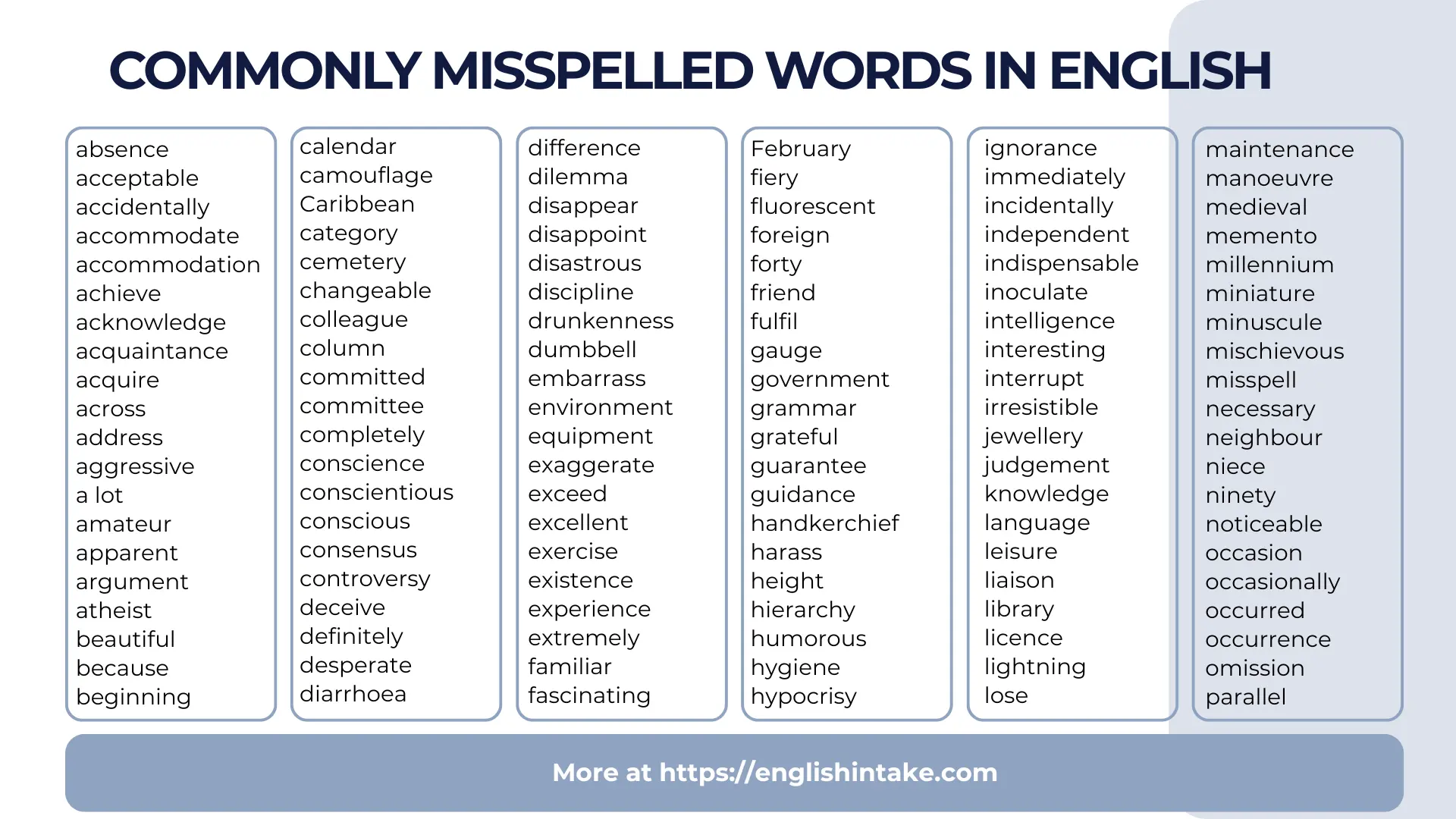
Glossary of frequently misspelled words with correct spellings and memory tips
✗ absense, abcense
Think: absent has an "e", absence has an "e" too
✓ acceptable✗ acceptible
Accept + able = acceptable
✓ accidentally✗ accidentaly, accidently
Accidental + ly (keep both l's)
✓ accommodate✗ accomodate, acommodate
This word accommodates two c's and two m's
✓ achieve✗ acheive
"I before e" applies here: ach-i-eve
✓ acknowledge✗ acknowlege, aknowledge
Ack + knowledge (know + ledge)
✓ acquaintance✗ acquaintence, aquaintance
Acquaint + ance (not -ence)
✓ acquire✗ aquire, adquire
AC + quire (like choir)
✓ across✗ accross
One c is enough to cross
✓ address✗ adress
Add + dress = address
✓ aggressive✗ agressive
Two g's make it more aggressive
✓ a lot✗ alot
Always two words; "alot" is not a word
✓ amateur✗ amatuer, amature
A mate who is new: a-mate-ur
✓ apparent✗ apparant, aparent
Two p's, then -arent (like parent)
✓ argument✗ arguement
Argue loses its "e" when forming argument
✓ atheist✗ athiest
The "e" comes before the "i"
✗ beatiful, beautyful
Big Elephants Are Ugly: b-e-a-u-tiful
✓ because✗ becuase, becasue
Big Elephants Can Always Understand Small Elephants
✓ beginning✗ begining
Begin + n + ing (double the n)
✓ believe✗ beleive
Never believe a lie: beLIEve
✓ bizarre✗ bizzare, bizare
One z, two r's: bi-z-arre
✓ boundary✗ boundry
Bound + ary (keep the a)
✓ broccoli✗ brocolli, brocoli
Two c's, one l
✓ bureaucracy✗ beaurocracy, burocracy
Bureau + cracy
✓ business✗ buisness
Bus-i-ness (a busy bus)
✗ calender
Ends in -ar, not -er
✓ camouflage✗ camoflage, camoflague
Camo-u-flage (don't forget the "u")
✓ Caribbean✗ Carribean, Caribean
One r, two b's
✓ category✗ catagory
Cat-e-gory (not cat-a-gory)
✓ cemetery✗ cemetary, cematery
Three e's, no a's: "Eek!" in the cemetery
✓ changeable✗ changable
Keep the "e" to keep the soft "g" sound
✓ colleague✗ collegue, collaegue
Coll-ea-gue (like league)
✓ column✗ colum, coloumn
Silent "n" at the end
✓ committed✗ commited, comitted
Commit + ted (double the t)
✓ committee✗ commitee, comittee
Double m, double t, double e
✓ completely✗ completly
Complete + ly
✓ conscience✗ concience, consience
Con + science
✓ conscientious✗ consciencious
Conscience becomes conscientious (t not c)
✓ conscious✗ concious, consious
Con-sci-ous (science in the middle)
✓ consensus✗ concensus
Con + sensus (not census)
✓ controversy✗ contraversy
Contro + versy (not contra)
✗ decieve
"I before e except after c": dec-ei-ve
✓ definitely✗ definately, definatly, defiantly
There's a finite in definitely
✓ desperate✗ desparate
Des-per-ate (think "despair" without the i)
✓ diarrhoea✗ diarhea, diarrhea
Dash In A Real Rush, Hurry Or Else Accident (British spelling)
✓ difference✗ diffrence
Differ + ence
✓ dilemma✗ dilema, dilemna
Emma faces a dilemma (double m, no n)
✓ disappear✗ dissapear, disapear
Dis + appear (one s, two p's)
✓ disappoint✗ dissapoint, disapoint
Dis + appoint (one s, two p's)
✓ disastrous✗ disasterous
Disaster drops the "e" to become disastrous
✓ discipline✗ disipline, discpline
Disc + i + pline
✓ drunkenness✗ drunkeness
Drunken + ness (double n)
✓ dumbbell✗ dumbell, dumbel
Dumb + bell (two separate words)
✗ embarass, embarras
Two r's, two s's: I go Really Red and Start Sweating
✓ environment✗ enviroment
Environ + ment (keep the n)
✓ equipment✗ equiptment
Equip + ment (no t before ment)
✓ exaggerate✗ exagerate
Two g's exaggerate the word
✓ exceed✗ excede
Ex + ceed (double e)
✓ excellent✗ excelent, excellant
Excel + lent (double l)
✓ exercise✗ excercise, exersize
Ex-er-cise (not exc-er)
✓ existence✗ existance
Exist + ence (not -ance)
✓ experience✗ experiance
Ends in -ience (not -iance)
✓ extremely✗ extremly
Extreme + ly
✗ familar, familliar
Your family is familiar (one l)
✓ fascinating✗ facinating
Fasc-in-ating (keep the sc)
✓ February✗ Febuary
Feb-ru-ary (don't skip the first r)
✓ fiery✗ firey
Fire drops "e" but adds "y": fier-y
✓ fluorescent✗ flourescent, florescent
Flu-or-escent
✓ foreign✗ foriegn
Exception to "i before e": for-eig-n
✓ forty✗ fourty
Four becomes forty (drops the "u")
✓ friend✗ freind
I'll be your friEND to the END
✓ fulfil✗ fullfil, fulfill
One l in the middle, one at the end (British)
✗ guage
G-A-U-ge (a before u)
✓ government✗ goverment, governmant
Govern + ment (keep the n)
✓ grammar✗ grammer
Ends in -ar not -er
✓ grateful✗ greatful, gratefull
Grate + ful (not great)
✓ guarantee✗ garantee, garentee
Guard with a guarantee (gua-)
✓ guidance✗ guidence
Guide + ance
✗ hankerchief
Hand + kerchief
✓ harass✗ harrass
One r, two s's (it's truly harassing)
✓ height✗ heighth, heigth
No "th" at the end (unlike width)
✓ hierarchy✗ heirarchy, hierachy
Hier-arch-y
✓ humorous✗ humerous
Humour + ous (not humerus, the bone)
✓ hygiene✗ hygene, hygine, hygeine
Hy-gi-ene
✓ hypocrisy✗ hypocracy
Ends in -isy not -acy
✗ ignorence
Ignor + ance (not -ence)
✓ immediately✗ imediately, immediatly
Immediate + ly
✓ incidentally✗ incidently
Incidental + ly
✓ independent✗ independant
Ends in -ent not -ant
✓ indispensable✗ indispensible
Ends in -able not -ible
✓ inoculate✗ innoculate
One n, one c
✓ intelligence✗ inteligence, intelligance
Intelli-gence
✓ interesting✗ intresting
Inter-est-ing (don't skip the second e)
✓ interrupt✗ interupt
Inter + rupt (double r)
✓ irresistible✗ irresistable
Ends in -ible not -able
✗ jewelery, jewlery
Jewel + lery (British spelling)
✓ judgement✗ judgment
Keep the "e" in British English
✗ knowlege, knoledge
Know + ledge
✗ langauge, langage
Lang-u-age (don't forget the u)
✓ leisure✗ liesure
Exception to "i before e": lei-sure
✓ liaison✗ liason, liaision
Li-ai-son (two i's)
✓ library✗ libary, liberry
Lib-rar-y (two r's)
✓ licence✗ license (as noun)
In British English: noun = licence, verb = license
✓ lightning✗ lightening
No "e" (lightening means making lighter)
✓ lose✗ loose
Lose has one "o" (loose is the opposite of tight)
✗ maintainance, maintnance
Main + ten + ance
✓ manoeuvre✗ manoeuver, maneuver
British spelling keeps -oe-
✓ medieval✗ medeval, medevil
Medi-ev-al
✓ memento✗ momento
Mem-ento (think "memory")
✓ millennium✗ millenium, milenium
Mill + enn + ium (double l, double n)
✓ miniature✗ miniture
Mini + ature (keep the a)
✓ minuscule✗ miniscule
Related to "minus", not "mini"
✓ mischievous✗ mischievious, mischevous
Mis-chie-vous (no i after the v)
✓ misspell✗ mispell, misspel
Mis + spell (double s)
✗ neccessary, necessery
One c, two s's: one Collar, two Sleeves
✓ neighbour✗ nieghbor, nieghbour
Exception to "i before e": neigh-bour
✓ niece✗ neice
"I before e" applies: n-ie-ce
✓ ninety✗ ninty
Nine + ty (keep the e)
✓ noticeable✗ noticable
Keep the "e" for the soft "c" sound
✗ occassion, ocasion
Two c's, one s
✓ occasionally✗ occasionaly, occassionally
Occasional + ly
✓ occurred✗ occured, ocurred
Double c, double r
✓ occurrence✗ occurence, occurrance
Two c's, two r's, ends in -ence
✓ omission✗ ommision, omision
One m, two s's
✗ paralell, parrallel
Para-ll-el (the l's are parallel)
✓ parliament✗ parliment
Par-lia-ment (I am in parliament)
✓ particularly✗ particuly, particulary
Particular + ly
✓ pastime✗ passtime, pasttime
Pass + time, but only one s and one t
✓ peculiar✗ pecuilar
Pec-u-liar
✓ perceive✗ percieve
"I before e except after c": perc-ei-ve
✓ perseverance✗ perseverence
Per-sever-ance (ends in -ance)
✓ personnel✗ personell, personel
Person + nel (double n)
✓ pharaoh✗ pharoah, pharoh
Phar-a-oh
✓ piece✗ peice
"I before e": p-ie-ce (a piece of pie)
✓ plagiarise✗ plagerize, plagiarize
Plagi-arise (British spelling uses -ise)
✓ possession✗ posession, possesion
Two s's in the middle, two s's at the end
✓ potatoes✗ potatos
Add "es" for the plural
✓ precede✗ preceed
Pre-cede (not -ceed)
✓ prejudice✗ predjudice
Pre-judice
✓ presence✗ presance
Present becomes presence (-ence)
✓ principal✗ principle (when meaning person/main)
The principal is your pal (person/main)
✓ principle✗ principal (when meaning rule)
A principle is a rule
✓ privilege✗ priviledge, privelege
Privi-lege (no d)
✓ profession✗ proffession
One f, two s's
✓ professor✗ proffessor, professer
One f, two s's, ends in -or
✓ pronunciation✗ pronounciation
Pro-nun-ci-ation (no "o" after the n)
✓ publicly✗ publically
Public + ly (exception to -ically rule)
✗ questionaire, questionnair
Question + naire (double n)
✓ queue✗ que, cue
Q + ueue (four silent letters)
✗ realy
Real + ly (double l)
✓ receipt✗ reciept
"I before e except after c": rec-ei-pt
✓ receive✗ recieve
"I before e except after c": rec-ei-ve
✓ recommend✗ recomend, reccommend
One c, two m's
✓ referred✗ refered
Refer + red (double the r)
✓ reference✗ referance, refrence
Refer + ence
✓ relevant✗ relevent, revelant
Relev-ant (ends in -ant)
✓ religious✗ religous
Relig-i-ous (keep the i)
✓ repetition✗ repitition
Repeat becomes repetition
✓ restaurant✗ restarant, restraunt
Rest-au-rant
✓ rhyme✗ rime, ryhme
Rh-y-me
✓ rhythm✗ rythm, rythem, rythym
Rhythm Has Your Two Hips Moving
✓ ridiculous✗ rediculous
Ri-dic-ulous (starts with ri-)
✗ shedule, scedule
Sch-edule
✓ secretary✗ secratary, secretery
Secret + ary
✓ seize✗ sieze
Exception to "i before e": s-ei-ze
✓ sensible✗ sensable
Ends in -ible not -able
✓ separate✗ seperate
There's "a rat" in separate
✓ sergeant✗ sargent, sergent
Ser-ge-ant
✓ siege✗ seige
"I before e": s-ie-ge
✓ similar✗ similer, similiar
Ends in -ar not -er
✓ sincerely✗ sincerly
Sincere + ly
✓ skilful✗ skillful, skilfull
Skill drops an l in British English
✓ speech✗ speach
Sp-ee-ch (double e)
✓ strength✗ strenth
Streng-th (don't forget the g)
✓ subpoena✗ subpena
Sub-poe-na (silent "b" + "oe")
✓ succeed✗ succede, suceed
Two c's, two e's
✓ successful✗ succesful, successfull
Success + ful (one l)
✓ supersede✗ supercede
Super-sede (only -sede word in English)
✓ surprise✗ suprise, surprize
Sur-prise (two r's)
✗ temperture, temprature
Temper-a-ture (keep the a)
✓ thorough✗ thorogh, thoro
Thor-ough (like "through" ending)
✓ threshold✗ threshhold
Thresh + old (one h in the middle)
✓ tomorrow✗ tommorow, tommorrow
One m, two r's
✓ tongue✗ tounge, tung
Ton-gue
✓ truly✗ truely
True drops the "e" before -ly
✓ twelfth✗ twelth, twelvth
Twelf-th (f before th)
✓ tyranny✗ tyrany
Double n: tyr-ann-y
✗ underate
Under + rate (double r)
✓ until✗ untill
One l at the end
✓ unusual✗ unusuall
Un + usual
✗ vaccuum, vaccum, vacume
One c, two u's
✓ vegetable✗ vegatable, vegetible
Vege-table
✓ vehicle✗ vehical
Veh-i-cle (ends in -icle)
✓ vicious✗ visious
Vic-ious (vice + ious)
✗ Wendsday, Wensday
Wed-nes-day (WED-NES-DAY)
✓ weird✗ wierd
Exception to "i before e": w-ei-rd
✓ whether✗ wether
Wh-ether (a wether is a castrated ram)
✓ wilful✗ willful, wilfull
Will + ful (British: one l in each part)
✓ withhold✗ withold
With + hold (double h)
✓ writing✗ writting, writeing
Write drops "e", doesn't double "t"
4. Homophones: words that sound alike but differ in spelling
Among the most troublesome commonly misspelled words in English are homophones: words that sound identical but have different spellings and meanings. Spell checkers cannot catch these errors because each spelling is a valid English word. Learning to distinguish between them requires understanding their meanings.
| Word | Meaning | Example |
|---|---|---|
| their | Possessive pronoun (belonging to them) | Their house is beautiful. |
| there | Adverb indicating place | The book is over there. |
| they're | Contraction of "they are" | They're coming to dinner. |
| your | Possessive pronoun (belonging to you) | Is this your coat? |
| you're | Contraction of "you are" | You're welcome to join us. |
| its | Possessive pronoun (belonging to it) | The cat licked its paw. |
| it's | Contraction of "it is" or "it has" | It's raining outside. |
| affect | Verb meaning to influence | The weather will affect our plans. |
| effect | Noun meaning result | The effect was immediate. |
| accept | Verb meaning to receive | Please accept my apology. |
| except | Preposition meaning excluding | Everyone came except John. |
| advice | Noun meaning recommendation | She gave me good advice. |
| advise | Verb meaning to recommend | I advise you to study harder. |
| compliment | Noun/verb: praise or expression of admiration | She paid him a lovely compliment. |
| complement | Noun/verb: something that completes | The wine complements the meal perfectly. |
| stationary | Adjective meaning not moving | The car remained stationary. |
| stationery | Noun meaning writing materials | I need to buy some stationery. |
| practice | Noun (British English) | Practice makes perfect. |
| practise | Verb (British English) | You must practise every day. |
| licence | Noun (British English) | Do you have a driving licence? |
| license | Verb (British English) | The council will license the premises. |
| to | Preposition indicating direction | We went to the shop. |
| too | Adverb meaning also or excessively | It's too hot today. |
| two | The number 2 | I have two brothers. |
| lose | Verb meaning to misplace or fail to win | Don't lose your keys. |
| loose | Adjective meaning not tight | These trousers are too loose. |
| than | Conjunction used in comparisons | She is taller than me. |
| then | Adverb indicating time | We had dinner, then watched a film. |
5. British vs American spelling differences
Some words that appear on lists of commonly misspelled words in English are not actually errors but rather reflect differences between British and American spelling conventions. If you are writing for a British audience, use British spellings consistently; if writing for an American audience, use American spellings. The key is consistency throughout your document.
| British spelling | American spelling | Pattern |
|---|---|---|
| colour, favour, honour | color, favor, honor | -our vs -or |
| realise, organise, recognise | realize, organize, recognize | -ise vs -ize |
| centre, theatre, metre | center, theater, meter | -re vs -er |
| defence, licence, offence | defense, license, offense | -ce vs -se |
| travelled, labelled, cancelled | traveled, labeled, canceled | Double vs single consonant |
| judgement, acknowledgement | judgment, acknowledgment | Keeping vs dropping "e" |
| catalogue, dialogue, analogue | catalog, dialog, analog | -ogue vs -og |
| grey, plough | gray, plow | Miscellaneous differences |
| skilful, wilful, fulfil | skillful, willful, fulfill | Single vs double l |
| programme (but: computer program) | program | -mme vs -m |
| aeroplane, aluminium | airplane, aluminum | Word formation differences |
| doughnut, draught | donut, draft | Simplified American spellings |
6. Memory tricks and mnemonics
One of the most effective ways to master commonly misspelled words in English is to create memorable associations. Here are some tried-and-tested mnemonics that can help:
- Necessary: One Collar and two Sleeves (one c, two s's)
- Rhythm: Rhythm Has Your Two Hips Moving
- Because: Big Elephants Can Always Understand Small Elephants
- Separate: There's "a rat" in separate
- Definitely: There's a "finite" in definitely
- Believe: Never believe a lie
- Friend: I'll be your friEND to the END
- Piece: Have a piece of pie
- Stationery: StationEry for Envelopes
- Cemetery: Scream "Eee!" three times in a cemetery
- Principal: The principal is your pal
- Island: An island is land surrounded by water
- Diarrhoea: Dash In A Real Rush, Hurry Or Else Accident
- Beautiful: Big Elephants Are Ugly
- Wednesday: We Do Not Eat Soup Day
- Accommodation: It has enough room for two cots (cc) and two mattresses (mm)
7. Common spelling patterns and rules
While English spelling can seem chaotic, certain patterns and rules can help you navigate many of the commonly misspelled words in English.
7.1 The "i before e" rule
The traditional rule states: "i before e, except after c, or when sounded like 'ay' as in neighbour and weigh."
Examples following the rule: believe, achieve, piece, field, relief, niece, receive, ceiling, deceive, perceive, neighbour, weigh, vein, reign
Notable exceptions: weird, seize, either, neither, foreign, leisure, caffeine, protein, species, science, sufficient, conscience
7.2 The -able vs -ible endings
There is no simple rule to distinguish -able from -ible endings, but some patterns can help:
Use -able when:
- The root is a complete word: comfortable, dependable, fashionable
- The root ends in a hard "c" or "g": applicable, navigable
- The root ends in "e" (usually dropped): believable, lovable, usable
Use -ible when:
- The root is not a complete word: audible, credible, feasible, visible
- The root ends in a soft "c" or "g": forcible, legible
- The root ends in -miss or -mit: admissible, permissible
7.3 The -ance vs -ence endings
Similarly, -ance and -ence endings follow loose patterns:
Words ending in -ance/-ant: assistance, attendance, guidance, ignorance, relevance, tolerance, abundant, dominant, elegant, pleasant
Words ending in -ence/-ent: absence, audience, confidence, difference, existence, presence, confident, different, excellent, independent
7.4 Doubling consonants
When adding a suffix beginning with a vowel (-ing, -ed, -er, -est) to a word:
Double the final consonant if:
- The word has one syllable with one vowel followed by one consonant: run → running, stop → stopped
- The word has more than one syllable and the stress falls on the final syllable: begin → beginning, occur → occurred, refer → referred
- In British English, words ending in "l" usually double: travel → travelling, cancel → cancelled
Do not double if:
- The final consonant is preceded by two vowels: need → needing, beat → beating
- The word ends in two consonants: help → helping, start → started
- The stress does not fall on the final syllable: open → opening, benefit → benefited
8. Tips for improving your spelling
Mastering commonly misspelled words in English takes practice, but these strategies can accelerate your progress:
1. Read often: Exposure to correctly spelled words reinforces proper spelling in your memory. Reading books, quality newspapers, and academic texts helps embed correct spellings.
2. Keep a personal spelling list: When you notice words you frequently misspell, write them down with the correct spelling. Review this list regularly.
3. Break words into syllables: Pronouncing each syllable clearly can help you remember which letters to include. Feb-ru-ary, Wed-nes-day, com-fort-able.
4. Learn word roots and origins: Understanding that "psychology" comes from Greek "psyche" (mind) helps explain the silent "p". Etymology can illuminate seemingly illogical spellings.
5. Use mnemonics: Create memorable phrases or associations for words you struggle with. The sillier, the better—they are easier to remember.
6. Write by hand: The physical act of writing engages motor memory, which can help reinforce correct spellings better than typing.
7. Proofread carefully: Always review your writing. Read slowly, or read aloud, to catch errors that your eyes might skip over.
8. Do not rely solely on spell checkers: While helpful, they cannot distinguish between homophones or catch every error. Use them as a tool, not a crutch.
9. Test yourself: Regular practice through spelling tests, dictation, or online quizzes helps identify weak spots and reinforces correct spellings.
10. Learn the rules (and exceptions): While English spelling rules have many exceptions, knowing the basic patterns can help you make educated guesses about unfamiliar words.